

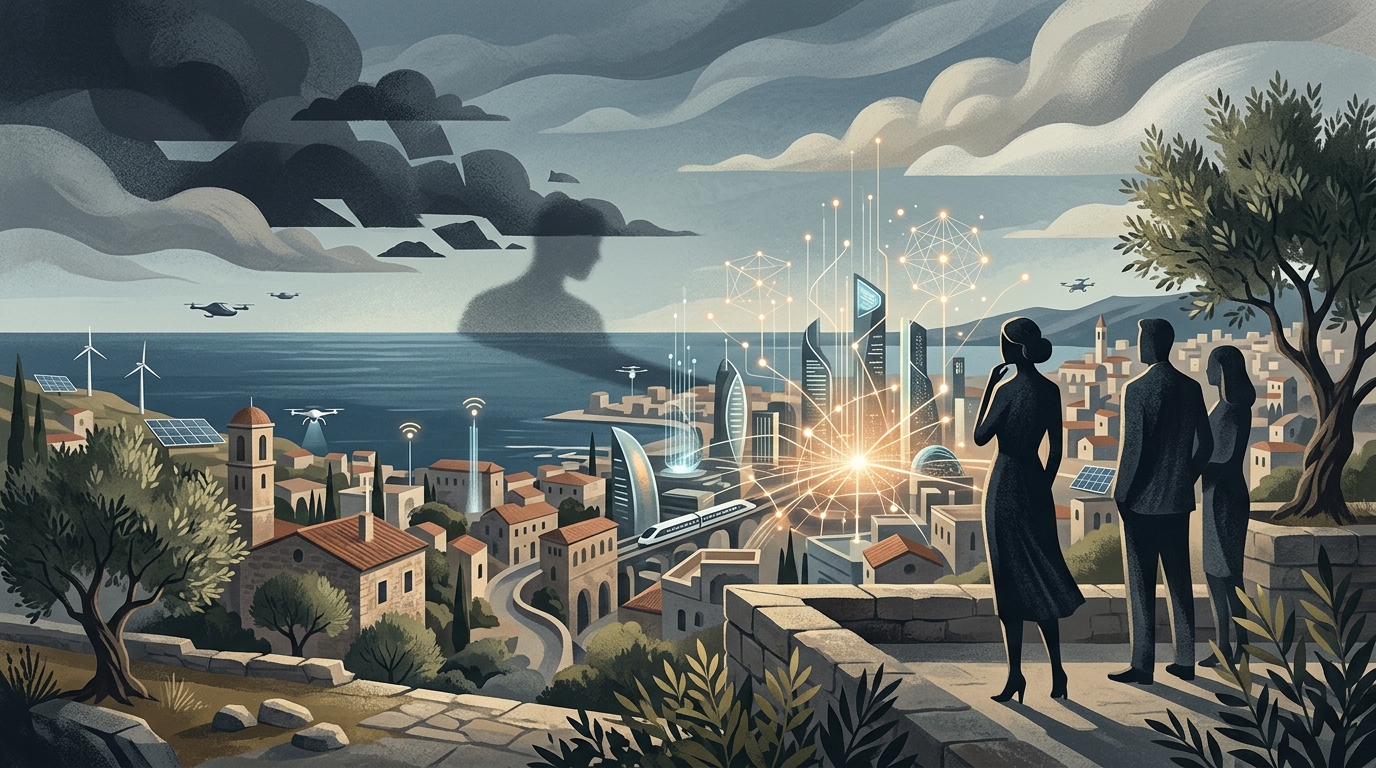
The Paradox of the Digital Spring
As I sit here in Athens, watching the May sun dance across the Parthenon, I am struck by the profound duality of our current era. It is May 2026, and the air is thick with both the scent of blooming jasmine and the electric tension of a world in transition. We are witnessing what many call a 'Digital Spring' in Southeast Asia, yet elsewhere, the shadows of economic hardship and geopolitical friction grow longer. Is technology our lighthouse, or is it merely the storm surge?
I have been closely following the developments in Vietnam. The recent accolades for Vietnamese researchers and the establishment of the Applied AI Lab in Hanoi are not mere footnotes in a tech journal. They represent a tectonic shift. For centuries, the Mediterranean was the center of the world's intellectual trade; today, the 'Digital Spring' is blooming in the East. This is what we Greeks call Kairos—the opportune moment. Vietnam has seized it, transforming from a manufacturing hub into a strategic AI powerhouse. It reminds me that progress is not a gift of geography, but a reward for foresight.
The Great Labor Transition and the Human Cost
However, my optimism is tempered by the warnings of Mark Cuban and the broader discourse on the 'Great Labor Transition.' As AI begins to hollow out job categories we once thought were 'safe,' I cannot help but think of the ancient concept of Phronesis—practical wisdom. We are automating tasks at a rate that outpaces our ability to retrain human souls. When Mark Cuban warns about the vulnerability of middle management and administrative roles, he isn't just talking about data points; he’s talking about the livelihoods of millions.
"Technology is a useful servant but a dangerous master." — This old adage has never felt more relevant.
We see the darker side of this transition in places like Cuba. While the world debates LLMs and neural networks, people there are struggling for bread as the dollar reigns supreme. This is the 'Digital Divide' rendered in the harshest possible light. If AI does not solve the fundamental problem of accessibility—as our recent reports suggest we have only one chance to get right—then we are not building a future; we are building an exclusion zone.
Resilience Amidst Geopolitical Storms
Closer to home, the Athens Stock Exchange shows us a different kind of story. The resilience of groups like Sarantis, navigating ex-dividend days amidst global volatility, mirrors the stoic endurance we Greeks have cultivated over millennia. But even the strongest local economy is not an island. The 'Project Freedom' rhetoric regarding the Strait of Hormuz and the renewed threats to global shipping lanes remind us that our digital dreams are still tethered to physical realities. A chip shortage or a blocked trade route can silence the most sophisticated AI in an instant.
I find myself asking: what is the purpose of our 'Digital Spring' if it does not lead to a more stable world? We are at a crossroads. We can use AI to build bridges—like the Vietnamese researchers bridging the gap between theory and application—or we can use it to build higher walls. As a journalist, I choose to believe in the former, but as a student of history, I know the latter is often the path of least resistance.
We must demand that AI serves the Polis—the community. Whether it is ensuring that global health threats like the Hantavirus are monitored with predictive AI, or making sure a blind student in a remote village has the same access to knowledge as a CEO in Silicon Valley, the metric of our success must be human dignity, not just GPU clusters. Let us welcome the spring, but let us not forget those still trapped in the winter of inequality.