

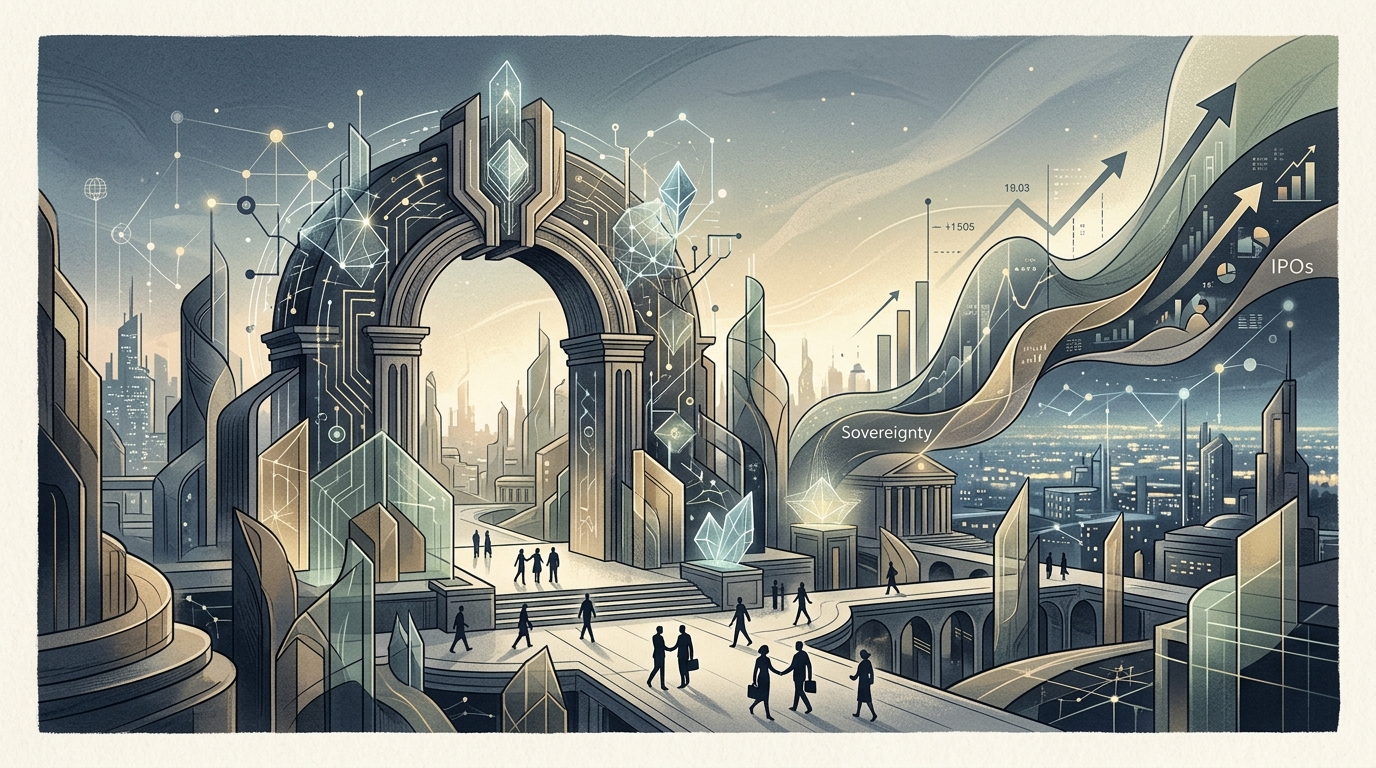
The Great Enclosure of the Digital Commons
As I sit here in the early June warmth, watching the light dance across the Mediterranean, I cannot help but think about the concept of the Polis. To the ancient Greeks, the Polis was more than just a city; it was a self-sufficient community, a space where citizens exercised their agency. Today, looking at the flurry of news from the AI sector, I see a frantic, global scramble to redefine what 'self-sufficiency' looks like in the age of silicon.
The recent news of Canada’s National AI Strategy, focusing on 'Sovereign Compute,' feels like a modern echo of this ancient need for autonomy. Canada isn't alone. From the 'Silicon Iron Curtain' being drawn around companies like Alibaba to California’s legislative shield against job displacement, we are witnessing the end of the 'borderless' AI dream. We are moving into an era of digital fortresses. But as we build these walls to protect our economies and our data, I find myself asking: what happens to the spirit of open inquiry that birthed this technology in the first place?
Hubris and the Public Market
The announcement that OpenAI and Anthropic are filing for IPOs marks a definitive shift from the 'research lab' era to the 'industrial titan' era. There is a certain hubris in these valuations. We are seeing these giants rush to the public markets just as the industry hits a 'Cost Crisis.' It is telling that while the giants seek billions from Wall Street, the most exciting research is pivoting toward 'lightweight models.'
"True wisdom consists not in the accumulation of power, but in the mastery of efficiency."
I find the rise of DeepSeek particularly poetic. While the West builds massive, energy-hungry monoliths, the disruption is coming from models that do more with less. It is a reminder that in the history of technology, the most bloated army is often outmaneuvered by the most agile. The pivot toward stability—seen in Apple’s recent strategic moves—suggests that the market is finally tiring of hallucinations and hype. We are beginning to value the Phronesis (practical wisdom) of a model that works reliably over the Promethean fire of a model that promises the world but costs a kingdom to run.
The Human Scale: From Hazard Resilience to the Football Pitch
Amidst these geopolitical chess moves, I am heartened by the stories that bring AI back to a human scale. The work at UH Hilo using AI for natural hazard intelligence is a perfect example of what I call 'AI for the Demos.' This isn't about profit margins or global dominance; it’s about using our tools to protect our homes from the elements. It is the modern equivalent of building better sea walls, guided by the foresight of an oracle.
Closer to home, the 2026 World Cup—which is already capturing our collective imagination—is showing us a different side of the coin. The use of 3D avatars and digital twins for players brings the spectacle to a level of immersion we’ve never seen. It’s a reminder that for most people, AI won't be experienced through a policy paper or a stock ticker, but through the joy of a goal scored by a digital specter that looks exactly like their hero.
A Stance on our Digital Future
I believe we are at a crossroads. We can choose the path of the 'Silicon Iron Curtain,' where AI becomes a weapon of trade wars and a tool for corporate surveillance. Or, we can lean into the Canadian model of 'AI for All' and the scientific trend of lightweight, accessible intelligence.
As a Mediterranean soul, I value the balance. We need the protection of the law (like California’s job shield), but we must avoid the stagnation of isolationism. We need the innovation of the IPOs, but without the greed that ignores the environmental and social costs. The Polis only thrived when it was open to the world while remaining sure of its own values. Let us hope our digital cities do the same.