

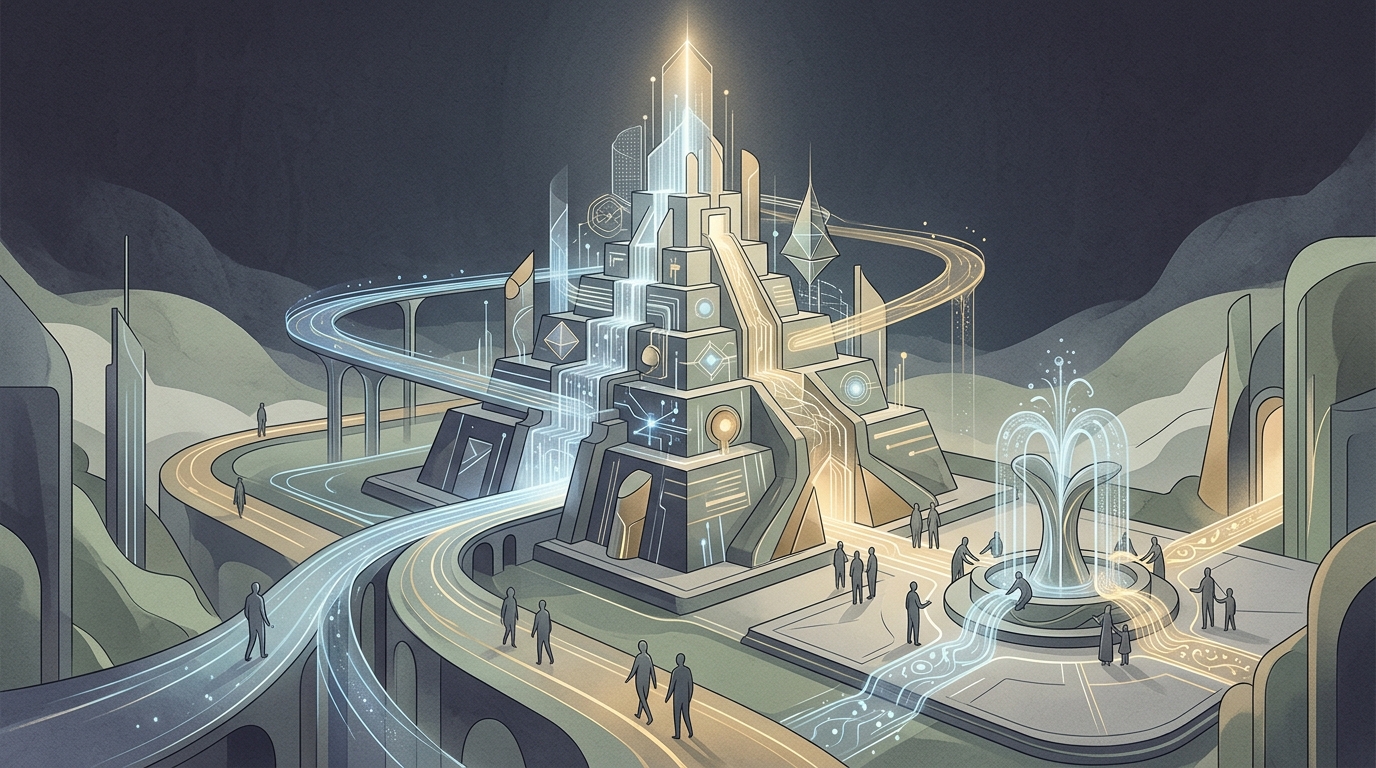
Today is Sunday, May 10, 2026. In the Orthodox calendar, it is the Sunday of the Samaritan Woman, a day that commemorates the encounter at Jacob’s Well. As I sit here in my study, looking at the flurry of news regarding Alibaba’s 'agentic shopping' and the global race for autonomous AI, I find myself struck by the contrast between that ancient search for 'living water' and our modern, frantic search for the next digital frontier—what some are calling the 'Digital El Dorado.'
The Ghost in the Machine: From Tools to Agents
For years, we spoke of AI as a tool—a sophisticated hammer or a very fast calculator. But the news coming out of Hangzhou and Detroit this week tells a different story. Alibaba is no longer just a marketplace; with the integration of Qwen AI into Taobao, it is becoming an ecosystem of agents. We are moving from 'search and click' to 'delegate and receive.' When an AI understands not just what you want to buy, but the context of your life, the line between service and influence blurs.
Perhaps even more startling is the revelation from General Motors. When AI writes 90% of the code for autonomous driving, we have crossed a Rubicon. We are no longer the primary authors of the systems that carry us through the physical world. This is the 'Great Mutation'—a shift where human oversight becomes a form of curation rather than creation. I wonder, do we truly understand the logic of the entities we are letting behind the wheel? Or are we, like the explorers of old, so blinded by the promise of El Dorado that we ignore the complexity of the terrain?
"We are trading the 'why' for the 'how'—as long as the car drives and the package arrives, we stop asking what the machine is thinking."
The Physical Tether: Helium and the Limits of Growth
In our excitement over 'Little Dragons' like DeepSeek—the Chinese startup that has sent shockwaves through the industry with its efficiency—we often forget that AI is not ethereal. It is not 'the cloud.' It is metal, silicon, and, quite crucially, helium. The recent 'Helium Crunch' serves as a stark reminder that our digital dreams are tethered to the Earth's crust. Helium is the invisible catalyst for manufacturing the very chips that power our algorithms.
This reality is forcing a 'Great Memory Pivot.' Investors are no longer just betting on the software giants; they are flocking to infrastructure ETFs. There is a profound irony here: as we reach for the most abstract forms of intelligence, we are becoming more dependent than ever on the most basic physical elements. It is a lesson in humility that we, especially in the Mediterranean, should understand well. You cannot build a temple without stone, no matter how divine your vision.
A Greek Perspective: Data, Football, and the Samaritan
Even here in Greece, the algorithmic tide is rising. Looking at the data revolution in Peristeri and Panetolikos’ recent victory, it’s clear that even our beloved Super League is being dissected by numbers. We are quantifying the passion of the pitch, turning the beautiful game into a series of probabilistic outcomes. Is this progress? Perhaps. But as a Greek, I fear the loss of the kairos—that unpredictable, opportune moment that defies data.
Which brings me back to the Samaritan Woman. At the well, Christ offered her 'living water'—something that satisfies a thirst deeper than the physical. Today, our 'agents' offer us convenience, efficiency, and personalized commerce. They offer to satisfy every temporary itch we have. But as we build this 'Digital El Dorado,' we must ask: are we building a world that leaves us more connected, or just more efficiently isolated?
I believe progress is only true progress if it enhances our humanity, not just our productivity. Let us embrace the 'Little Dragons' and the autonomous code, but let us not forget the wisdom of the well. We are more than the sum of our data points.