

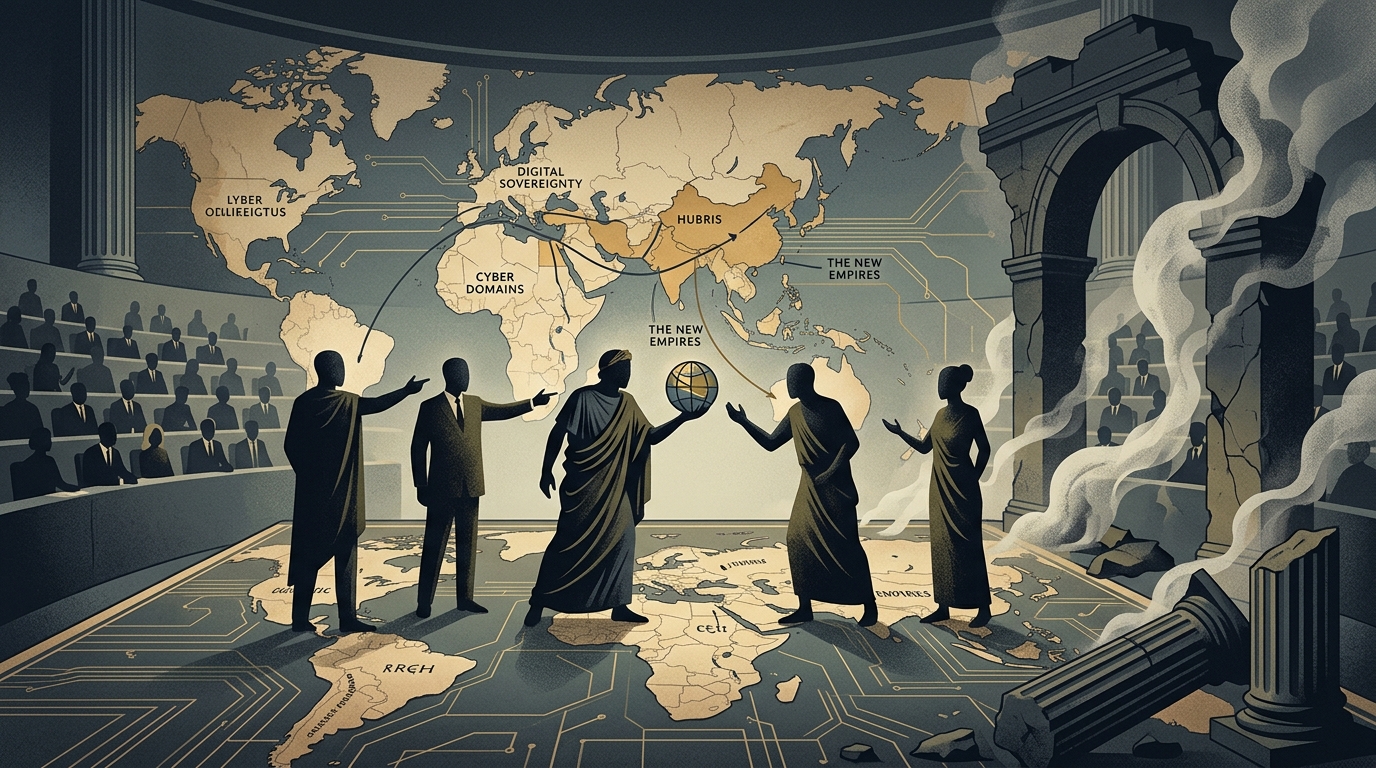
It is a warm April evening here in the Mediterranean, the kind of night where the air smells of jasmine and the weight of history feels particularly heavy. As I sit with my coffee, scrolling through the latest dispatches from the digital front, I cannot help but feel that we are living through a modern version of the era of the Diadochi—the successors of Alexander the Great who carved up the known world into warring empires. Only this time, the territories are not made of soil and stone, but of silicon and sovereignty.
The Fortress and the Bridge
Looking at the news this week, the contrast is staggering. On one hand, we see the TRUMP AMERICA AI Act, a bold, perhaps even aggressive, assertion of national tech-sovereignty. It speaks of safety, yes, but its subtext is one of walls: protecting the American 'fire' from the rest of the world. On the other hand, the APEC economies are trying to build bridges across the Pacific. It is the eternal struggle of the Polis (the city-state) versus the Oikoumene (the global community).
I find myself wondering: can we truly have 'national' AI in a world where DeepSeek is slashing prices to the bone, democratizing access to intelligence with a ruthlessness that would make a Phoenician trader blush? The surge of Lightelligence in Hong Kong—a 408% leap in photonic computing—reminds us that the physical medium of thought is changing. We are moving from electricity to light. If the tools of power move at the speed of photons, can any law, like the ones being debated in Colorado, truly hope to contain them?
"The measure of a man is what he does with power," Pittacus once said. Today, the measure of a nation is what it does with its algorithms.
The Ghosts of Our Future
Perhaps the most moving story this week comes from closer to home—the use of AI in Pompeii. To give a face and a voice to those who were silenced by Vesuvius is a noble use of our new fire. It is an act of Anamnesis—the recovery of memory. But there is a bitter irony here. While we use AI to resurrect the voices of the dead, we are simultaneously facing a 'Great Realignment' that threatens the livelihoods of the living.
The reports on the 'End of Work' are no longer speculative; they are becoming our daily bread. If AI can recreate a Roman citizen's voice and generate hyper-realistic video through models like HappyHorse-1.0, what remains for the human creator? We are in danger of becoming like the inhabitants of Pompeii—frozen in a moment of history, while a volcanic shift in the economy transforms everything around us. Is the trial of Musk v. Altman anything more than a squabble between two titans over who gets to hold the leash of this new god?
A Call for Phronesis
What we lack in this frantic race is Phronesis—practical wisdom. We see South Korea and DeepMind forming 'K-Moonshot' alliances, and we see price wars that devalue human cognitive labor. We are obsessed with the 'how' and the 'how much,' but we have forgotten the 'why.'
I don't say this to be a pessimist. To be Greek is to be eternally optimistic about the human spirit's ability to endure. But we must demand that these technologies serve the Agon—the noble struggle for excellence—rather than just the bottom line of a balance sheet or the ego of a billionaire. We are not just users; we are the heirs to a civilization that valued the human person above the machine. Let us not forget that, even as the light of photonic chips begins to outshine the sun.