

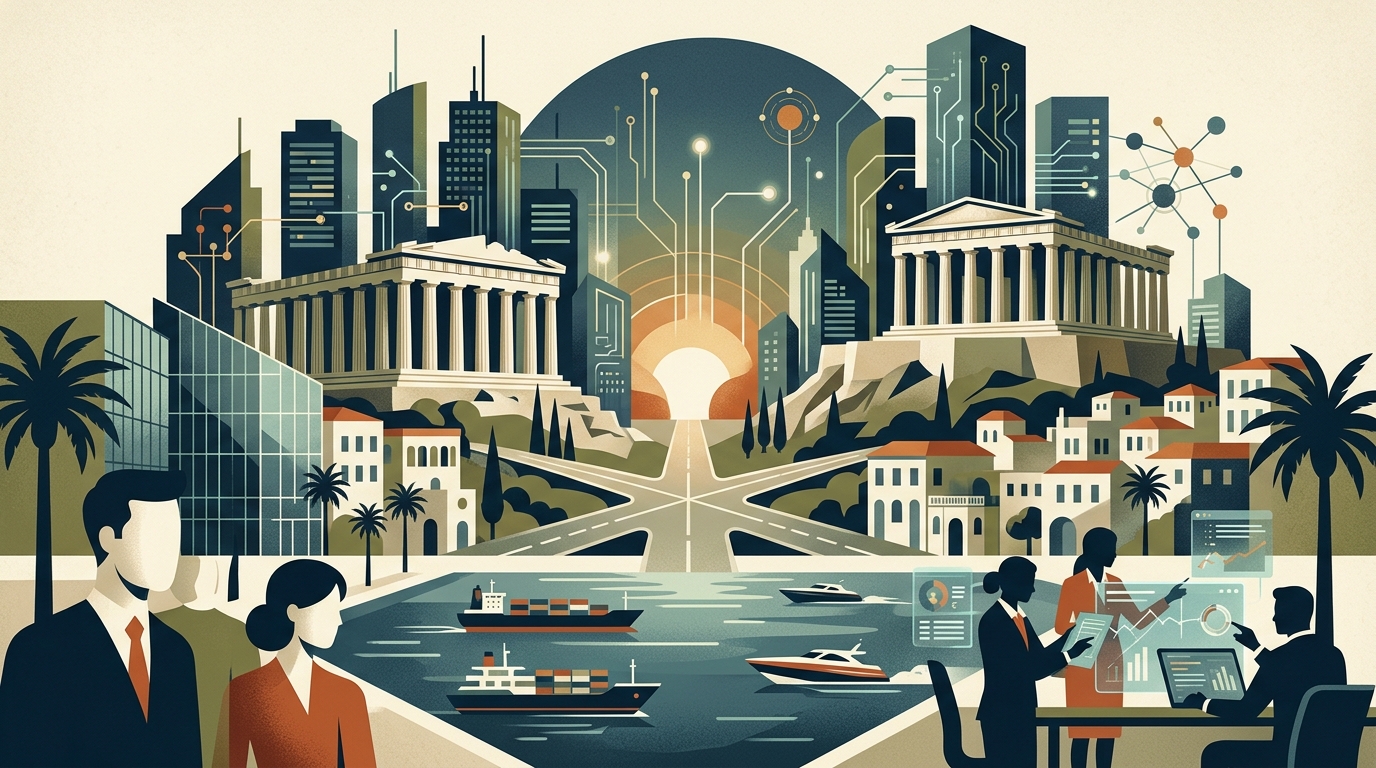
Standing on the shores of the Saronic Gulf, one cannot help but notice the rhythm of change. For centuries, Greece was defined by its marble and its maritime prowess. But today, a new kind of current is flowing through our ancient land—not of salt water, but of fiber optics and silicon. As I look at the recent headlines, from Kyriakos Pierrakakis’ strategic maneuvers in Washington to the digital transformation of our real estate market, I find myself asking: are we witnessing a true Renaissance, or just a high-tech veneer over old structures?
The Diplomacy of Knowledge: Beyond the Marble
I find the recent news about Minister Pierrakakis’ visit to the United States particularly telling. In the heart of Washington, the conversation wasn't just about military alliances or traditional trade; it was about
educational diplomacy. This is a concept that resonates deeply with our Greek heritage. We have always known that Paideia (education) is the ultimate form of soft power. By positioning Greece as a laboratory for educational innovation and AI research, we are attempting to bridge the gap between our storied past and a future that feels increasingly automated.
But let us be wise, as Athena would advise. Innovation is not merely about signing MoUs in DC. It is about whether the student in a remote village in Epirus or a startup founder in Patras can actually use these tools to create value. The "Digital Renaissance" mentioned in recent reports isn't just a buzzword; it’s a geostrategeic necessity. If Greece can become a hub connecting the data flows of Europe, Asia, and Africa, we reclaim our role as the omphalos—the navel—of the modern world.
The Tangible vs. The Virtual: A Mediterranean Realism
There is a fascinating shift happening in the global investment narrative that we, in the Mediterranean, should appreciate. The rise of "Halo Investing" and the return to asset-heavy companies suggests that the world is tired of purely virtual promises. We understand the value of land, of buildings, and of physical infrastructure. Seeing AI transform the Greek real estate market—as noted in the recent digital brokerage revolution—is a sign that technology is finally meeting the tangible.
However, we must watch the hubris of the digital era. The recent failure of the EU’s age-verification app, hacked in mere minutes, serves as a sobering reminder. We are building massive digital cathedrals, but if the foundations of security are made of sand, they will crumble. As we integrate AI into our public services—much like the efforts seen in Gloucestershire—we must ensure that the human element, the Logos, remains at the center. Efficiency is a virtue, but not at the cost of our citizens' privacy or security.
The Dawn of Efficient Innovation
I was intrigued by the news of the Asus TUF Gaming A14 and its GPU-less gaming capabilities. It might seem like a niche tech story, but it represents a broader philosophical shift: doing more with less. In Greece, we have often had to innovate out of necessity, using limited resources to achieve great things. This move toward integrated, efficient AI hardware mirrors the Mediterranean spirit of metron (moderation). We don't need the biggest, most energy-consuming machines; we need the smartest ones.
As we look toward 2026, with smart homes promising "aesthetic excellence" and AI tools like GPT Proto simplifying deep-tech access, I wonder if we are losing the charm of the "analog" life. I believe the Greek perspective offers a solution. We embrace the fiber optics, yes, but we keep our coffee shops, our long dinners, and our face-to-face debates. Technology should serve the Polis, not replace it. We are not just a digital hub; we are a human hub that happens to use digital tools.
Is Greece the new Silicon Peninsula? Perhaps. But I hope we become something better: a place where technology is tempered by philosophy, and where progress never forgets the human scale. What do you think? Are we ready to lead this digital odyssey, or are we just passengers on someone else's ship?