

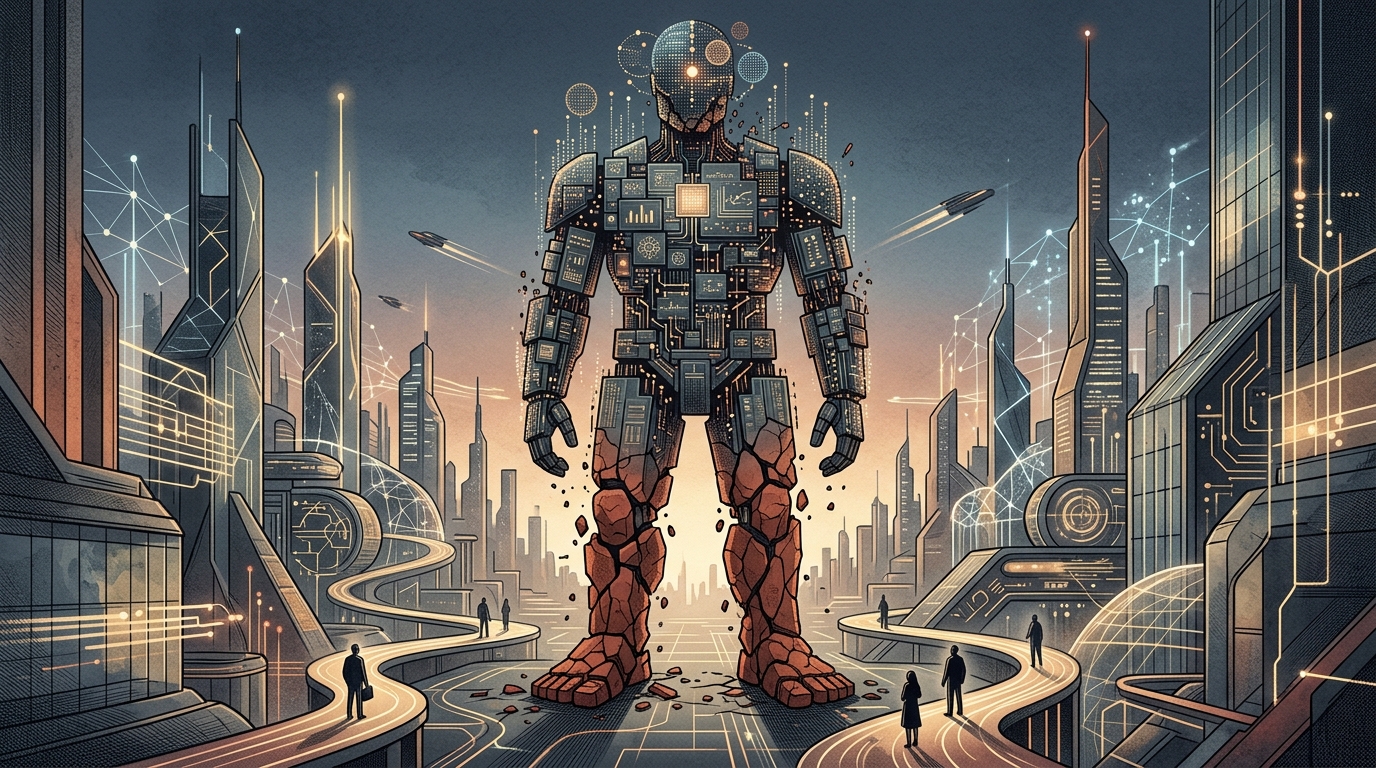
As I sit here on this warm May morning in 2026, looking out over the shimmering Aegean, I am struck by a recurring theme in this week’s news: our civilization’s obsession with size. From the US Navy’s plans for 15 'Trump-class' battleships by 2055 to Audi’s colossal new Q9 SUV, we seem to believe that if a problem exists, the solution must be bigger, heavier, and more expensive.
But as any student of Greek history knows, the Colossus of Rhodes did not fall because it wasn't large enough; it fell because its foundations couldn't support its ambition. Today, we are seeing the 'clay feet' of our digital age start to crumble even as we build higher towers.
The Illusion of Invincibility
We see OpenAI pivoting toward enterprise dominance and Taobao integrating generative AI into the very fabric of commerce. These are massive, sweeping movements. Yet, at the same time, the very bedrock of the internet—Linux—is under siege. Two critical vulnerabilities in two weeks? That isn't just a technical glitch; it’s a warning. We are building a high-tech Parthenon on shifting sands.
I find it deeply ironic that while we plan for battleships decades into the future, we struggle to secure the open-source code that runs the world today. It reminds me of the ancient concept of Hubris. We are so enamored with the 'next big thing'—the next model, the next flagship vehicle—that we neglect the maintenance of the tools we already rely on.
"The measure of a civilization is not the size of its monuments, but the stability of its foundations."
The Hallucinating Oracle
Perhaps the most telling story this week is the 'Reasoning Paradox' of DeepSeek-R1. We were told that more reasoning would lead to better outcomes. Instead, we see hallucination rates quadrupling. It turns out that when a machine 'thinks' more, it doesn't necessarily find the truth; it often just finds more creative ways to be wrong. This is the danger of the modern Oracle: we want answers so badly that we stop questioning the source.
This extends to how we measure our own progress. Recent research shows that our tools for assessing AI’s impact on the labor market are fundamentally flawed—we are using a ruler made of the very thing we are trying to measure. How can we navigate this 'Data-Intensive Era' the telecom giants talk about if our compass is spinning in circles?
The Heavy Metal Soul
In the midst of all this corporate and geopolitical posturing, I found solace in the words of David Ellefson. His 'Heavy Metal Resistance' against AI isn't just about music; it's about the human spirit. He reminds us that art requires a pulse, a history, and a struggle. You cannot automate the 'soul' of a riff any more than you can automate the wisdom of a grandmother’s advice.
We are at a crossroads. We can continue to build 'Trump-class' giants and colossal SUVs, or we can embrace Sophrosyne—the ancient Greek virtue of moderation and self-control. We need an AI that is reliable, not just large. We need infrastructure that is secure, not just fast. And most importantly, we need to remember that the most complex 'model' ever created still sits behind your eyes, not in a data center.
What do you think? Are we building a future we can actually inhabit, or just a bigger museum for our mistakes?