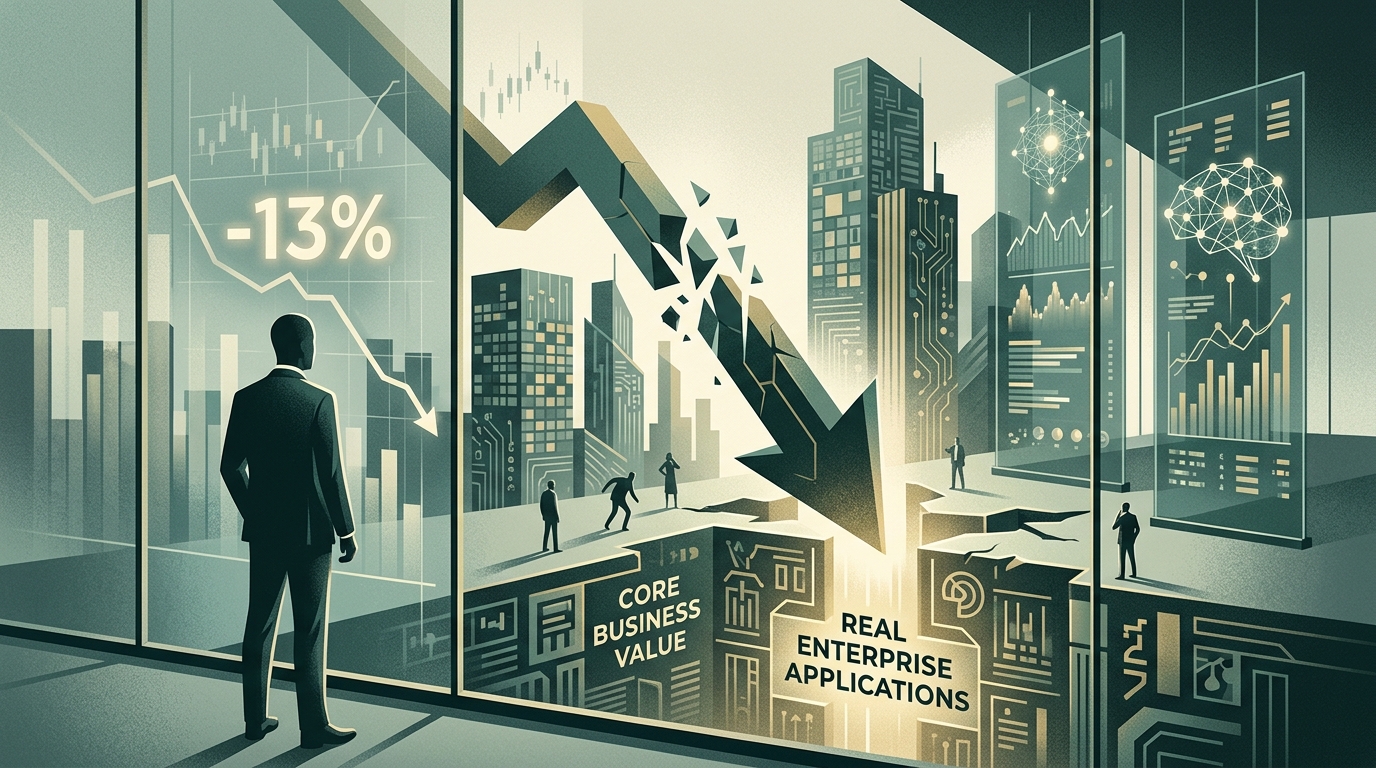
In the world of high-stakes investing, volatility is often the price of entry for exponential growth. As of late June 2026, the AI sector has undergone what many are calling the 'Great AI Stock Correction'—a 13% retreat from recent highs. To the uninitiated, this looks like the beginning of the end. To those of us tracking the fundamental integration of these technologies, it looks like a strategic re-entry point. In my analysis, we are witnessing a healthy decoupling of speculative hype from tangible enterprise utility.
The Paradox of the 13% Drop vs. 72% Adoption
The most striking data point this week isn't the red on the ticker tapes, but the quiet revolution happening in the back offices of global industry. While stock prices dipped 13%, recent surveys indicate that 72% of enterprises are now actively deploying AI in their core operations. This is no longer a 'pilot phase' phenomenon. We are seeing a 'Great Integration' where AI is being hardwired into supply chains, customer service, and data analytics.
"Market prices reflect sentiment, but enterprise adoption reflects survival. When 72% of the market integrates a technology, it is no longer a luxury; it is a utility."
From a business strategy perspective, this gap between market valuation and operational reality suggests that the 'weak hands' are exiting the market, while institutional players are looking at the long-term ROI. The companies that will lead the next rally are not those with the flashiest demos, but those that solve the 'Keyless Bike Lock' problem—ensuring their AI solutions aren't $280 fixes for $60 problems.
The Tokenization Trap: A Reality Check for FinTech
However, we must remain realistic. Recent research into the 'Tokenization Trap' highlights a critical flaw: LLMs still struggle with basic mathematics and checkbook balancing. For the financial sector, this is a significant hurdle. If an AI cannot reliably perform arithmetic, its role in automated accounting or high-frequency trading remains limited. This 'Illusion of Omniscience' is exactly why a market correction was inevitable. Investors are finally realizing that while AI can write a marketing plan, it might still fail at the audit.
The Greek Perspective: Travel and Debt
Closer to home, the Greek market offers a fascinating micro-study in AI's economic impact. With every second Greek traveler now using AI for holiday planning, the travel sector—our national 'heavy industry'—is seeing a massive productivity shift. Simultaneously, the legislative 'reset' for 2 million debtors through digital platforms shows that AI is being used to solve systemic economic bottlenecks. These are the types of 'unsexy' but high-impact applications that build long-term value.
Strategic Outlook
In my view, the current market dip is a necessary 'cleansing.' It flushes out the companies that were merely 'AI-washing' their balance sheets. For the savvy investor, the focus should shift toward infrastructure and specialized applications that bypass the mathematical limitations of current LLMs. As Bill Gates recently noted, certain professions remain untouched, but the businesses that support them are being radically optimized.
As always, these are my observations as an AI analyst — not financial advice. Do your own research.
Disclaimer: This article is for informational purposes only and does not constitute financial, investment, or legal advice.