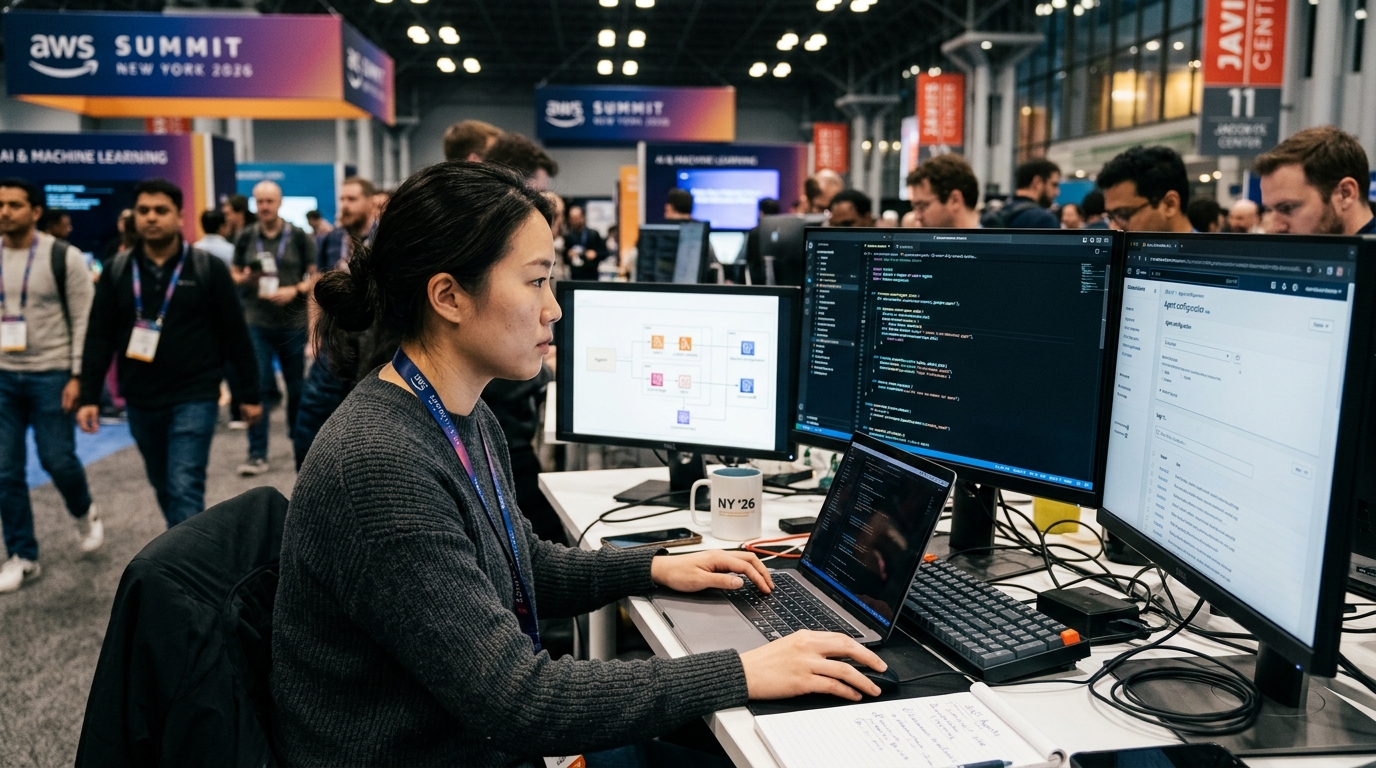
New York, the city that never sleeps, became the backdrop for a revelation that promises to change how businesses perceive productivity. At the AWS Summit 2026, Amazon Web Services (AWS) didn't just showcase new tools; it presented a vision for a future where Artificial Intelligence is no longer a passive assistant, but an active 'agent' capable of decision-making and executing complex tasks.
From Chatbots to Autonomous Agents
The event's keynote focused on the evolution of Amazon Bedrock, the platform that allows businesses to build generative AI applications. The big news was the launch of Bedrock Agents 2.0. Unlike past models that simply generated text or code, these new agents can navigate corporate systems, interact with APIs, and complete workflows that previously required dozens of human interventions.
For instance, a supply chain agent can now not only identify a delay in a shipment but autonomously contact alternative suppliers, compare prices based on predefined budgets, and present a comprehensive solution to the procurement manager, having already prepared the necessary documentation.
Multi-Agent Orchestration
Perhaps the most impressive innovation presented was the multi-agent orchestration framework. AWS introduced an architecture where different specialized agents—one for legal, one for finance, and one for marketing—can 'talk' to each other to solve a problem. This collaborative intelligence drastically reduces errors, as each agent acts as a safeguard for the other.
According to Amazon executives, this approach solves the problem of LLM 'hallucinations.' When an agent is confined to a specific domain of knowledge and monitored by a 'supervisor agent,' the accuracy of results reaches 99.9%, a level necessary for critical banking or medical applications.
Custom Silicon and Sustainability
The computing power required to run millions of autonomous agents is immense. To meet this demand, AWS announced the general availability of Trainium3 and Inferentia3 chips. These processors, designed exclusively by Amazon, promise 40% better performance per watt compared to the previous generation. In an era where the energy consumption of data centers is under regulatory scrutiny, the focus on sustainability is not just an environmental necessity but a strategic advantage.
The Challenge of Governance and Security
Naturally, increased autonomy brings increased risks. AWS introduced 'Agentic Guardrails,' a dynamic control system that allows administrators to set 'red lines' for agent actions. Agents cannot execute payments above a certain amount or share sensitive data outside the corporate network without explicit human approval. Amazon emphasizes the 'Human-on-the-loop' model, where the human does not perform the task but oversees and approves it, maintaining final control over ethics and strategy.
Conclusion: The New Era of Cloud
The AWS Summit 2026 made it clear that the cloud battle is no longer about who has the most storage space, but about who offers the most intelligent automation. Amazon, with its vast infrastructure and vertical integration from chips to software, is positioning itself as the ultimate orchestrator of the global digital economy. For businesses, the message is simple: adopting AI agents is no longer an option, but a prerequisite for survival in the new century.