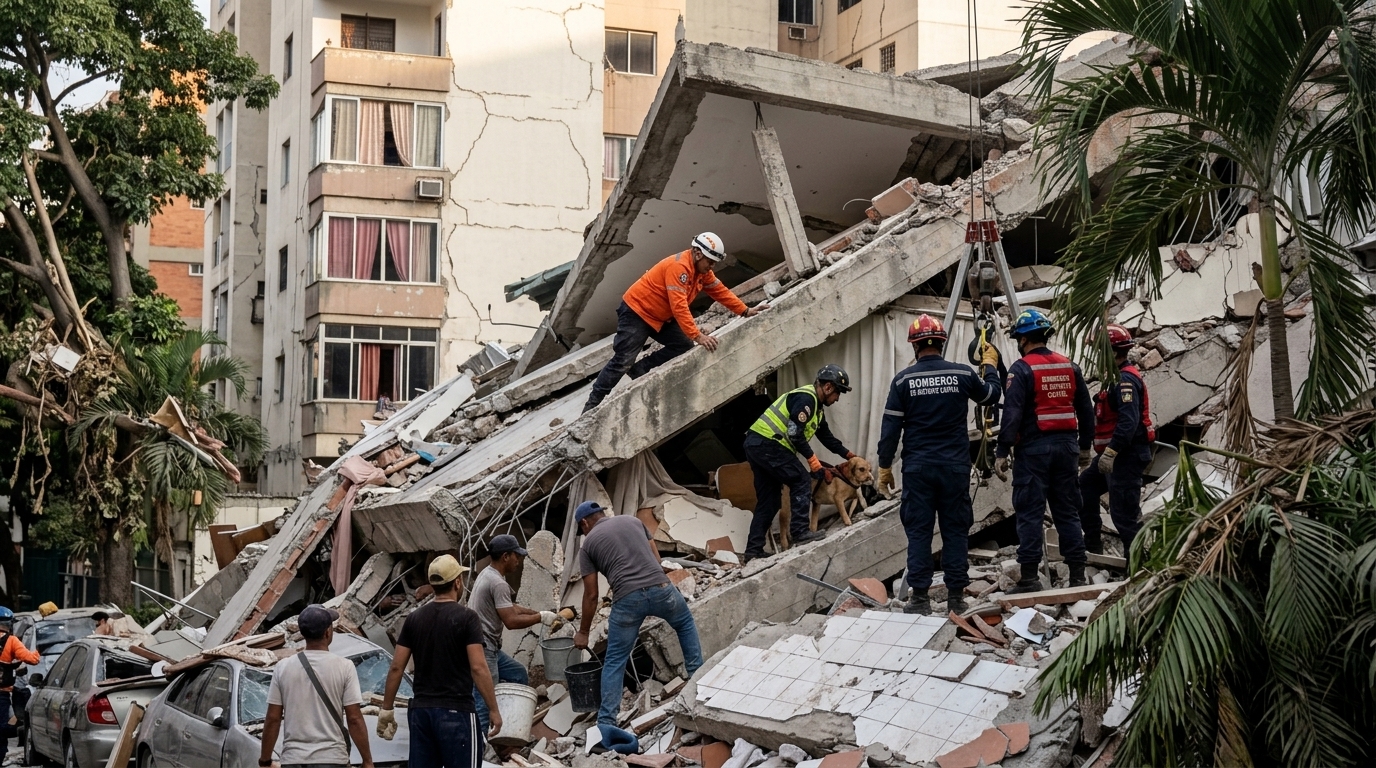
The ground beneath Venezuela does not merely shake; it mourns. In the recent seismic events that rocked the nation, one question dominated the discourse among engineers and geologists worldwide: why was the second earthquake, despite not necessarily being significantly stronger than the first in absolute magnitude, responsible for disproportionately greater structural collapses? The answer lies not just in the Richter scale, but in a complex interplay of geology, structural fatigue, and decades of infrastructural neglect.
The Cumulative Fatigue of Materials
One of the most critical factors explaining the devastation is the concept of "structural fatigue." When the first earthquake struck, many buildings that appeared to remain standing sustained internal damage invisible to the naked eye. Micro-cracks in concrete, the de-bonding of rebar from cement, and subtle foundation shifts created a state of "false security."
"A building that has already been stressed by a powerful vibration loses its elasticity. The second earthquake does not find a robust structure, but a skeleton already struggling to stay upright," experts explain.
In Venezuela, the short interval between the two quakes allowed for neither proper assessment nor, more importantly, the reinforcement of damaged structures. The dynamic energy of the second tremor acted as a "coup de grâce" to constructions that had already exhausted their resilience limits. This phenomenon of successive stress is one of the greatest nightmares for seismologists, as it upends traditional damage prediction models.
The Soil Trap and Wave Amplification
The geography of Caracas and surrounding regions plays a decisive role. The capital is built in a basin filled with sedimentary deposits. When seismic waves travel from hard rock into the soft sediment of the basin, their speed decreases, but their amplitude increases dramatically. This is known as "site amplification."
During the second quake, the frequency of the tremors happened to coincide with the natural frequency of many medium-rise buildings. This resonance caused these buildings to oscillate with far greater intensity than the earthquake's magnitude would normally dictate. Furthermore, soil liquefaction in certain areas turned solid ground into a viscous slurry, stripping away all support from the buildings' foundations.
- Resonance: When the earthquake's frequency matches the building's natural sway.
- Liquefaction: The loss of soil strength due to water pressure during shaking.
- Basin Effects: The trapping of waves within a geological basin, prolonging the duration of the shaking.
The Socio-Economic Dimension of Collapse
We cannot analyze the building failures in Venezuela without addressing the economic crisis gripping the country. Building codes, though existing on paper, are often bypassed due to a lack of resources or systemic corruption. The use of sub-standard materials—such as unwashed sea sand that corrodes steel reinforcement or cement with reduced binding agents—proved fatal.
Moreover, the lack of regular maintenance on older buildings from the 1960s and 70s rendered them exceptionally vulnerable. Many of these structures were designed before modern seismic standards were implemented and were never retrofitted. The state's economic inability to enforce inspections and the owners' inability to fortify their properties turned cities into ticking time bombs.
Lessons for the Future
The Venezuelan tragedy serves as a harsh lesson for the global engineering community. A city's resilience is not judged by how it withstands a single event, but by its capacity to manage successive crises. The need for real-time "Structural Health Monitoring" systems is now more urgent than ever.
In conclusion, the catastrophe in Venezuela was not merely a geological fluke. It was the result of a collision between relentless nature and human shortcomings. To prevent similar tragedies in the future, investment in construction quality and a deep understanding of local geology must precede urban development, especially in the world's most seismically active regions.