The history of artificial intelligence could be divided into two eras: the era of 'brute force,' where dominance was measured by GPU counts and billions of dollars in energy consumption, and the era of 'strategic efficiency.' With the official launch of DeepSeek V4, it appears we have definitively transitioned into the latter. The Hangzhou-based Chinese firm has not only managed to match the performance of flagship models from OpenAI and Anthropic but has done so at a fraction of the cost, forcing the entire ecosystem to rethink its priorities.
The Architecture of Intelligence: Mixture-of-Experts and MLA
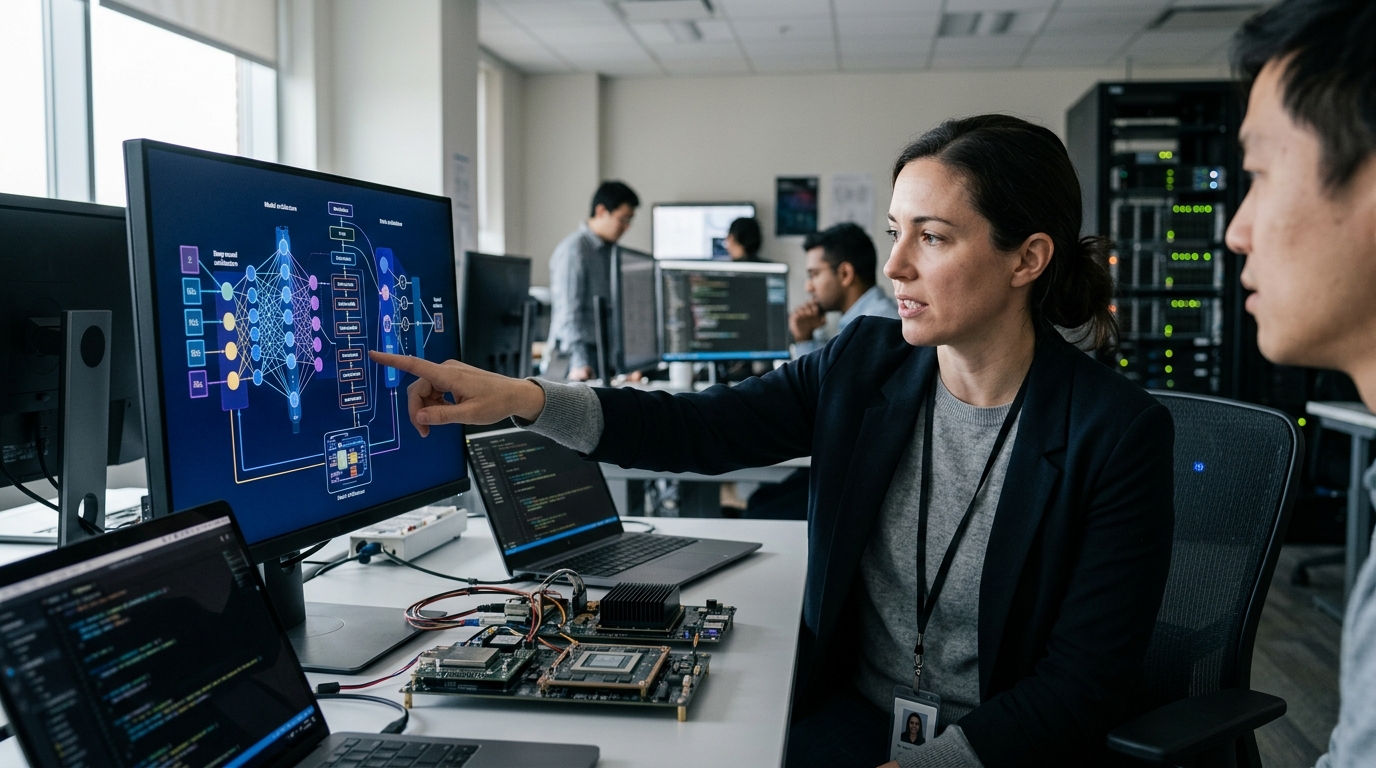
DeepSeek V4 is built upon an evolved Mixture-of-Experts (MoE) architecture, which allows the model to activate only a small subset of its parameters for any given task. However, the true innovation lies in Multi-head Latent Attention (MLA). While traditional Transformer models require massive memory to manage context, MLA compresses this information in a way that enables V4 to operate at speeds previously thought impossible for models of this scale.
This approach is not merely a technical detail; it is an economic manifesto. In today’s environment, where the demand for compute far outstrips supply, the ability to produce high-quality output with fewer resources is the ultimate competitive advantage. DeepSeek V4 proves that architectural ingenuity can defeat computational supremacy.
The Reasoning Revolution and Reinforcement Learning
One of V4’s most striking features is its prowess in complex reasoning. Utilizing advanced Reinforcement Learning (RL) techniques, the model has been trained not just to predict the next token, but to 'think' before it speaks. This places it in direct competition with OpenAI’s o1 model, though DeepSeek offers a more transparent approach to its chain-of-thought process.
- Enhanced capabilities in mathematical problem-solving and complex coding.
- Reduced hallucination rates through rigorous step-by-step verification.
- Exceptional performance in multilingual environments, particularly non-Western languages.
The model’s ability to self-correct during output generation is a game-changer for developers and researchers, turning it into a tool that provides not just answers, but methodologies.
Geopolitics and the Open Source Gambit
The rise of DeepSeek V4 carries profound geopolitical implications. In an era where the U.S. imposes strict export controls on high-end chips to China, DeepSeek’s success is a resounding response. It demonstrates that hardware constraints can be circumvented through software innovation. Furthermore, DeepSeek’s strategy of releasing open weights has democratized power in a way that creates a significant headache for Silicon Valley’s closed-garden platforms.
"DeepSeek V4 is not just a product; it is proof that the center of gravity in AI innovation is shifting eastward, not because of raw resources, but because of agility," industry analysts note.
This move is forcing giants like Google and Meta to accelerate their development cycles, while simultaneously offering startups worldwide access to cutting-edge technology without the prohibitive costs of major cloud providers.
The Future: Towards a More Accessible AI
In conclusion, DeepSeek V4 sets a new benchmark for what we should expect from AI in 2026. It is no longer enough for a model to be 'smart'; it must be sustainable, fast, and accessible. The race for the 'largest' model seems to be ending, giving way to the race for the 'most efficient.' For users and businesses, this means lower prices, better integration, and a technology that serves humanity without requiring the budget of a small nation.