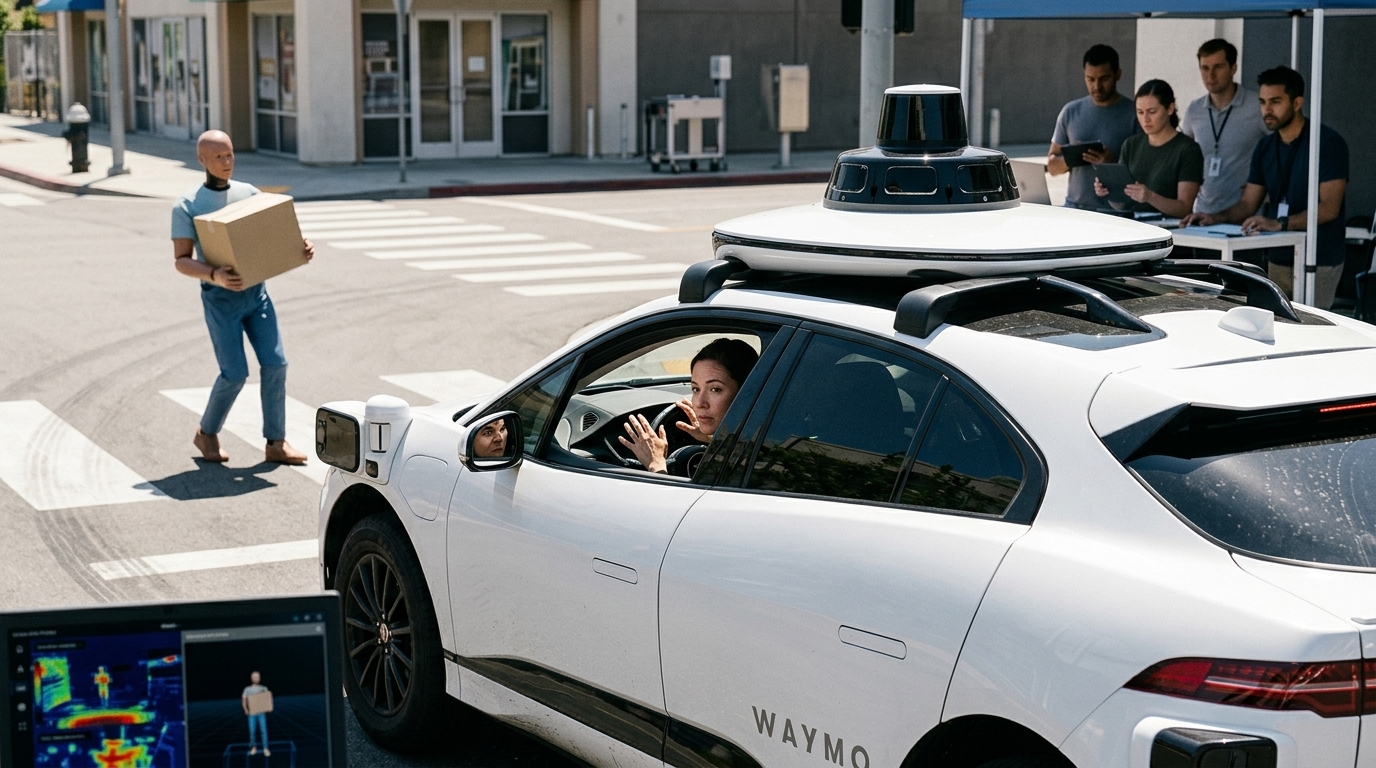
In the high-stakes arena of autonomous driving, the ultimate challenge is no longer just recognizing a stop sign or maintaining a lane. It is the profound understanding of the most unpredictable element on the asphalt: the human being. Waymo, Alphabet’s self-driving subsidiary, has taken a significant leap forward by developing a 'Reference Driver'—a sophisticated computational model designed not to drive its cars, but to simulate how a focused human would react to sudden, hazardous scenarios.
The Anatomy of Surprise: Modeling the Human OODA Loop
Why is it vital to quantify human reaction? The answer lies in the inherent limitations of biological processing. Humans are not machines; when a pedestrian steps into traffic or a lead vehicle slams on its brakes, the human brain requires fractions of a second to process the stimulus, orient to the threat, decide on a course of action, and finally act (the OODA loop). Waymo’s model specifically integrates these latencies to create a benchmark for safety.
This 'Reference Driver' is built upon millions of miles of real-world driving data and thousands of crash reports from public databases. By creating a 'hyper-attentive' yet biologically constrained human proxy, Waymo can run thousands of simulations. If the Waymo Driver (the AI) avoids a collision in a scenario where the virtual human fails, the company gains empirical evidence of its system’s superior safety profile. This methodology transforms safety from a marketing claim into a rigorous, peer-reviewed statistical standard.
Beyond the Trolley Problem: The Science of Perception
Public discourse on AI ethics often gravitates toward the 'Trolley Problem'—the hypothetical choice between two tragic outcomes. In reality, however, road safety is less about philosophy and more about perception. Waymo’s research focuses on the 'looming threshold'—the precise moment an object’s rate of expansion on the retina signals an imminent collision to a human driver.
- Simulating human visual constraints and blind spots in complex urban environments.
- Modeling the cognitive gap between perceiving a hazard and executing a physical response.
- Comparing the efficacy of AI-driven evasive maneuvers against human mechanical limits.
- Utilizing historical crash data to reconstruct 'edge cases' that are too dangerous to test in reality.
By benchmarking against a virtual human, Waymo addresses a critical regulatory hurdle. It provides a transparent answer to the question: 'How much better than a human must a robot be?' By showing that their AI can perceive and react to threats before a human even registers the 'looming' danger, they build a compelling case for the widespread adoption of autonomous fleets.
The Strategic Frontier of Autonomous Mobility
The creation of a digital twin for human fallibility is perhaps the most necessary irony in the pursuit of full autonomy. As Waymo expands its commercial operations into complex urban centers like Los Angeles and Austin, the ability to predict how human drivers—and victims—behave is paramount. Waymo is not merely engineering a driver; it is engineering a system that respects and accounts for human fragility.
"It is not enough to drive perfectly; you must understand how others fail to ensure a zero-collision future," industry analysts note regarding Waymo's latest white papers.
Ultimately, Waymo’s research suggests that the path to the future is paved with more than just LiDAR sensors and neural networks. It requires a deep, mathematical grasp of human psychology and physiology. The AI’s ability to 'understand' surprise, even through cold code, may be the most significant safety guarantee we have ever developed. As we move closer to a world of driverless cities, these virtual humans will be the silent guardians ensuring that our biological limitations no longer dictate our survival on the road.