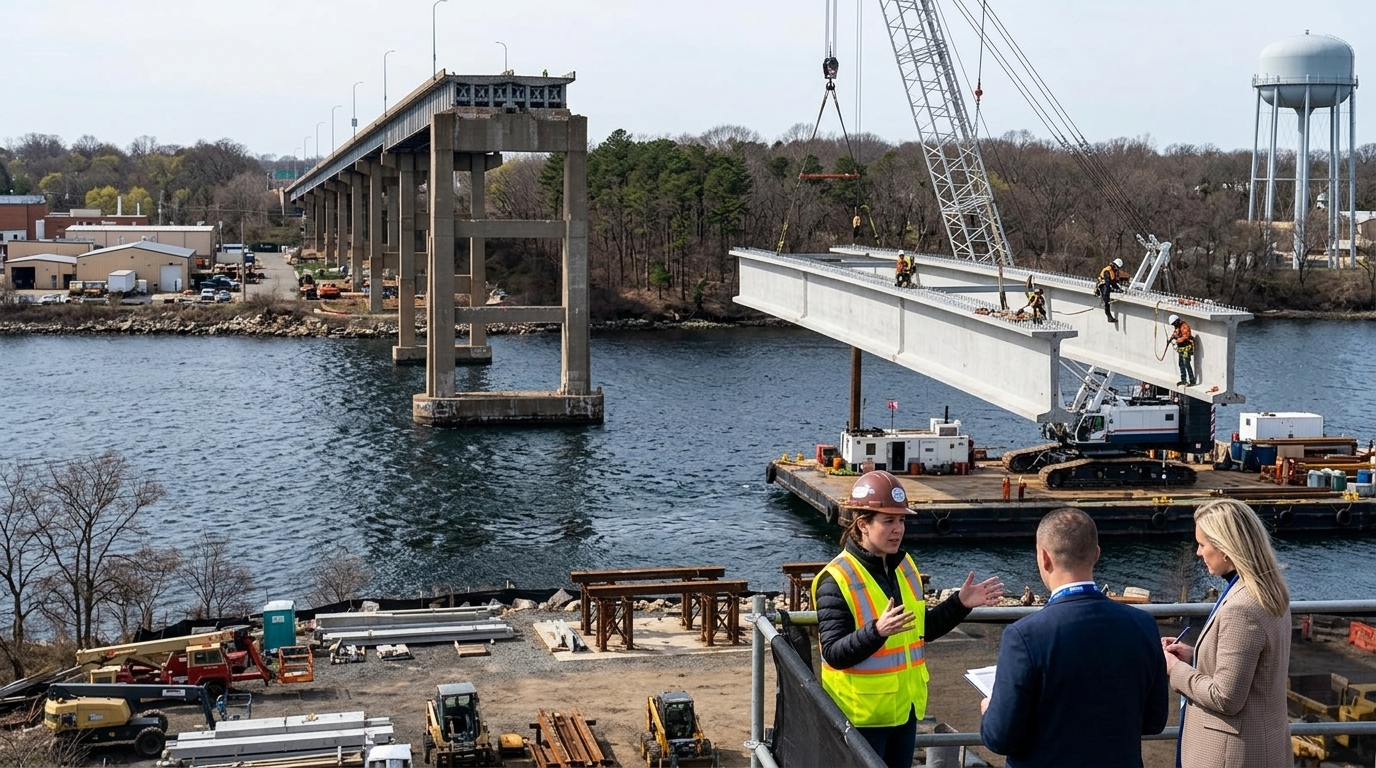
The image is now familiar but no less alarming: rusted steel, cracked concrete, and weight limit signs on bridges that serve as the arteries of global commerce. In the United States, more than 40,000 bridges are classified as "structurally deficient." Despite the billions of dollars from the Infrastructure Investment and Jobs Act, the inspection method remains desperately analog. According to federal rules, most bridges are visually inspected every 24 months—a process that relies on human observation, which is inherently subjective and often inaccurate.
While artificial intelligence and quantum computers dominate the headlines, another quantum revolution is quietly happening in labs: quantum sensors. These devices, capable of measuring infinitesimal changes in gravity, magnetism, and strain, could provide an "MRI" for our infrastructure. However, the gap between laboratory innovation and field application remains vast.
The Failure of Visual Inspection and the Quantum Alternative
The current inspection method is, at best, reactive. Inspectors look for visible signs of wear, such as cracks or corrosion. But by the time a crack becomes visible to the naked eye, the structural integrity of the bridge has already been seriously compromised. This is where quantum technology comes in. Quantum gravity sensors can detect voids inside concrete or corrosion in internal steel reinforcements that are impossible to spot with traditional means.
These sensors work by exploiting the properties of atoms cooled near absolute zero. Using atom interferometry, they can measure gravitational pull with such precision that they perceive changes in material density due to a tiny internal crack. Instead of waiting two years for a human with a flashlight and a hammer, quantum sensors could provide continuous, non-invasive, real-time monitoring.
Barriers to Adoption: Cost, Scale, and Maintenance
If the technology is so superior, why isn't it already in use? The answer is multifaceted. First, there is the issue of cost. Quantum sensors are currently extremely expensive and require specialized personnel to operate. Installing such systems on 40,000 bridges requires an investment that local and state governments are hesitant to undertake, preferring to allocate their resources to immediate repairs rather than advanced prevention.
Second, there is the problem of scale. Most quantum sensors are sensitive laboratory instruments not designed to withstand the harsh environmental conditions of a bridge—vibrations, extreme temperatures, and humidity. The "ruggedization" of the technology is a challenge that researchers are still trying to solve. Furthermore, the volume of data generated by these sensors is enormous. Without a robust AI infrastructure to process and interpret this data, the information remains useless.
The Convergence of AI and Quantum: The Future of Smart Infrastructure
The future lies not just in the sensors themselves, but in their connection to artificial intelligence. Imagine a "Digital Twin" of a bridge, fed with data from quantum sensors. AI could predict exactly when a bridge will need maintenance, decades before a catastrophic failure occurs. This proactive approach could save trillions of dollars in the long run by reducing the need for total reconstructions.
However, to get there, we need a paradigm shift in policy. Current U.S. legislation focuses on "fixing" rather than "predicting." Regulatory bodies must modernize inspection protocols, allowing quantum data to replace or supplement visual checks. The technology is ready to leave the lab; the question is whether political will can keep pace with the speed of physics.
"We cannot build the 21st century with 19th-century inspection methods. Quantum technology is not a luxury; it is a necessity for public safety," says a leading MIT researcher.
In conclusion, the crisis of American bridges is a reminder that innovation is not just about the gadgets in our pockets, but the foundations beneath our feet. Quantum sensors offer the key to safer and more efficient infrastructure, provided we dare to invest in the invisible to protect the visible.