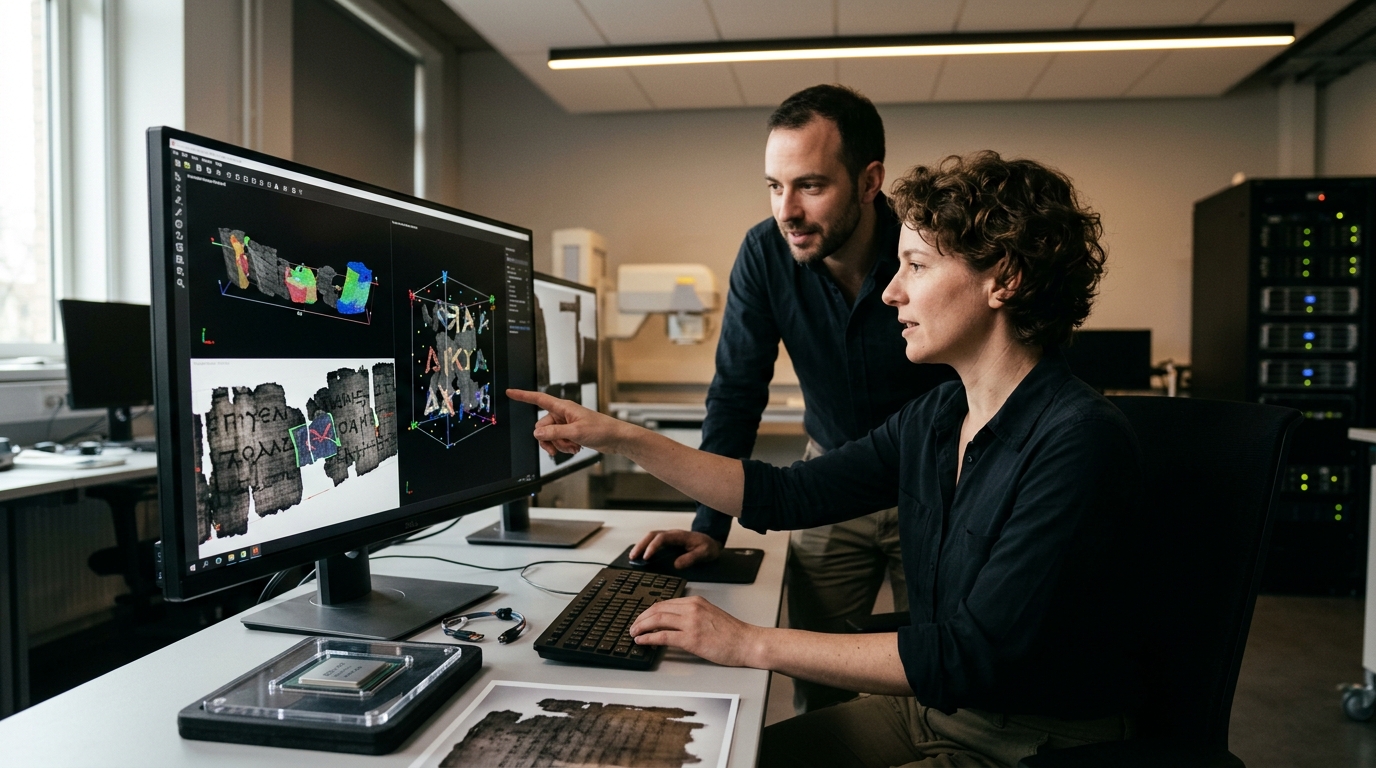
The history of humanity is riddled with gaps—libraries burned to ashes and wisdom lost to the fog of time. However, as of June 2026, the scientific community is experiencing a sense of euphoria not seen since the discovery of the Rosetta Stone. The "digital resurrection" of the Herculaneum library, buried under the volcanic debris of Mount Vesuvius in 79 AD, is no longer a science fiction trope but a reality achieved through the convergence of high-resolution computed tomography (CT) and advanced Artificial Intelligence.
For nearly two millennia, the hundreds of scrolls found in the so-called "Villa of the Papyri" remained silent. To the naked eye, they resembled nothing more than lumps of charcoal. Any attempt at physical unrolling inevitably led to fragmentation and permanent destruction. The solution did not come from an archaeologist’s scalpel but from the algorithms of data scientists and machine learning engineers.
The Vesuvius Challenge: A Model for Open Innovation
The breakthrough was catalyzed by the "Vesuvius Challenge," a global competition that offered substantial financial rewards to anyone who could decipher even a few words from the carbonized scrolls. This crowdsourcing approach, largely funded by Silicon Valley entrepreneurs, demonstrated that solving the world’s most complex historical puzzles requires the collective intelligence of the global tech community.
Researchers utilized high-energy 3D X-rays to create digital twins of the scrolls. The fundamental problem, however, was that the ink—made of carbon and water—had the same chemical signature as the charred papyrus itself, rendering it invisible to human eyes even in high-definition scans. This is where AI stepped in. Through machine learning, algorithms were trained to detect subtle texture variations on the papyrus surface—the "crackle pattern"—that indicated the presence of dried ink.
From Darkness to Light: The First Words of Philodemus
The first full sentences recovered belong to the Epicurean philosopher Philodemus. These texts are not mere historical records; they are profound explorations of pleasure, music, and the aesthetics of life. In one decoded passage, the philosopher contemplates whether things available in smaller quantities provide greater pleasure than those found in abundance—a question that resonates deeply in our modern era of hyper-consumption.
The significance of this discovery extends far beyond the content of these specific scrolls. The Villa of the Papyri is believed to have belonged to Lucius Calpurnius Piso Caesoninus, the father-in-law of Julius Caesar. Its library may contain lost works by Aristotle, Sophocles, or even Latin texts previously thought lost forever. In this context, AI does not replace the historian; it serves as a powerful lens that pierces through the veil of time.
A Second Renaissance and Future Challenges
We stand at the threshold of a "Second Renaissance." If the first Renaissance was fueled by the rediscovery of ancient manuscripts in monastic libraries, today's revival is powered by the digital processing of data once considered "dead." However, this process is not without its hurdles. The ethical management of digital cultural heritage, equitable access to these findings, and the long-term funding of such interdisciplinary research remain critical talking points.
- Virtual unrolling techniques allow for reading without any physical contact with the fragile artifacts.
- Segmentation algorithms can separate layers of papyrus with micrometer precision.
- The collaboration between classical philologists and software engineers is forging a new branch of the humanities.
As technology evolves, the hope is to decode all 800+ scrolls already recovered, and perhaps more importantly, to justify further excavations of the villa's lower levels, which remain buried. Vesuvius, which once brought death and destruction, inadvertently acted as a time capsule, preserving knowledge for future generations. Today, Artificial Intelligence is the key that finally turns the lock, reminding us that technology, at its best, is an act of preservation and a bridge to our shared human identity.