In an era where climate change is no longer a distant threat but a daily reality, technology is being called upon to play a providential role. In Hong Kong, a city historically at the mercy of tropical cyclones, the integration of Chinese Artificial Intelligence into weather forecasting marks a new epoch in civil protection. As the region braces for a season of "super typhoons," traditional Numerical Weather Prediction (NWP) models are giving way to deep neural networks that promise speed and accuracy once thought unattainable.
The Revolution of Pangu and FengWu Models
Traditional meteorology relies on solving complex differential equations describing atmospheric dynamics. This process requires massive computational power and time. In contrast, Chinese AI models, such as Huawei's Pangu-Weather and the Shanghai AI Laboratory's FengWu, approach the problem through pattern recognition across decades of historical data. Instead of "calculating" the weather, they "predict" it based on what they have learned from the past.
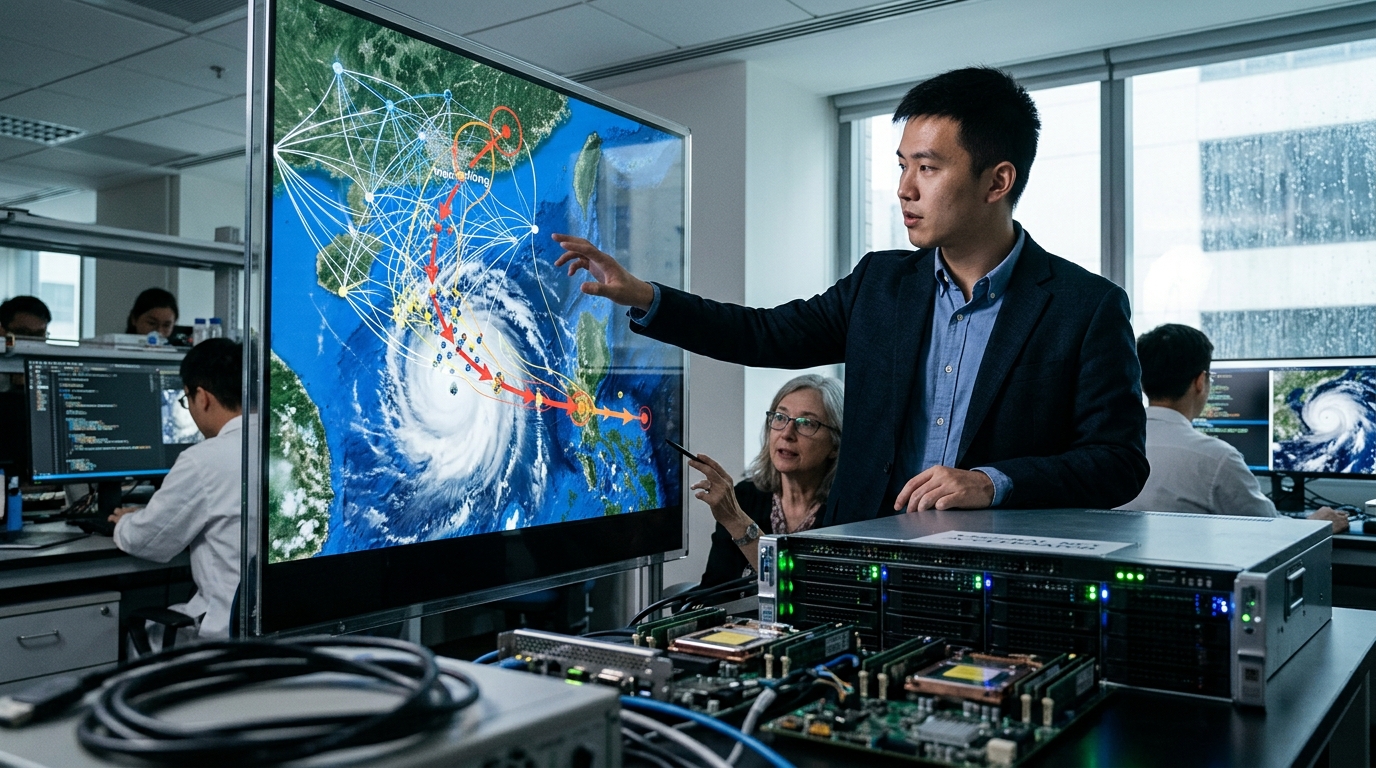
The Pangu-Weather model, which has already received global acclaim, utilizes a 3D Earth-Specific Transformer architecture. This allows it to process atmospheric data at various altitude levels, offering a holistic view of a storm's structure. According to recent reports from the Hong Kong Observatory (HKO), these models have managed to predict the tracks of recent cyclones with significantly lower error margins than European or American traditional models, and they do so in fractions of a second.
Strategic Significance for Hong Kong
For Hong Kong, accurate forecasting is not merely a matter of convenience; it is a question of economic survival and public safety. A super typhoon hitting the city can cause billions of dollars in damage and paralyze a global financial hub. The ability of AI to provide early warnings up to 10 days in advance allows authorities to fortify infrastructure, evacuate vulnerable areas, and manage energy grids with greater efficiency.
The HKO has begun integrating these tools into its operational arsenal, blending Chinese technology with its own localized data. Using AI also allows for the creation of "ensemble forecasts" at a much lower cost. Instead of running a single prediction, meteorologists can run hundreds of scenarios simultaneously, calculating the probabilities for every possible path a typhoon might take. This statistical approach reduces uncertainty and aids in making critical decisions under pressure.
Challenges and the Future of Meteorological Intelligence
Despite the successes, experts warn that AI is not a panacea. These models are exceptional at track prediction but sometimes struggle to estimate rainfall intensity or sudden shifts in wind speed. This occurs because AI relies on historical data and can be "surprised" by extreme events that have never been recorded before—a phenomenon becoming increasingly common due to global warming.
Furthermore, there is the issue of climate geopolitics. China's dominance in AI meteorology is part of its broader strategy for technological supremacy. While collaboration in weather science has traditionally been global, the competition for who owns the best forecasting algorithm is now taking on national dimensions. Hong Kong, acting as a bridge, is at the heart of this development, proving that technology can save lives when science meets political will.
- AI model processing speed is up to 10,000 times faster than conventional systems.
- The FengWu model can predict atmospheric states for 10 days in less than 30 seconds.
- Track prediction accuracy has improved by approximately 20% over the last two years.
- The integration of AI reduces the energy consumption of data centers used for forecasting.
In conclusion, the battle against super typhoons in Hong Kong is entering a phase where data is the strongest levee. Chinese AI does not just offer better forecasts; it offers a new philosophy of risk management, where prevention is built on algorithmic foresight. As we move deeper into 2026, the success of these models will likely set the standard for urban resilience worldwide.