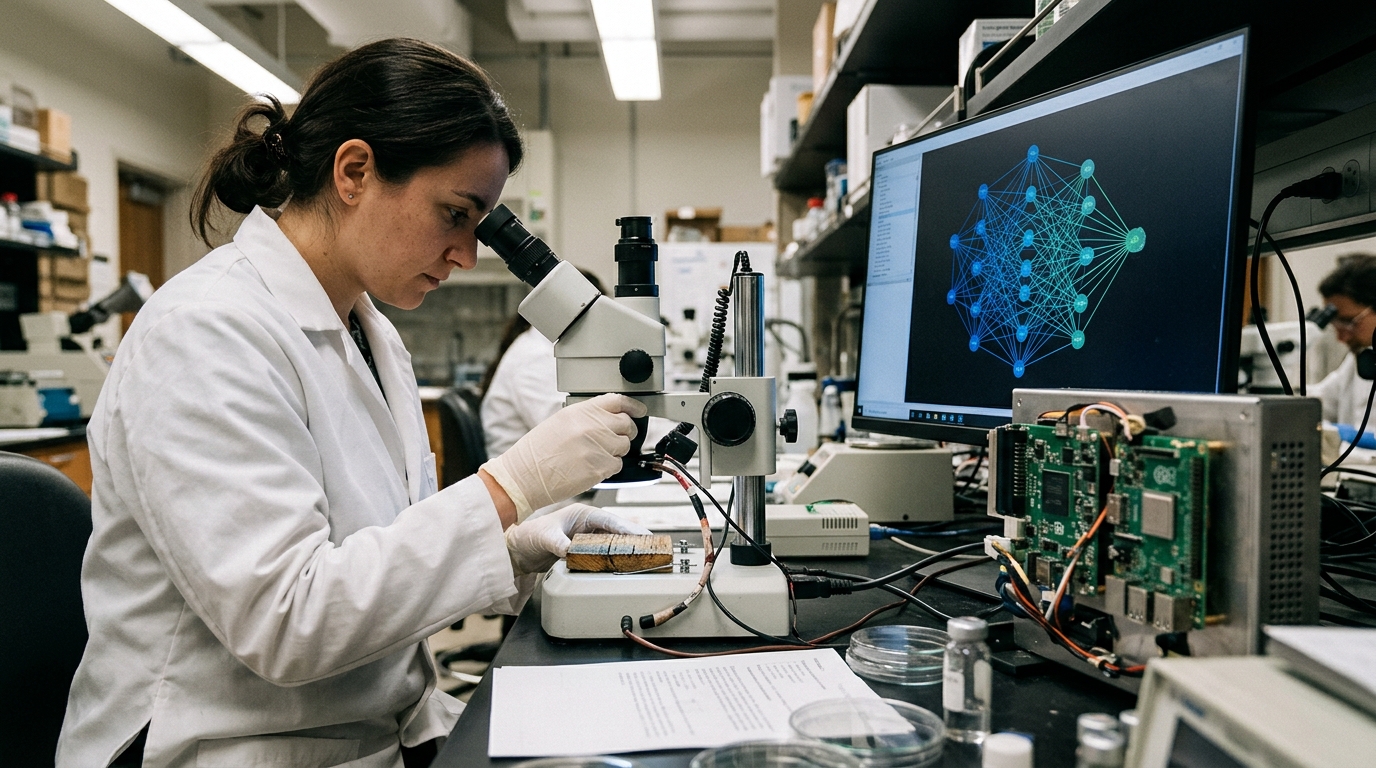
The use of wood in architecture and construction is experiencing a global renaissance as humanity seeks sustainable alternatives to concrete and steel. However, wood remains a vulnerable material, exposed to the relentless forces of nature: UV radiation, moisture, and temperature fluctuations. Until now, the maintenance of wooden structures has relied heavily on visual inspection. But by the time cracks or peeling paint become visible to the human eye, the damage to the underlying wood substrate is often already advanced. A groundbreaking study featured in Spectroscopy Online reveals how Machine Learning (ML) can radically change this landscape, offering "superhuman" vision to conservators.
The Science Behind the Invisible
The new research approach utilizes spectroscopy—a technique that analyzes the interaction of light with matter—to "read" the chemical signature of protective coatings. As varnish or paint is exposed to the environment, its polymer bonds begin to break down due to photo-oxidation. These chemical changes occur at a molecular level months or even years before the first visible degradation appears. Researchers trained machine learning algorithms to recognize the subtle patterns in spectroscopic data that signal the onset of decay.
The system does not merely function as a detector; it is a predictive tool. By analyzing the rate and nature of chemical degradation, the model can predict with impressive accuracy exactly when a coating will fail. This shift from "reactive" maintenance (repairing after failure) to "preventive" or "predictive" maintenance (intervening at the precise moment of need) represents the holy grail of modern materials engineering.
Sustainability and Economic Impact
The implications of this technology extend far beyond the laboratory. In the construction sector, the premature replacement of wooden elements due to poor maintenance entails massive economic and environmental costs. Being able to know that a building needs repainting in six months, even though it looks perfect today, allows for optimal work scheduling and the avoidance of costly structural repairs. Furthermore, this technology can be applied to cultural heritage preservation. Historic wooden buildings and artworks can now be monitored using non-invasive methods, ensuring their longevity without compromising their integrity through frequent and unnecessary interventions.
- Reduction of wood waste by extending the lifecycle of materials.
- Minimization of chemical coating usage, as application occurs only when necessary.
- Increased safety in wooden bridges and infrastructure through early warning systems.
Toward a New Era of "Smart" Infrastructure
Integrating Artificial Intelligence into materials care is just the beginning. In the future, we could see handheld scanning devices that allow homeowners or building inspectors to check the condition of exterior surfaces with the click of a button. The challenge remains scaling this technology and creating databases that cover all types of wood and coatings. However, this study proves that AI is not just about the digital world; it is an essential ally for preserving our physical world. In an era where the climate crisis accelerates material degradation, such tools are vital for the resilience of our cities.
"The ability to see the invisible is no longer science fiction, but a necessity for sustainable 26th-century architecture," researchers state.
As we move toward 2030, the convergence of materials science and computer science will redefine our relationship with the built environment. Wood, man's oldest building material, finds its ultimate protector in the most modern of algorithms.