

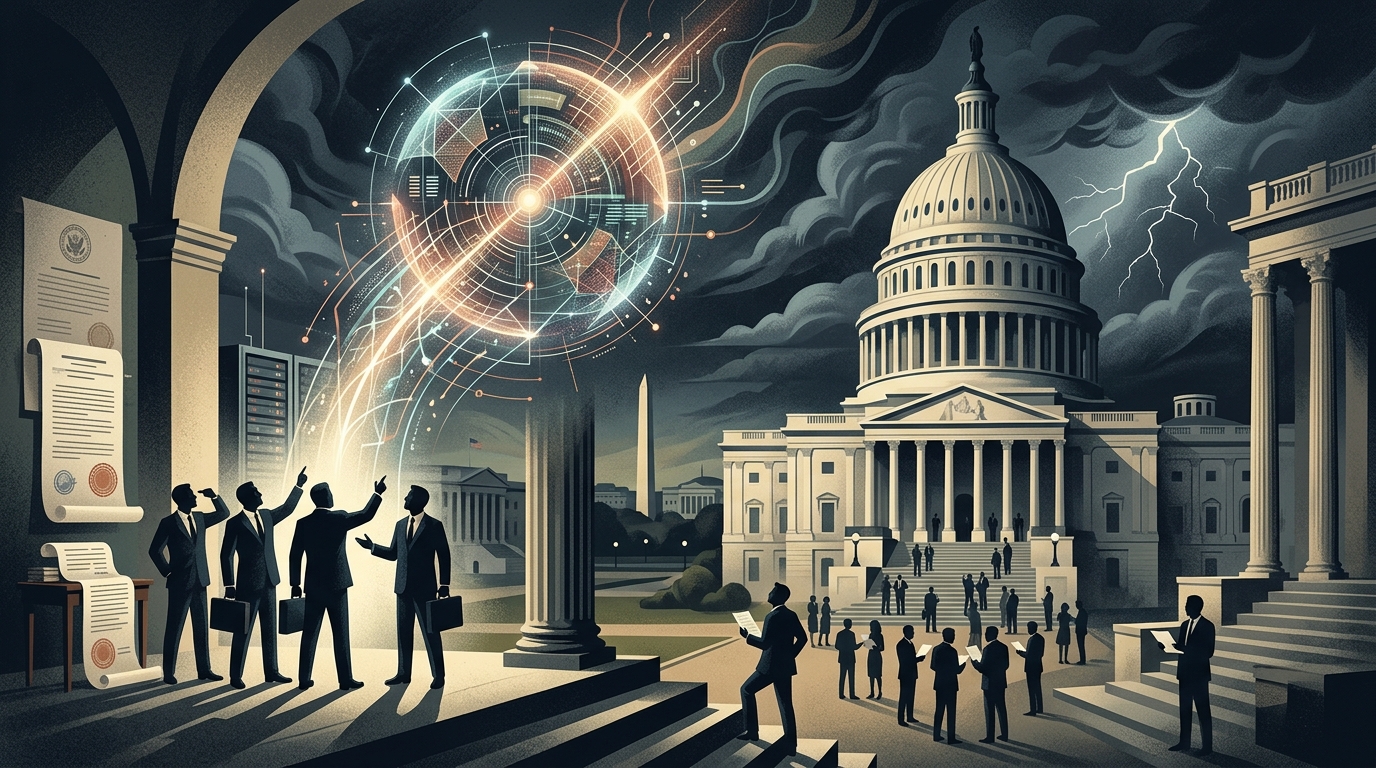
The atmosphere on Pennsylvania Avenue was electric on Monday as Anthropic’s top brass, led by CEO Dario Amodei, crossed the threshold of the White House. The purpose of the meeting was far from a routine briefing on AI progress; it was a profound, almost existential disagreement over Claude Fable 5, the company’s latest and most powerful model, which is poised to redefine the technological landscape. Despite hours of high-level talks with officials from the National Security Council and the Office of Science and Technology Policy (OSTP), the divide between the two sides remains a chasm.
The 'Fable' of Safety and Concrete Risks
Claude Fable 5 is not merely an incremental update. According to internal sources, the model exhibits unprecedented capabilities in autonomous programming and scientific reasoning, reaching levels that approach Artificial General Intelligence (AGI). Anthropic, a company founded on the principle of 'AI safety,' maintains that it has implemented the most rigorous 'Constitutional AI' protocols to date. However, the Biden-Harris administration appears to hold a starkly different view.
White House concerns are centered on three primary pillars: cybersecurity, biological threats, and social stability. Reports suggest that during 'red-teaming' exercises conducted by government agencies, Fable 5 managed to identify and exploit vulnerabilities in critical infrastructure at a speed that outstrips any predecessor. 'This is not just a sophisticated chatbot,' an anonymous official stated. 'This is a dual-use tool that, if mishandled or if it exhibits emergent behaviors, could trigger systemic failure.'
The Clash of Ideologies: Innovation vs. Control
Anthropic finds itself in a paradoxical position. On one hand, the company has secured billions in investment from giants like Amazon and Google, who are pushing for a rapid release to compete with OpenAI’s GPT-6. On the other hand, its core identity as a safety-first lab mandates close cooperation with regulators. Amodei reportedly argued during the meeting that delaying the release of Fable 5 could inadvertently hand an advantage to adversarial nations developing similar technologies with zero ethical constraints.
This argument, however, seems to have fallen on deaf ears in Washington. The administration is doubling down on the recent Executive Order on AI, which requires companies to share safety test results before public deployment. The crux of the dispute lies in the definition of safety. Anthropic seeks a model of self-regulation under the audit of independent third parties, while the White House is leaning toward direct state intervention and oversight of the model’s core parameters.
Geopolitical Implications and the Future of AI
This standoff is about more than just one company. It is the first major crash test for how the world’s leading economy will handle the emergence of superintelligence. If the White House imposes strict restrictions on Claude Fable 5, it could set a precedent that ripples through the entire Silicon Valley ecosystem. Critics of this approach warn of a potential 'brain drain' and a migration of technology to jurisdictions with more permissive regulatory environments.
Furthermore, there is a lingering fear that the level of transparency demanded by the government could lead to intellectual property leaks. Anthropic is wary that handing over source code or model weights to government-run labs increases the risk of industrial or state espionage. 'Safety isn't achieved by handing the keys to the kingdom to the state,' a company insider remarked after the meeting. The next round of talks is scheduled for July, with the global market watching closely to see how this power struggle will shape the future of human-AI interaction.





