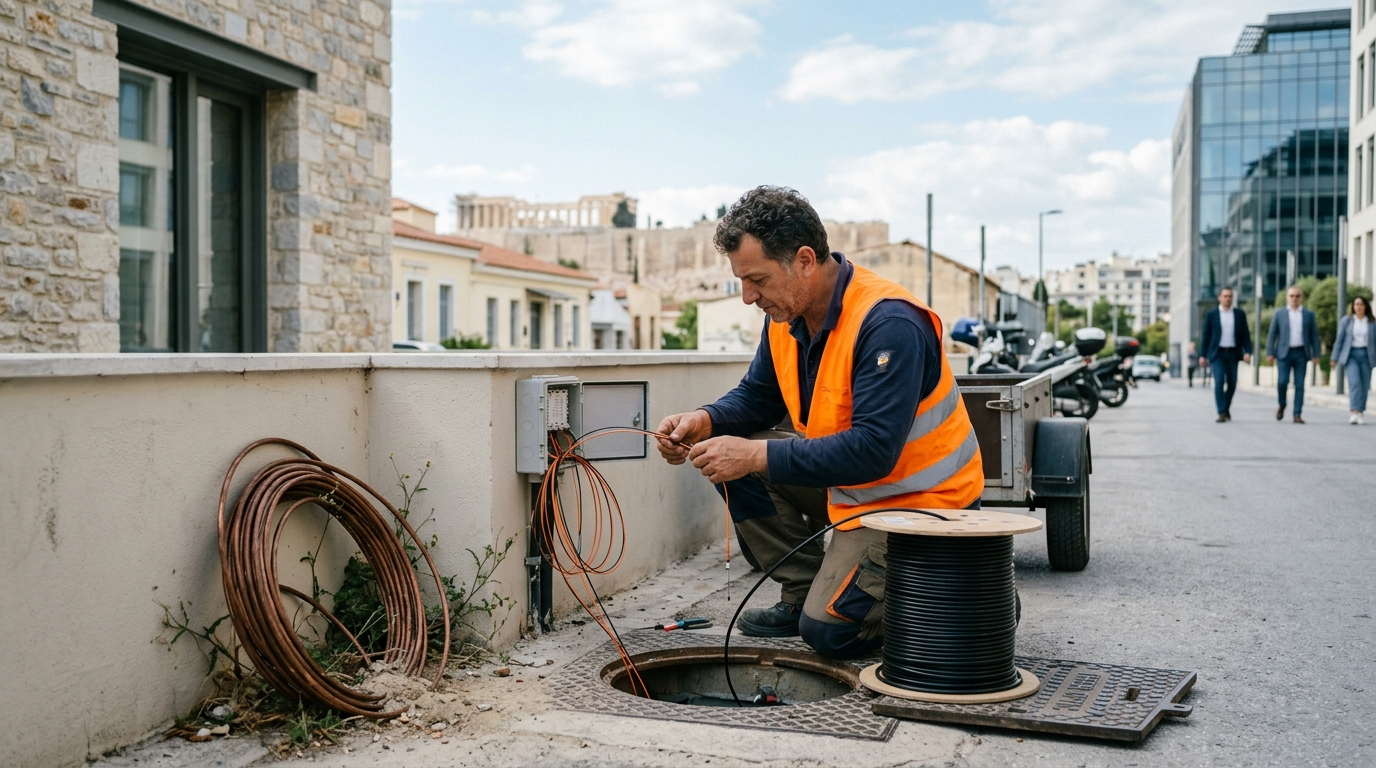
The Greek telecommunications market is at a critical turning point as traditional copper infrastructures give way to the superiority of fiber optics. Vodafone Greece's recent announcement to upgrade its subscribers to 100% fiber (Fiber to the Home - FTTH) at the same price is not merely a commercial offer; it is a strategic move with profound implications for the country's digital future.
The Strategy of the "Free" Upgrade
Vodafone's move to offer fiber speeds at no extra cost to existing customers covered by its network aims to accelerate the penetration of high-speed broadband services. For years, Greece lagged at the bottom of European indices regarding FTTH adoption, primarily due to high installation costs and the complexity of work in multi-dwelling units. By removing the financial barrier, the company seeks to "lock in" its user base to a higher-quality network while simultaneously reducing the churn rate.
This upgrade applies to subscribers in areas where Vodafone has already deployed its proprietary fiber optic network. The process involves installing fiber directly into the home, offering guaranteed speeds unaffected by distance from the exchange or the quality of old copper wiring. This translates into a radically different user experience, essential for the era of cloud computing, high-definition streaming, and remote work.
The End of Copper and Infrastructure Economics
Why would a company offer a superior service at the same price? The answer lies in operational costs. Maintaining legacy copper networks (ADSL/VDSL) is extremely expensive and energy-intensive. Copper is prone to faults from weather conditions and humidity, requiring constant technical support. In contrast, fiber optics is a passive network, far more durable, and with significantly lower maintenance costs over time.
Furthermore, Vodafone, like other providers in Greece (OTE, Nova), is pressured by the EU's 2030 Digital Decade goals. Greece must make up for lost ground, and mass user migration is the only way. This move coincides with the activation of state subsidy programs, such as the "Gigabit Voucher" and "Smart Readiness," which aim to boost demand and prepare buildings for new technologies.
Competition and Challenges in the Greek Market
Competition in the Greek telecommunications sector has intensified. OTE continues to hold the lion's share of infrastructure, while Nova is investing heavily in its own network. Vodafone, with this move, is trying to differentiate itself by focusing on value for money and simplifying the customer experience. However, challenges remain: bureaucracy in licensing for municipal excavations and the reluctance of some building managers to allow work remain significant hurdles.
- Guaranteed speed without losses due to distance.
- Increased property value for buildings with FTTH infrastructure.
- Connection stability even during peak hours.
- Reduced environmental footprint due to lower energy consumption.
In conclusion, Vodafone's initiative is a bold step toward full digital transformation. While the return on investment will take time, the strategic importance of transitioning from copper to light is indisputable. Greek consumers, who for years paid high prices for mediocre speeds, are finally beginning to see real convergence with European connectivity standards.