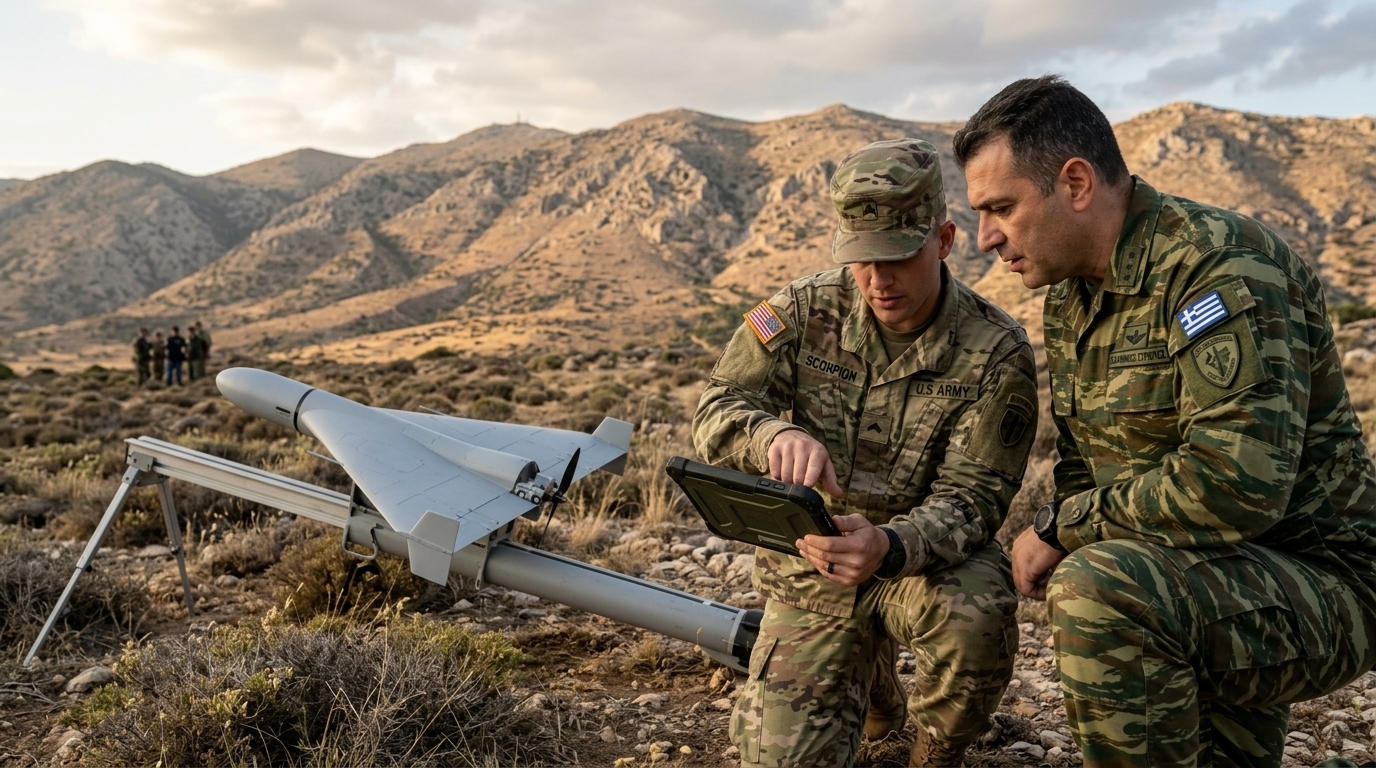
Today is Saturday, May 9, 2026, and the Greek press presents a snapshot of a nation at a critical crossroads, attempting to balance the challenges of the digital era with the persistent structural issues of its economy. The central theme dominating the headlines is the incident of the 'stray' drone, a news story that raises serious questions about airspace security and the efficacy of autonomous flight control systems in the heart of Athens.
The Mystery of the 'Stray' Drone: Security Breach or Technical Failure?
The report of a drone wandering uncontrollably over sensitive areas of the capital holds a prominent position in today's front pages. In an era where Artificial Intelligence and autonomous systems have been fully integrated into supply chains and surveillance, a 'stray' craft is not just a minor curiosity; it is a warning about the limits of our technological dominance. Reports suggest that the drone likely suffered a malfunction in its geofencing systems, allowing it to enter restricted zones without responding to authorities' commands.
This incident highlights the urgent need for a more robust U-Space framework in Greece. As 2026 sees our cities filled with delivery vehicles and research drones, the lack of a centralized Unmanned Traffic Management (UTM) system capable of digitally 'neutralizing' such threats is glaringly obvious. Security analysts point out that if such a craft could remain airborne for hours without identification, then the anti-drone systems installed at government buildings require immediate upgrades.
Economic Suffocation: Inflation and the Housing Crisis
Alongside the technological thriller, 'Naftemporiki' and 'Apogevmatini' turn their focus toward the structural problems of Greek society. Naftemporiki's headline, 'Held Hostage by High Inflation,' reflects the reality faced by households in 2026. Despite growth fueled by high-tech investments, the cost of living remains staggering, with energy and food prices failing to follow the downward trend predicted by central banks.
In the same vein, the announcement of 2,300 social housing units by the end of 2027 comes as an attempt to curb the housing crisis. While the use of AI in urban planning and property management has helped identify needs, the implementation of such infrastructure projects remains slow. Society demands solutions 'here and now,' as the digital transition seems to be leaving behind a significant portion of the population unable to cope with the new economic landscape.
The Challenge of Regulation and the Responsibility of the Press
The way the press handles the drone issue is indicative of a broader trend. There is a tendency toward dramatization, but also a substantive effort to pose questions to Civil Protection and the Ministry of Digital Governance. In 2026, news is no longer just about 'what happened,' but 'why the technology failed.' The reliability of the algorithms guiding these crafts is being called into question, and the role of journalists is to act as the bridge between technical complexity and common sense.
- The need for stricter Remote ID identification for all drones sold in the Greek market.
- Strengthening collision avoidance algorithms through collective swarm intelligence.
- Linking economic hardship with the delay in adopting automations that could lower production costs.
'Technology without control is simply a new way to create old problems,' notes one of the day's columnists, highlighting the gap between innovation and safety.
In conclusion, the front pages of May 9, 2026, remind us that the Greece of the future is already here, but it carries with it the insecurities of the past. Whether it is a drone that lost its way or an economy struggling with price hikes, the goal remains stability and transparency. Artificial Intelligence may be the tool, but human judgment remains the only valid pilot.