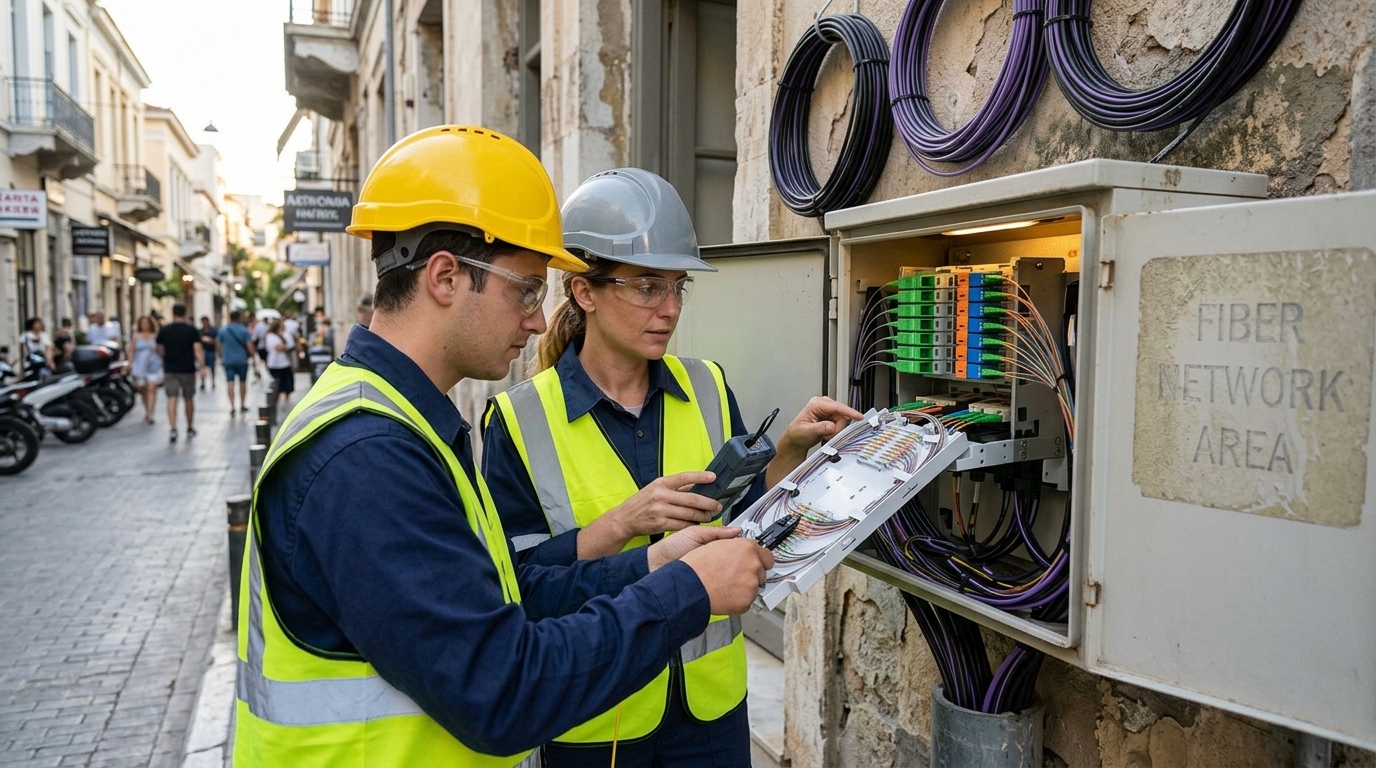
The Greek telecommunications market is at a critical turning point, as the recent announcement of the partnership between PPC (Public Power Corporation) and Vodafone Greece signals the dawn of a new era for the country's digital infrastructure. For years, OTE's dominance in fiber-to-the-home (FTTH) networks was taken for granted, with other players trailing significantly behind. However, PPC's entry through its subsidiary, Fiber Grid, is radically shifting the balance of power, creating a formidable force that aims to break the long-standing monopoly on next-generation infrastructure.
The Strategy of the 'Aerial' Revolution
PPC's primary advantage is its existing electricity distribution network. While OTE and other providers rely heavily on underground trenching—a process that is time-consuming, expensive, and often bogged down by bureaucracy—PPC Fiber Grid utilizes the poles of the electricity grid. Aerial fiber optic installation allows for rapid network deployment at a fraction of the cost of traditional methods. This model, which has been successfully implemented in other European nations, enables PPC to reach thousands of households in record time.
Vodafone, for its part, finds in PPC the ideal partner to accelerate its own digital transformation. Instead of investing billions in its own excavations, Vodafone is 'leasing' PPC's infrastructure, focusing its resources on providing innovative services and enhancing customer experience. This partnership is more than just a commercial agreement; it is a strategic choice for survival and growth in a market that demands massive capital expenditure (Capex).
Impact on Competition and the Consumer
The entry of a new wholesale player into the market is the best news the Greek consumer has had in a decade. Until now, the lack of alternative infrastructure meant that prices remained high compared to the EU average, while FTTH penetration rates were disappointing. With PPC offering wholesale access at more competitive rates, the necessary room is created for retail price reductions.
Furthermore, competition is expected to intensify not only in terms of price but also in quality. OTE, sensing the threat, is certain to accelerate its own investment plan, while Nova will also be forced to position itself within this new landscape. The result will be a faster digitalization of the country, which is a key objective of the Recovery and Resilience Facility (RRF) and the Greek government. Greece, which often ranks low in the EU's DESI indices for connectivity, now has a genuine opportunity to close the gap.
Challenges and the Regulatory Framework
Despite the optimism, the path forward is not without obstacles. The Hellenic Telecommunications and Post Commission (EETT) will play a decisive role in ensuring healthy competition. Issues regarding infrastructure access, wholesale pricing, and the prevention of practices that could lead to new market distortions are under the scrutiny of regulatory authorities. Additionally, the technical challenge of maintaining an aerial fiber network, which is more exposed to weather conditions than underground cables, remains a question that only time will answer.
In conclusion, the PPC – Vodafone partnership is a masterstroke that reshuffles the deck. PPC is transforming from a traditional energy provider into a modern infrastructure conglomerate, while Vodafone gains the 'weapons' it needed to challenge the primacy of the incumbent. For the Greece of 2026, this development may prove to be the most significant catalyst for true digital convergence with the rest of Europe.