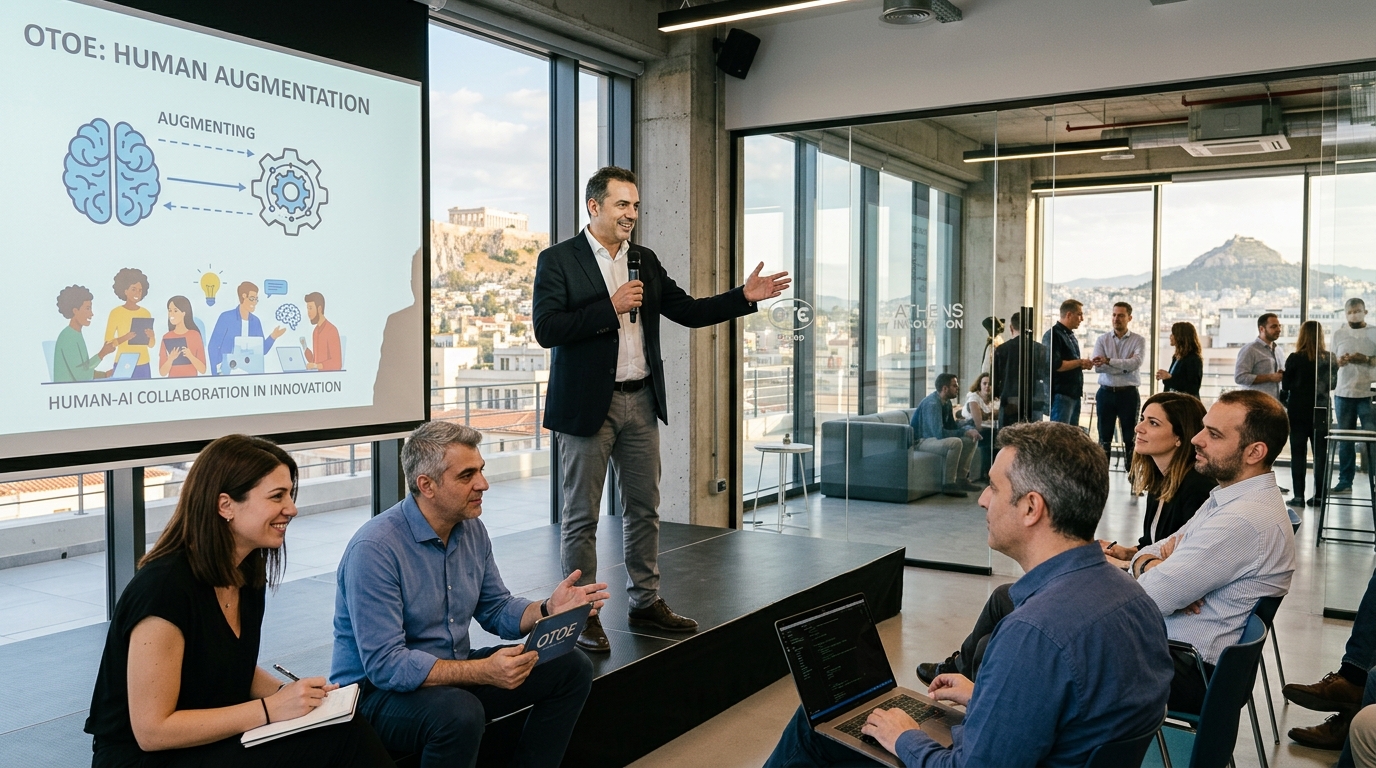
The rapid advancement of Artificial Intelligence (AI) is no longer a futuristic scenario; it is a daily reality fundamentally transforming the banking sector in Greece. In this context, the Hellenic Federation of Bank Employee Unions (OTOE) has taken a decisive stand, emphasizing that technological progress must serve as a tool to enhance human capabilities rather than a pretext for staff reductions. OTOE's intervention comes at a critical juncture, as Greek banks invest billions in digital transformation to optimize their processes.
The Human-Centric Approach to Digital Transition
For OTOE, the challenge is not to reject technology but to control its impact on labor. The Federation stresses that AI can liberate employees from repetitive, bureaucratic tasks, allowing them to focus on high-value areas such as personalized advisory services and complex relationship management. However, this transition requires a new "social contract" in the workplace.
According to the Federation's recent statement, the use of algorithms and AI systems must be governed by principles of transparency and accountability. Employees should not be treated as mere data points in a productivity equation but as the primary users and controllers of these new tools. OTOE demands employee participation in the design and implementation of AI systems, ensuring that the "machine" does not replace human judgment, especially in decisions concerning career progression or performance evaluation.
Reskilling: The Answer to the Digital Threat
A central pillar of OTOE's demands is investment in reskilling and upskilling. The Federation argues that banks have a moral and social obligation to prepare their workforce for the new digital era. Instead of voluntary exit schemes, which have weakened the branch network in recent years, OTOE proposes the creation of internal knowledge academies.
- Continuous training in new technologies for all age groups of employees.
- Protection of labor rights against algorithmic management.
- Ensuring privacy and personal data protection for workers.
- Fair distribution of productivity gains resulting from AI integration.
The Federation's concern is rooted in the fact that automation could lead to further branch closures, isolating large segments of the population, such as the elderly or residents of remote areas, who lack the necessary digital skills. The presence of the bank employee remains vital for social cohesion and the provision of quality services.
Institutional Framework and Collective Agreements
OTOE calls on the State and bank management to integrate the provisions of the European AI Act into Collective Labor Agreements. Institutional protection for workers is essential to avoid "digital despotism," where decisions are made by opaque algorithms without the possibility of challenge or human intervention.
"Technology must serve humanity, not the other way around. AI in banking can be an opportunity for a qualitative upgrade of work, provided it is not used as a tool for aggressive cost-cutting," the Federation notes.
In conclusion, OTOE's stance highlights the need for a balanced approach. Innovation is welcome, but maintaining the dignity of work and protecting employment remain non-negotiable values. The path to the future of the banking system must be a shared one for management and employees, guided by the public interest and social welfare.