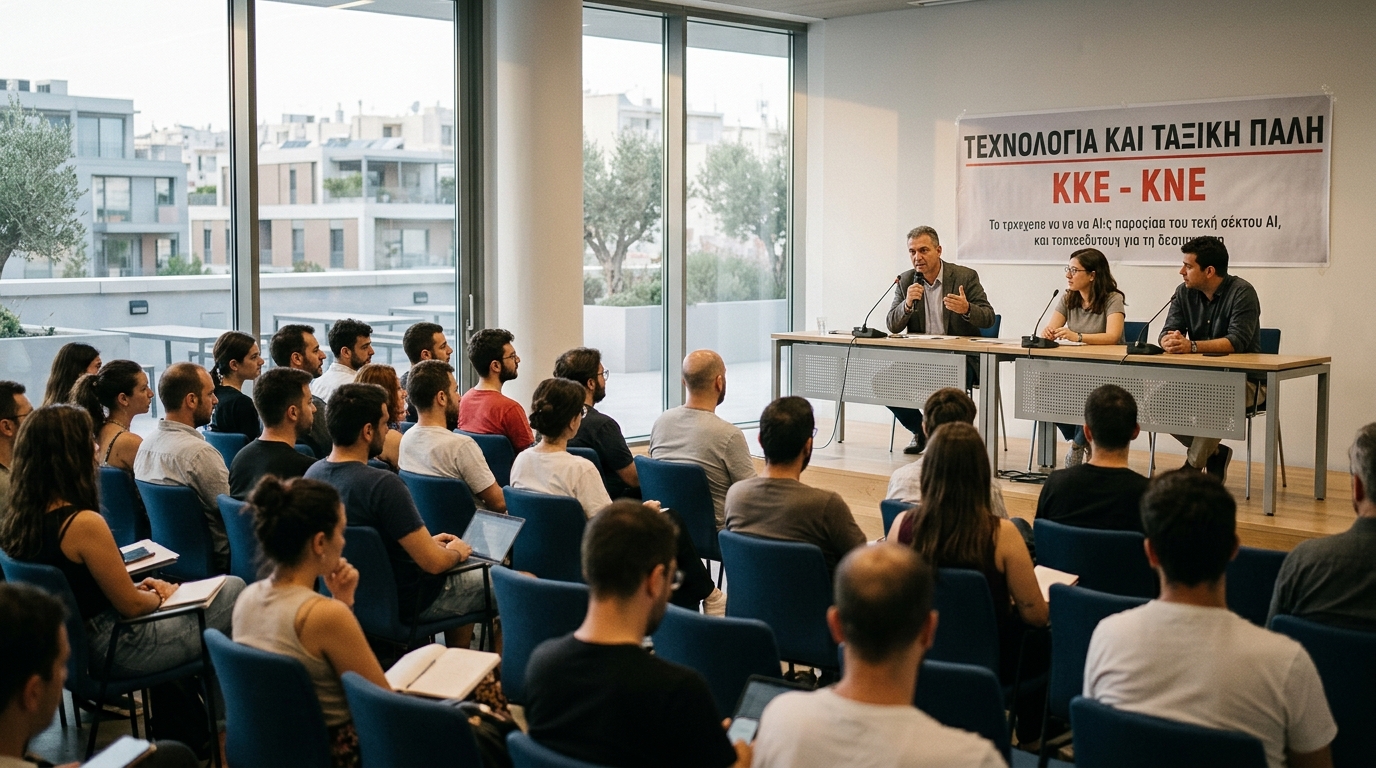
At a time when Artificial Intelligence (AI) is presented by governments and tech giants as a neutral "revolution" that will benefit all of humanity equally, the Communist Party of Greece (KKE) and the Communist Youth of Greece (KNE) are intervening with a distinct, class-based perspective. On Sunday, June 14, 2026, the Sectoral Organizations of Telecommunications and Information Technology are hosting a major political event that promises to deconstruct the dominant narrative of "digital transformation" and highlight the real impact of AI on the working class.
The Ideological Framework of Technological Evolution
For the KKE, technology does not exist in a social vacuum. Artificial Intelligence, as the most advanced means of production of our era, is firmly in the hands of large monopoly groups. The event aims to demonstrate that the development of AI under capitalist conditions is not intended to alleviate human toil, but to maximize profit through labor intensification and production cost reduction. Speakers are expected to analyze how algorithmic systems are already being used for workforce management (algorithmic management), the targeting of trade union activities, and the creation of a new generation of "digital proletarians."
"Technology is the weapon, but the hand that holds it determines the victim. Under capitalism, Artificial Intelligence is the tool for increasing the rate of exploitation," states a pre-event briefing from KNE.
The Reality for Workers in the IT Sector
The Telecommunications and IT sector in Greece is a field of intense contradictions. On one hand, the country is promoted as an emerging "tech hub" in Southeast Europe, attracting investments from giants like Microsoft and Google. On the other hand, workers in the sector—developers, network technicians, call center employees—face flexible hours, unpaid overtime, and the constant stress of "skill obsolescence" due to the rapid evolution of AI. Sunday's event will place particular emphasis on collective labor agreements and the need for workers to organize against employer arbitrariness dressed in the mantle of "innovation."
- Analysis of the impact of Large Language Models (LLMs) on code production and creative labor.
- The use of AI in surveillance and the monitoring of employees' personal data.
- The contradiction between the technological potential to reduce working hours and the reality of increased productivity for the benefit of capital.
An Alternative Proposal: Technology in the Service of the People
The event's conclusion is expected to focus on the KKE's vision for a different social organization. In an economy where the means of production and algorithms are social property, Artificial Intelligence could serve as the cornerstone of scientific central planning. This means AI would be used to forecast social needs, optimize the distribution of goods, upgrade the healthcare system, and, most importantly, drastically reduce working hours for everyone. The event on June 14 is not merely a theoretical discussion but a call to action and a demand for a future where people come before profits and algorithms serve social progress.
Conclusion: The Political Stakes of the Digital Age
As the debate over AI safety and regulation intensifies in Brussels and Washington, the KKE's initiative serves as a reminder that the most critical question remains: "Who owns the machines?" By focusing on the IT sector, the party acknowledges that the battle for labor rights in the 21st century will be fought not just in factories, but in data centers and through lines of code. The turnout and the discourse at this event will likely set the tone for the Left's strategy regarding the "Fourth Industrial Revolution" in Greece and beyond.