For decades, science fiction warned us of the day robots would replace factory workers and construction laborers. However, the reality of the mid-2020s has proven quite different. Artificial Intelligence (AI) first stormed the offices, threatening programmers, lawyers, and copywriters, while leaving—for now—plumbers, electricians, and nurses largely untouched. This phenomenon, often described as the "revenge of the blue-collar worker," highlights a fundamental hurdle in technological evolution: AI's difficulty in interacting with the unpredictable physical world.
Moravec’s Paradox and the Complexity of the Obvious
To understand why AI struggles with blue-collar tasks, we must look at Moravec’s Paradox. Hans Moravec, a robotics researcher, observed in the 1980s that high-level reasoning (like chess or statistical analysis) requires very little computation, while low-level sensorimotor skills that a human acquires in early childhood (like walking on uneven ground or picking up a fragile object) require immense computational resources.
Today, GPT-4 can draft a complex legal settlement in seconds, but a robot still struggles to distinguish a specific screw in a dusty toolbox or sense exactly how much pressure to apply to a rusted pipe without snapping it. Manual labor is not "simple"; it is a continuous exercise in real-time problem-solving where the environment is in constant flux. An accountant works in a structured environment of data. A construction worker works in a chaotic environment of matter.
Economic Pressure and the Push for Automation
Despite technical barriers, the pressure to automate blue-collar roles is intensifying, primarily due to demographic shifts. In Europe and the US, labor shortages in sectors like construction, logistics, and healthcare have reached crisis levels. In Greece, this problem is evident in the primary sector and tourism, where finding staff is becoming increasingly difficult.
This scarcity is driving a new generation of investment in robotics. Companies like Figure AI, Tesla (with Optimus), and Boston Dynamics are attempting to bridge the gap between "cerebral" AI and physical action. The goal is to create general-purpose humanoid robots capable of performing tasks in environments designed for humans. However, the cost remains prohibitive for most small and medium-sized enterprises, making human labor the most cost-effective and flexible solution for the foreseeable future.
The Greek Context and Adaptation
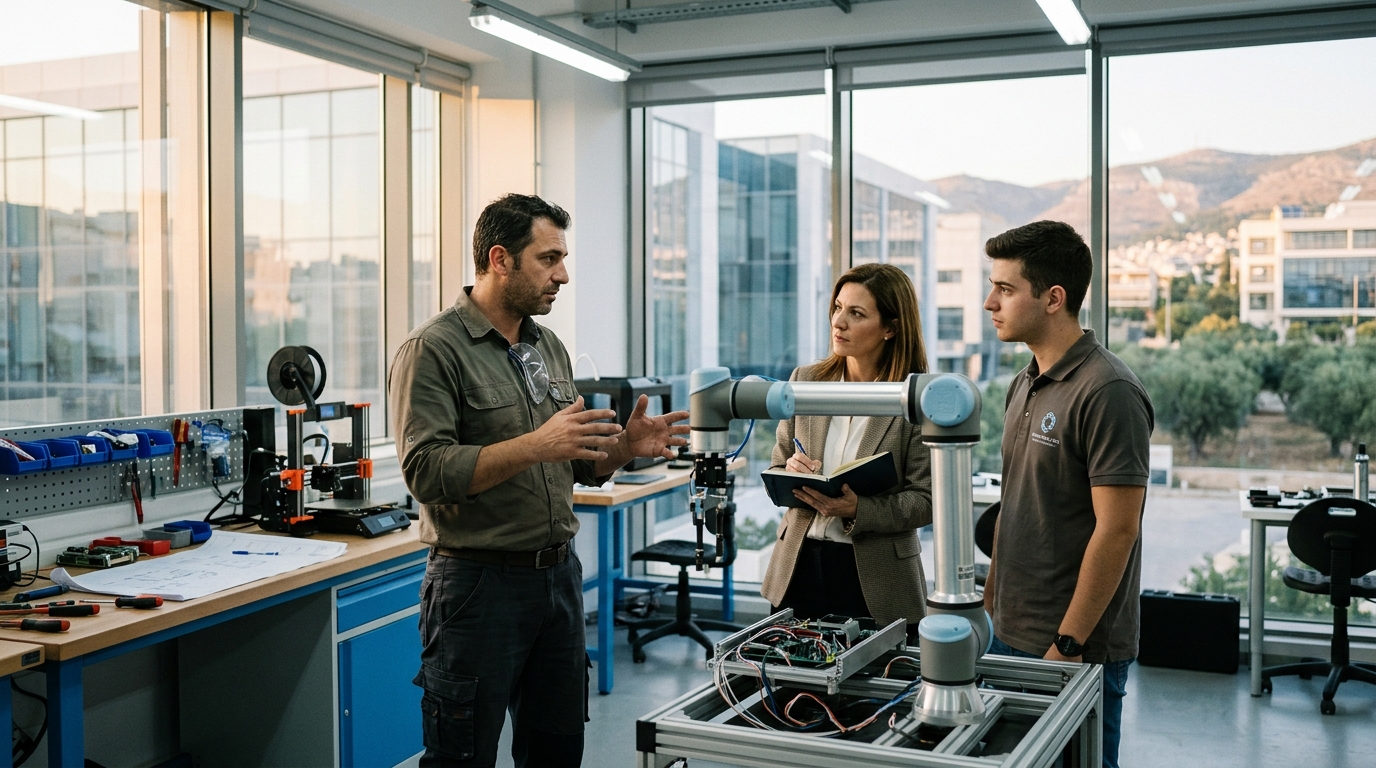
For the Greek economy, which relies heavily on services and small businesses, the AI explosion in blue-collar sectors might seem distant, but its effects are already here. The digitization of the supply chain and the use of drones in precision agriculture are the first steps. The real challenge, however, lies in upskilling. The "craftsman of the future" in Greece will not just be someone who knows a trade, but an operator of advanced systems that enhance their physical strength and precision.
- Integration of AI into wearable devices (exoskeletons) to protect workers from injury.
- Use of Augmented Reality (AR) to guide technicians in remote or complex repairs.
- Automation of logistics in Greek ports, which serve as critical gateways to Europe.
"Technology isn't coming to abolish manual labor, but to liberate it from danger and repetitive drudgery," market analysts suggest.
Conclusion: The Value of the Human Touch
As AI conquers the world of information, the physical world remains the final frontier. Blue-collar workers are no longer the lower rung of the economy; they are the gatekeepers of skills that machines cannot yet replicate: empathy and adaptability. The challenge for the coming years will not only be how to replace manual labor, but how to use technology to make it safer, more efficient, and ultimately, more dignified.