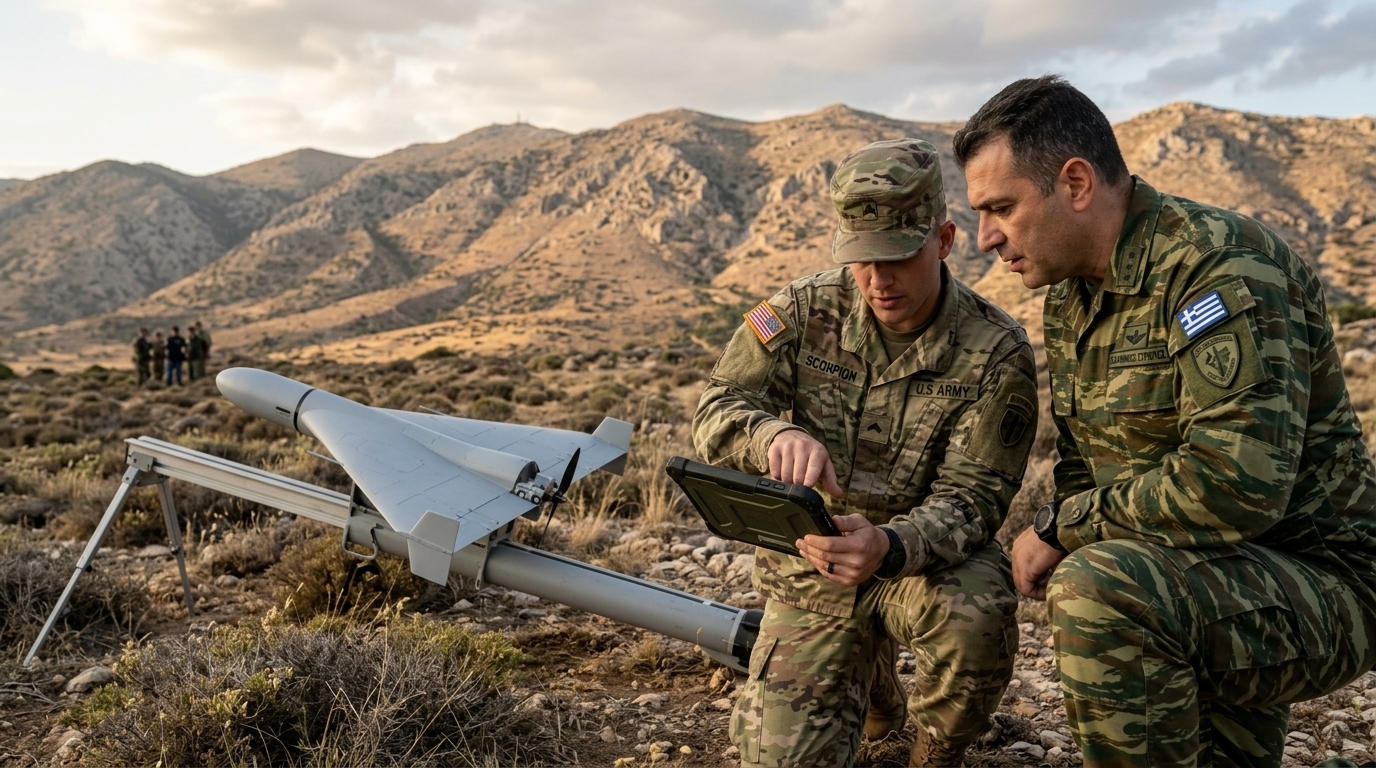
In an era where the boundaries between peace and war are becoming increasingly blurred, Artificial Intelligence (AI) is emerging as the ultimate catalyst for hybrid warfare. As strategic analyst Konstantinos Balomenos points out, the integration of AI into destabilization strategies is no longer a science fiction scenario but a living, daily threat to modern democracies. Hybrid warfare, which combines conventional means with unconventional methods—such as disinformation, cyberattacks, and economic pressure—finds in AI a powerful force multiplier.
The Digital Erosion of Truth: Deepfakes and Cognitive Warfare
The most immediate and visible application of AI in hybrid warfare is the manipulation of public opinion through so-called "cognitive warfare." The use of sophisticated algorithms to create deepfakes—realistic but fake video and audio files—allows hostile actors to manufacture crises from scratch. Imagine a video of a political leader declaring war or admitting to an economic collapse just hours before polls open. The speed at which this information spreads via social networks makes debunking it almost impossible before irreparable damage is done to social cohesion.
Furthermore, AI enables the mass production of personalized propaganda. Instead of generic messages, algorithms analyze the data of millions of users to send the right lie to the right person, exploiting their biases and fears. This is not just propaganda; it is the industrialization of dissent, aimed at weakening a state's internal front without a single shot being fired.
Automated Cyberattacks and Critical Infrastructure
Beyond communication, AI upgrades the capabilities of cyberattacks. Traditionally, an attack on critical infrastructure—such as the power grid or the healthcare system—required time and specialized personnel. Today, AI can automatically scan thousands of systems for security vulnerabilities, adapt virus code in real-time to evade detection, and execute attacks with surgical precision.
- Autonomy: AI-based malware can make decisions on its own, selecting the target that will cause the most chaos.
- Scalability: A single attacker can manage thousands of simultaneous attacks, exhausting the defensive capabilities of the target state.
- Anonymity: The use of AI makes attribution extremely difficult, allowing rogue states to operate in the shadows.
For Greece, located in a geopolitically sensitive region, these threats are not theoretical. Protecting energy pipelines, ports, and state digital services now requires an "active defense" also based on Artificial Intelligence.
The Strategic Response: From Reaction to Prevention
Countering AI-driven hybrid warfare requires a radical paradigm shift. As Balomenos emphasizes, national security can no longer be limited to physical borders. It requires the creation of a "digital shield" involving cooperation between the state, academia, and the private sector. The European Union and NATO are already investing in centers of excellence to counter hybrid threats, but technological evolution is moving faster than bureaucracy.
"Artificial Intelligence in hybrid warfare is not just a new tool; it is a new environment in which all future conflicts will be conducted."
Educating citizens in critical thinking and digital literacy is perhaps the most important weapon. If a society learns to recognize manipulation, the value of AI as a weapon decreases dramatically. At the same time, developing domestic AI systems for deepfake detection and network protection is the only way to ensure sovereignty in the 21st century. The war of the future will not be judged only by who has the most tanks, but by who possesses the smartest algorithms and the most resilient society.