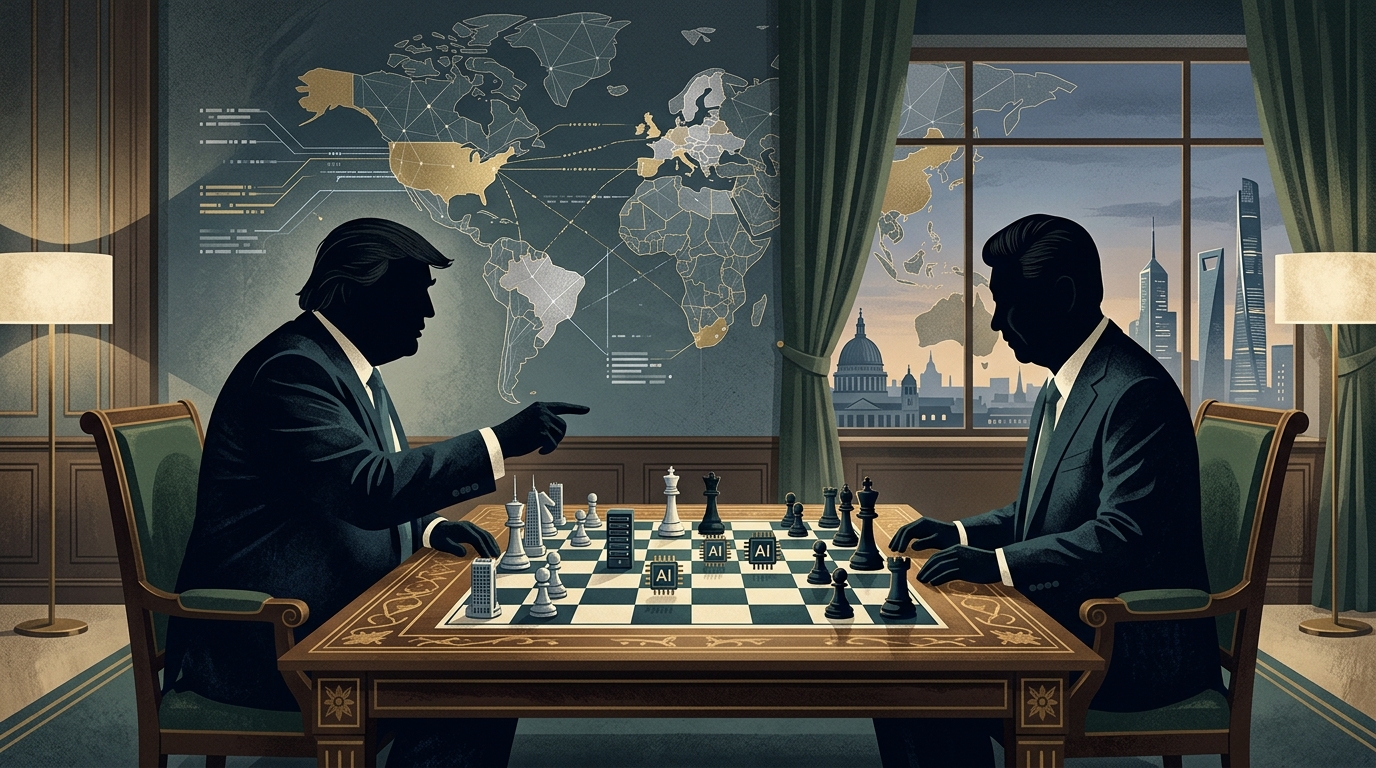
In the modern global arena, Artificial Intelligence (AI) is no longer merely a tool for economic growth; it has become the central pillar of national security and geopolitical influence. The confrontation between Donald Trump and Xi Jinping over the control of this technology is emerging as the most defining conflict of the 21st century. As the AI landscape shifts rapidly, these two leaders are forced to balance technological innovation with the necessity of strategic control.
The Return of Hard Power: Silicon as a Weapon
For Washington, the strategy remains consistent but is intensifying: maintaining a technological lead through strict export controls on semiconductors and chip-making equipment. Donald Trump, faithful to the "America First" doctrine, views AI as a field where retreat is not an option. His rhetoric focuses on the decoupling of supply chains from China to ensure that American intellectual property does not fuel Beijing's military modernization.
On the other side, Xi Jinping has made "technological self-reliance" a top national priority. Beijing is investing billions into its "New Quality Productive Forces" program, seeking to leapfrog the hurdles set by American sanctions. For China, AI is the key to overcoming its demographic crisis and establishing a new form of social control and economic efficiency.
Regulatory Chaos vs. State Control
One of the fundamental differences in the approach of the two superpowers lies in the regulatory framework. In the US, the debate revolves around the need for deregulation to avoid stifling the speed of innovation. Trump has repeatedly criticized restrictions imposed by international bodies, viewing them as a "drag" on American hegemony. His philosophy is simple: the fewer obstacles American companies (like NVIDIA and OpenAI) face, the faster they will win the race against China.
In contrast, China implements a strict model of "government oversight." AI must align with the values of the Communist Party. This creates a paradox: while China possesses vast amounts of data and state funding, ideological control may limit the creativity of algorithms, especially in Generative AI, where machine responses must be "politically correct" by Beijing's standards.
"Artificial Intelligence is not just an industrial revolution; it is the redistribution of global sovereignty in digital form."
The Battle for Talent and Energy
Beyond code and chips, the conflict extends to two other critical areas: human capital and energy. The US remains the top destination for the world's leading scientists, but the strict immigration policies often accompanying Trump's rhetoric could be a double-edged sword. China, for its part, is attempting to repatriate its own scientists working in the West by offering massive incentives.
Furthermore, AI requires colossal amounts of energy. The battle for AI supremacy is now inextricably linked to energy policy. The country that manages to power its massive data centers with cheap and reliable energy will have the upper hand. Here, China has an advantage in renewable energy production, while the US relies on its abundance of natural gas and a resurgence in nuclear power.
Conclusion: One World, Two Systems?
The Trump-Xi confrontation is not just about who will have the fastest computer. It is about which model of governance will prevail in the digital century. Will we have a world divided into two technological blocs—one Western and one Sino-centric? The answer will depend on whether the two leaders can find a minimum common ground for AI safety, or if the pursuit of absolute dominance will lead to an irreversible rupture, with unpredictable consequences for global stability.