In the tech hubs of Beijing and Shenzhen, Artificial Intelligence is no longer a futuristic promise but a daily reality permeating every facet of social and economic life. China, serving as the planet's largest testing ground, is embracing AI at a pace that far outstrips Western economies. This rapid integration is not merely about technological supremacy; it is a strategic maneuver that may define global standards for decades to come.
The Power of Data and the Super-App Ecosystem
China's greatest advantage in the global AI race is its vast reservoir of data. With a population of over 1.4 billion people who are fully integrated into digital life, the volume of data generated daily is inconceivable by Western standards. So-called "Super-Apps," such as Tencent's WeChat and Ant Group's Alipay, serve as central hubs where users pay, communicate, book medical appointments, and manage investments within a single interface.
This concentration of activity allows Chinese giants like Baidu and Alibaba to train their models in real-world conditions with a level of precision that Silicon Valley competitors often struggle to match, hampered by stricter data protection regulations (like GDPR) and market fragmentation. The result is an AI ecosystem deeply tailored to mass consumption and industrial production, positioning China as a beacon for developing nations seeking efficient automation solutions. The feedback loop between user behavior and algorithmic refinement is shorter and more intense here than anywhere else on Earth.
State Strategy and the 2030 Mandate
Behind the entrepreneurial momentum lies the firm hand of the Chinese state. The "New Generation Artificial Intelligence Development Plan," announced by Beijing, sets a clear objective: for China to become the world's primary AI innovation center by 2030. The government does not act simply as a regulator but as the lead investor and primary customer. From smart policing and traffic management to diagnostic systems in public hospitals, the state provides the necessary "sandbox" to test new technologies at a scale of millions.
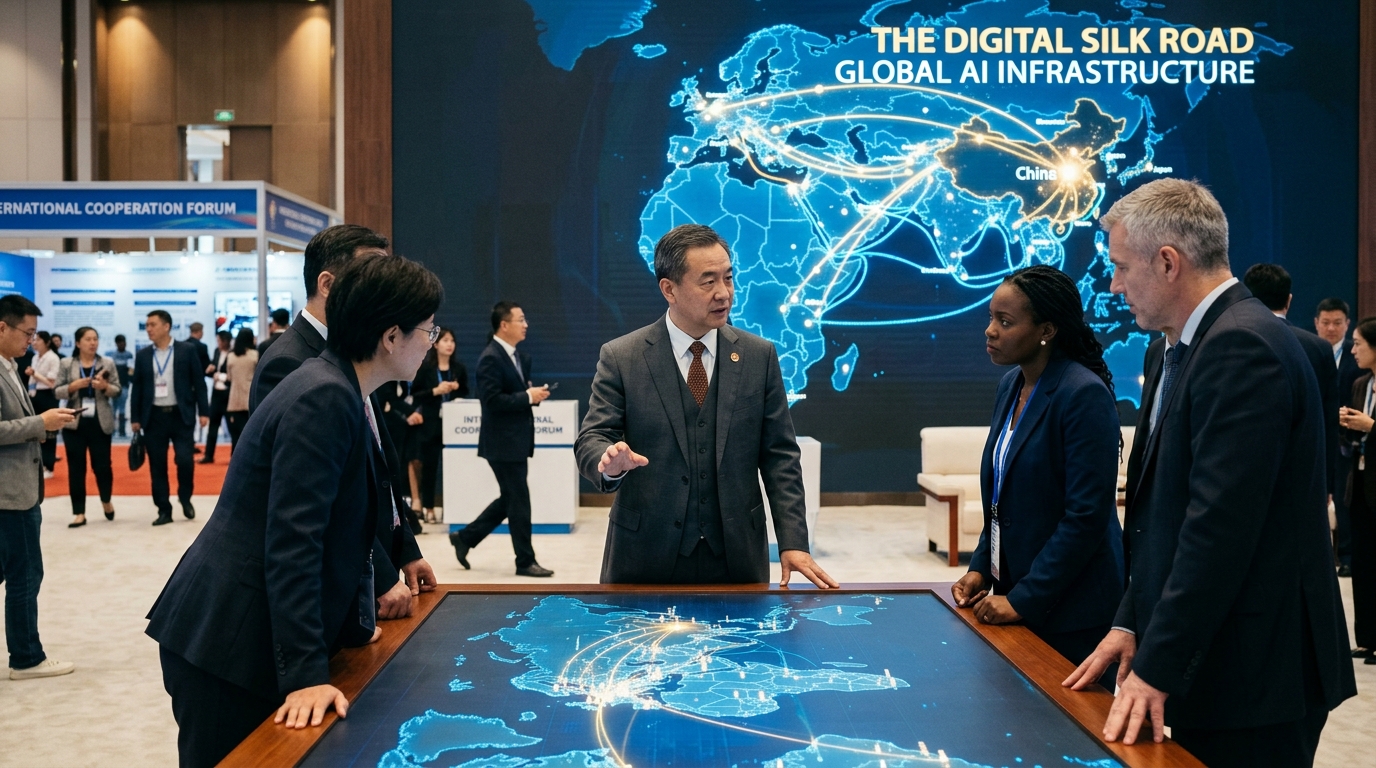
However, this tight state-tech nexus raises profound questions. The deployment of AI for surveillance and the social credit system represents the darker side of this progress. While the West debates "AI Ethics" and implements guardrails, China moves straight to implementation, prioritizing social stability and economic efficiency. This model of "authoritarian innovation" is now being exported to countries across Asia, Africa, and Latin America via the "Digital Silk Road," creating a new sphere of influence built on Chinese code and hardware architecture.
Geopolitical Competition and the Semiconductor Bottleneck
China's rapid ascent has not gone unnoticed. The United States, recognizing the threat to its technological hegemony, has imposed stringent restrictions on the export of advanced semiconductors and lithography equipment to China. The logic is straightforward: without high-end chips from the likes of Nvidia or AMD, training Large Language Models (LLMs) becomes exponentially more difficult and costly.
Nevertheless, China has demonstrated a remarkable capacity for adaptation. Companies like Huawei are investing billions into domestic processor development, while the industry as a whole is pivoting toward algorithmic optimization—making models perform better on less powerful hardware. This "chip war" has effectively bifurcated the world into two camps, with Europe attempting to balance the security of the US alliance against the economic necessity of the Chinese market. The outcome of this struggle will determine whether we maintain a unified global internet or retreat into a "Splinternet," where technological infrastructures are fundamentally incompatible.
Implications for the Global Future
The China experience teaches us that AI does not develop in a vacuum; it is shaped by political and cultural environments. While the West may still lead in foundational research and "big idea" innovation, China dominates in application and scaling. If AI is the "new electricity," then China is the nation building the grid that will power the 21st century.
For the rest of the world, monitoring the Chinese experiment is essential. Beijing's successes and failures will serve as the roadmap for global technology regulation. Whether it is the automation of manufacturing or the use of AI in personalized education, the data emerging from the Chinese market is invaluable. The challenge for the international community is to find a mode of engagement that ensures AI progress benefits humanity as a whole, without sacrificing fundamental freedoms on the altar of efficiency. The world is watching, not just because China is a competitor, but because it is a mirror of what our own automated future might look like.