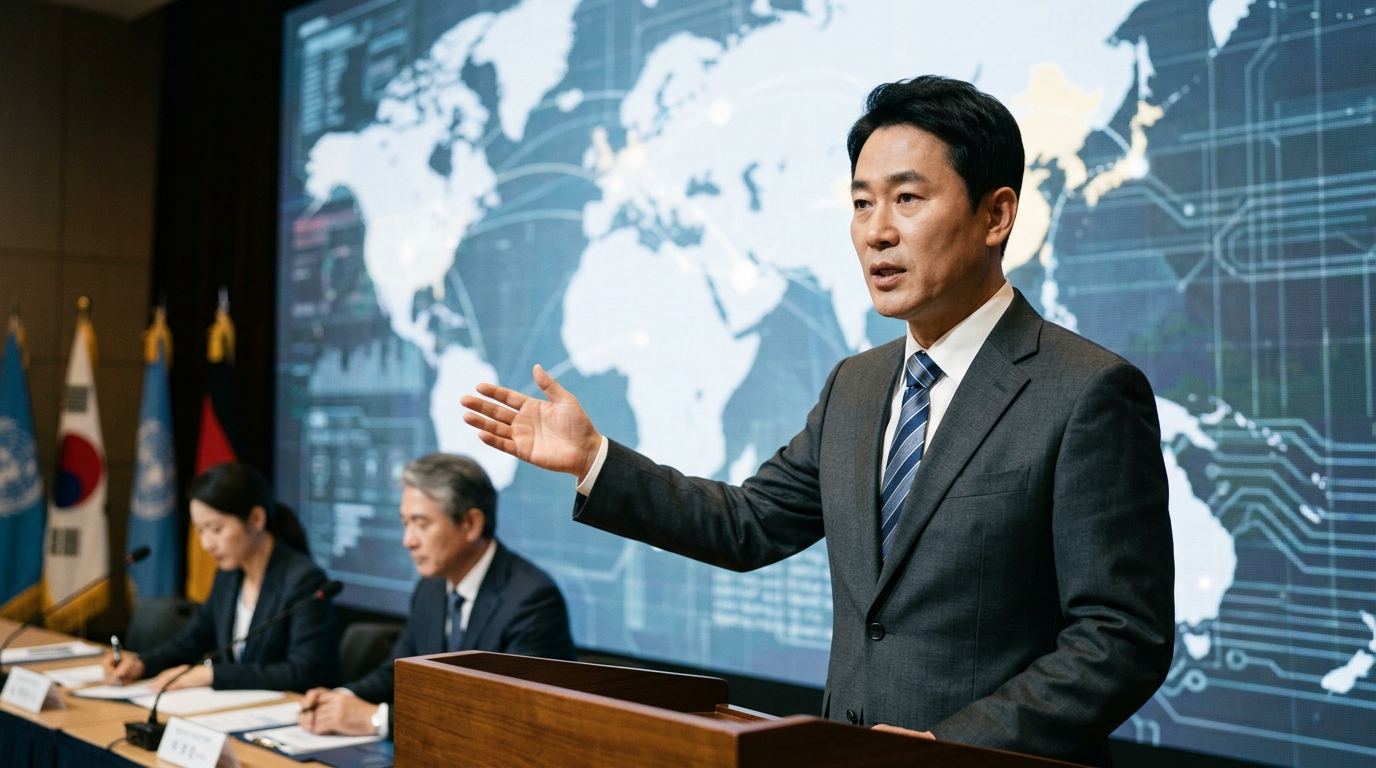
In the heart of East Asia, a new geopolitical reality is being forged, not with weaponry, but with transistors and high-speed memory modules. South Korea, under the leadership of President Yoon Suk Yeol, has unveiled the most ambitious technological roadmap in history: the creation of a "Semiconductor Mega Cluster" in Gyeonggi Province, backed by total investments of 622 trillion won (approximately $576 billion) through 2047. This move is far more than a corporate expansion; it is a national survival strategy in an era where Artificial Intelligence (AI) is the new "black gold."
The Gyeonggi Giant: An Unprecedented Ecosystem
The roadmap outlines the construction of 13 new semiconductor fabrication plants (fabs) and three research facilities, augmenting the 21 fabs already operational in the region. Samsung Electronics and SK Hynix, the twin pillars of the Korean economy, are spearheading the financial commitment. Samsung plans to deploy 360 trillion won to build six new units in Yongin, while SK Hynix has committed 122 trillion won for four fabs in the same district.
The government's objective is for South Korea to capture 10% of the global system semiconductor market (non-memory chips) by 2030, up from its current 3% share. Simultaneously, Seoul aims to cement its absolute dominance in High Bandwidth Memory (HBM)—the specialized silicon essential for training Large Language Models (LLMs) like GPT-5 and beyond.
The HBM War and the TSMC Rivalry
For decades, South Korea was the undisputed king of DRAM. However, the advent of Generative AI has rewritten the rulebook. SK Hynix managed to seize the early lead, becoming the primary supplier for Nvidia’s HBM3E chips, leaving Samsung in the uncharacteristic position of playing catch-up. These new investments are specifically designed to reclaim that lost ground and secure the future of AI infrastructure.
Yet, the real challenge isn't just domestic. Taiwan’s TSMC remains the titan of the foundry business, controlling over 60% of the market. South Korea is attempting to build a vertically integrated model where it can offer both processing power and memory in a single package, providing "one-stop shop" solutions for Silicon Valley’s tech giants.
Geopolitical Security and the "Silicon Shield"
Beyond the balance sheets, the Mega Cluster serves as a geopolitical fortress. Amidst the escalating tech-war between the United States and China, Seoul is positioning itself to be indispensable to both. While South Korea aligns with US-led restrictions on advanced technology exports to Beijing, China remains its largest trading partner. This balancing act is delicate.
The creation of the world’s largest chip production hub functions as a "Silicon Shield." The global economy would grind to a halt without Gyeonggi’s output, granting South Korea diplomatic leverage that far exceeds its military footprint. President Yoon has explicitly stated that semiconductors are a "national security issue," equating chip supremacy with the nation's very survival.
Challenges: Energy, Water, and Talent
Despite the grand vision, the path to $576 billion is fraught with obstacles. Operating such a massive industrial complex requires astronomical amounts of electricity and water. The government plans to rely heavily on nuclear energy to meet these demands—a decision that remains politically sensitive. Furthermore, a chronic shortage of specialized labor looms, with the country needing an estimated 30,000 high-level engineers over the next decade to staff the new facilities.
In conclusion, South Korea is not merely chasing economic growth. It is engaged in an existential race to control the infrastructure of future intelligence. If this gamble pays off, Seoul will become the ultimate gatekeeper of the digital age. If it falters, it risks being relegated to a mere subcontractor in a global supply chain dominated by others.