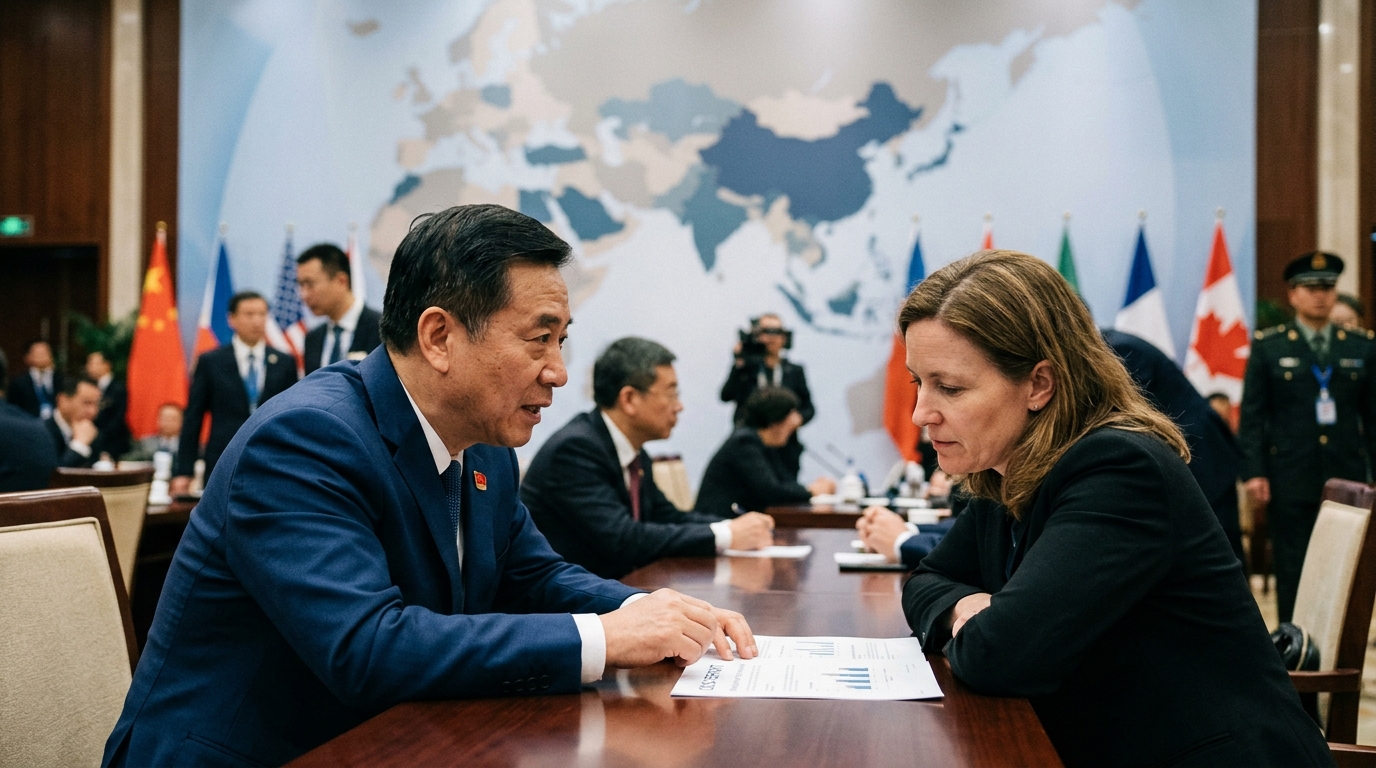
At the dawn of 2026, the global chessboard is no longer defined solely by oil reserves or control over maritime routes. A new form of power has emerged, more abstract yet equally decisive: computational power. "AI Diplomacy" has become the central pillar of national strategy for major powers, as a nation's ability to host massive data centers and produce advanced semiconductors translates directly into economic and military superiority.
Recent movements, as documented by international analysts and financial publications like Fortune, highlight an aggressive shift. Governments from Europe and the Middle East to Southeast Asia are offering land, resources, and billions in subsidies to attract the "knights" of the new era: Nvidia, Microsoft, Amazon, and TSMC. These are not merely investments; they represent an effort to secure what experts call "Compute Sovereignty."
The Rise of "Compute Nationalism"
For decades, technology was viewed as a globalized commodity. Today, we are witnessing the return of a unique form of protectionism. The United States, through the CHIPS and Science Act, has laid the groundwork for reshoring semiconductor production, fearing a potential crisis in Taiwan. China, for its part, is investing astronomical sums to bypass Western restrictions on AI graphics cards, creating a parallel ecosystem.
However, the game is not just for the two giants. Nations like the United Arab Emirates and Saudi Arabia are utilizing their Sovereign Wealth Funds to transform into global AI hubs. Their strategy is twofold: they purchase thousands of H100 chips while simultaneously building cloud infrastructures to serve the entire Global South. For these countries, AI is the vehicle to diversify away from fossil fuels.
Data Centers: The New Cathedrals of the Economy
If semiconductors are the brain of the new economy, data centers are its body. Constructing a modern AI data center is no longer a simple building project; it is a project of national importance requiring vast amounts of energy and water for cooling. This creates a new diplomatic tension: the quest for "green" energy. Countries with a surplus of renewable energy sources, such as Iceland, Norway, and Greece in the Eastern Mediterranean, are becoming attractive destinations.
Greece, for instance, is attempting to position itself as an energy and telecommunications hub. Attracting investments from giants like Microsoft and Google to create regions in Attica has not only an economic impact but a geopolitical one as well. The presence of critical data on Greek soil upgrades the country's importance within the digital architecture of the European Union.
The Risks of Digital Dependency
Despite the excitement, "AI Diplomacy" harbors traps. Over-reliance on a few American corporations for cloud infrastructure raises questions regarding data privacy and national security. What happens if a private company decides to cut off access to critical AI models due to a political disagreement between states? This scenario, once seemingly science fiction, is now a tangible risk on the tables of Ministries of Foreign Affairs.
Furthermore, the competition for chips is creating a new hierarchy of nations. Countries that lack the financial capacity to subsidize such infrastructure risk being permanently left behind in a state of "digital colonialism," where they export their raw data and import AI as an expensive finished product.
Conclusions for the Future
Global AI diplomacy will continue to intensify. By the end of the decade, a state's power will be measured in Petaflops and Gigawatts. The challenge for Europe and Greece is to find the balance between attracting foreign investment and developing domestic capabilities. Artificial Intelligence is not just a productivity tool; it is the new language of international politics, and those who do not speak it risk being left on the sidelines of history.