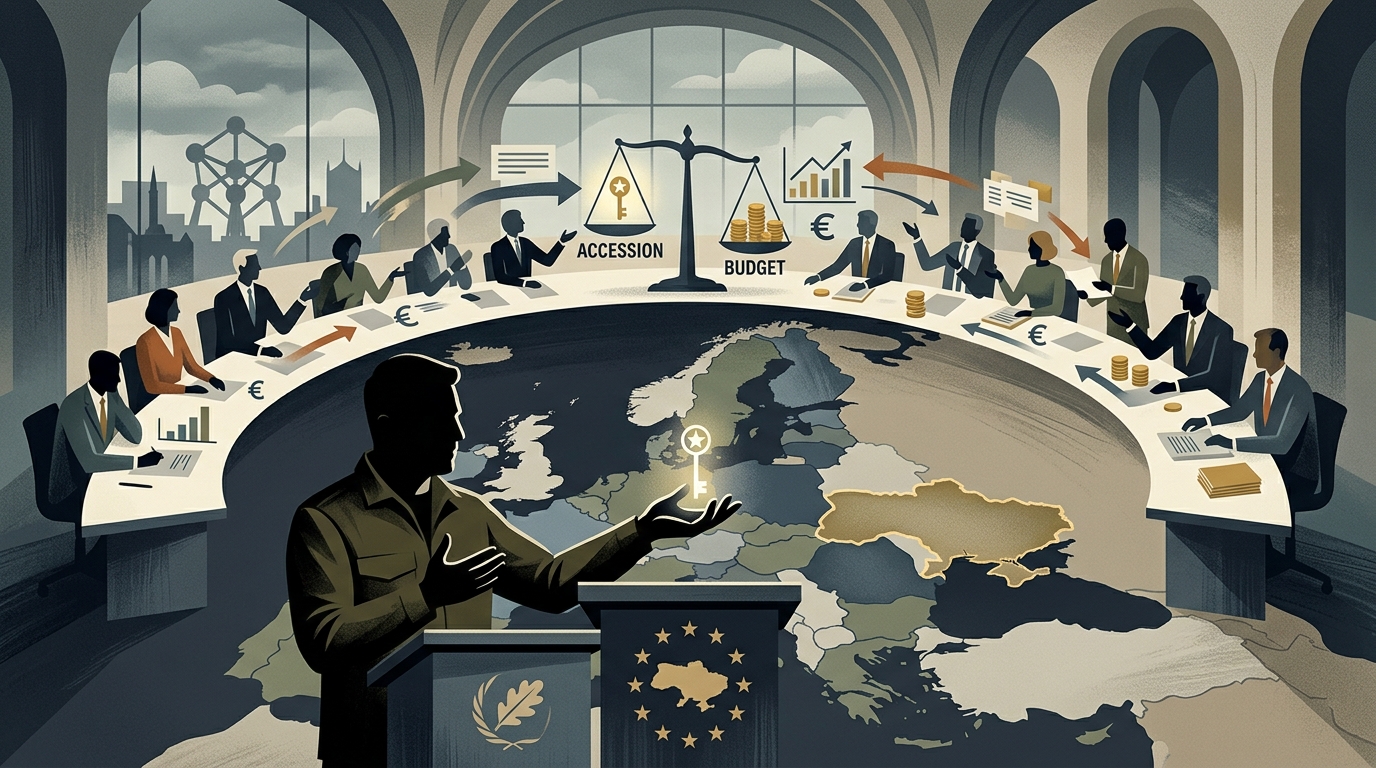
In Brussels, where bureaucracy meets high strategy, the atmosphere during the current June 2026 Summit is more than electric. Ukrainian President Volodymyr Zelenskyy, in another intervention that combined passion with raw political pressure, called for a "fast-track" process for his country's accession to the European Union. However, behind the closed doors of the leaders' dinner, the discussion was not limited to symbolism but extended to the hardest currency of politics: the Multiannual Financial Framework (MFF).
The Ukrainian Pressure and the Enlargement Dilemma
Zelenskyy is no longer just asking for weapons; he is asking for institutional shielding. His rhetoric is based on the argument that Ukraine constitutes the eastern bulwark of European democracy and, therefore, the traditional pace of the accession process is inadequate for these extraordinary circumstances. "We cannot wait a decade while our citizens die for European values," was the message that resonated through the room.
However, the "fast track" envisioned by Kyiv is hitting walls. Member states like France and Germany, while supportive in words, express concerns about the destabilization of the internal market and the EU's absorptive capacity. The accession of a country with the size and reconstruction needs of Ukraine would require a radical restructuring of common policies, particularly the Common Agricultural Policy (CAP), something that strikes fear into the hearts of Western European farmers.
The Battle for the Multiannual Financial Framework
Today, attention turns to the Multiannual Financial Framework, the EU's long-term budget. The "battle" is expected to be fierce. On one side, the "frugals" of the North insist on fiscal discipline, refusing to increase their national contributions. On the other, frontline countries and the South are calling for more funds for defense, the green transition, and, of course, continued support for Ukraine.
The question hanging over the negotiating table is simple but relentless: Who will pay the bill? The proposal for issuing new common debt, following the model of the Recovery Fund, remains a "red flag" for some capitals, despite the pressure exerted by the European Commission. The awkwardness is heightened by revelations of "open channels" of communication between some European governments and Moscow, a reality that undermines the image of a solid front that Brussels is trying to project.
Geopolitical Balances and the "Shadow" of Moscow
The reference to communication channels with the Kremlin caused intense discomfort. While the EU officially maintains sanctions, the need for energy security and war fatigue have led to behind-the-scenes contacts. This double game makes Zelenskyy's position even more difficult, as he realizes that European solidarity also has its limits, especially when it touches the pockets of European taxpayers.
In conclusion, this Summit is not just about Ukraine. It is about the very identity of the European Union in the 21st century. Will it remain an economic giant with geopolitical feet of clay, or will it dare to take the great leap towards a federal structure capable of managing crises of this magnitude? The answer will be judged in the details of the budget figures and the willingness of leaders to look beyond the next election cycle.
- Ukraine's request for fast-track accession divides the EU between moral obligation and economic reality.
- The Multiannual Financial Framework is the battlefield for the priorities of the next five years.
- The existence of communication channels with Moscow is causing tremors in European unity.
- Defense and reconstruction require resources that the EU is struggling to find without new borrowing.