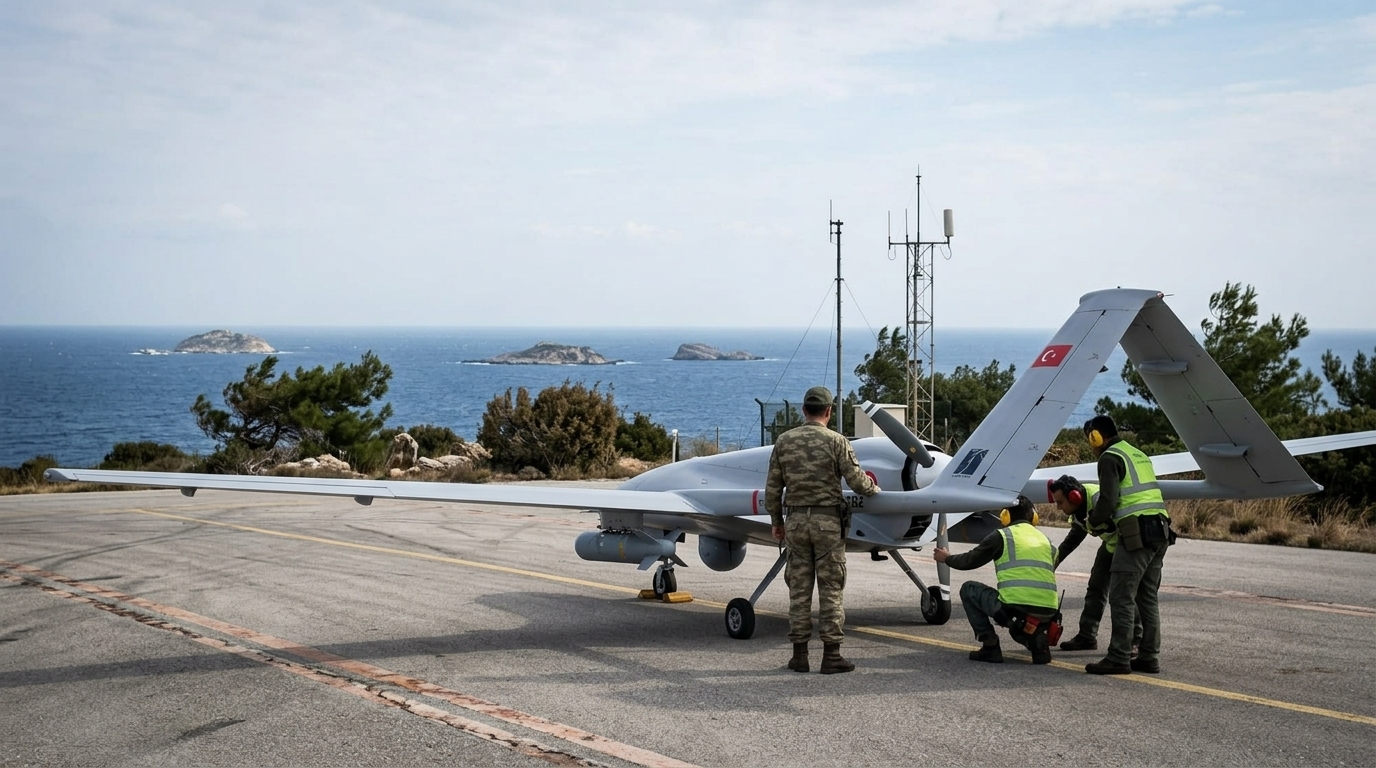
The relative calm in the Archipelago, though superficially maintained through diplomatic channels, is once again being tested by the "silent" presence of technology. On Thursday, May 14, 2026, a Turkish Unmanned Aerial Vehicle (UAV) conducted four violations of national airspace and one infringement of Athens FIR air traffic rules, focusing its activity in the Southeastern Aegean. While military analysts categorize this incident as "low intensity," it underscores Ankara's ongoing strategy of maintaining its claims through the deployment of autonomous systems.
The Transition from Fighter Jets to Drones
For decades, the confrontation in the Aegean was characterized by the costly and dangerous interceptions of F-16 fighter jets. However, in recent years, we have witnessed a clear shift toward the use of unmanned systems. Turkey, having invested heavily in its domestic defense industry with programs like the Bayraktar TB2 and Anka, now utilizes these assets to conduct reconnaissance missions and challenge the boundaries of the Athens FIR. The operational cost of a drone is a fraction of that of a fighter jet, and the risk of loss of life is eliminated, allowing Ankara to maintain a persistent presence over the Aegean without the political risk of a kinetic engagement.
On the other hand, the Hellenic Air Force faces a new equation. Intercepting a drone with an expensive Rafale or F-16 Viper represents an asymmetric economic burden. Consequently, Athens has accelerated the enhancement of its own capabilities in the drone and anti-drone sectors, seeking to balance the situation without exhausting its resources in a perpetual pursuit of "ghosts."
The Legal and Diplomatic Labyrinth
The issue of violations is not merely military but deeply legal. Turkey refuses to recognize the 10-nautical-mile Greek airspace, accepting only the 6 miles that coincide with territorial waters. This 4-mile discrepancy is the primary theater of friction. Furthermore, Ankara systematically ignores the obligation to submit flight plans for its state aircraft (including drones) within the Athens FIR, arguing that the Chicago Convention does not apply to military operations.
The timing of the incident is also noteworthy. Despite the fact that both countries signed the "Athens Declaration on Friendly Relations and Good-Neighbourliness" in December 2023, such actions indicate that the "Blue Homeland" (Mavi Vatan) doctrine remains a central pillar of Turkish foreign policy. The use of drones allows Turkey to create "grey zones" without triggering the immediate international condemnation that a manned fighter jet overflight of an inhabited island would provoke.
Strategic Implications and NATO
Instability on NATO's southeastern flank remains a persistent headache for Brussels and Washington. At a time when the Alliance is striving to appear unified against challenges from Eastern Europe, Greco-Turkish frictions act as a drag. The international community often maintains an equal-distance stance, which causes frustration in Athens, which cites International Law and the Law of the Sea (UNCLOS).
However, Greece is not standing still. The acquisition of Belharra frigates and the upgrade of the F-16 fleet, combined with strengthened defense cooperation with the US and France, create a robust deterrent web. The message is clear: technological prowess in drones cannot substitute for the overall military balance. The challenge for the future lies in managing these "minor" incidents so they do not become the spark for a larger crisis in a region already inflamed by geopolitical shifts.
Conclusion
The four violations by the Turkish drone may not be front-page news globally, but for Aegean security, they serve as a reminder that peace requires constant vigilance. Technology changes the means, but geographical and historical realities remain constant. Diplomacy must keep pace with technological evolution, creating rules that prevent the weaponization of autonomous systems as tools of pressure and destabilization.