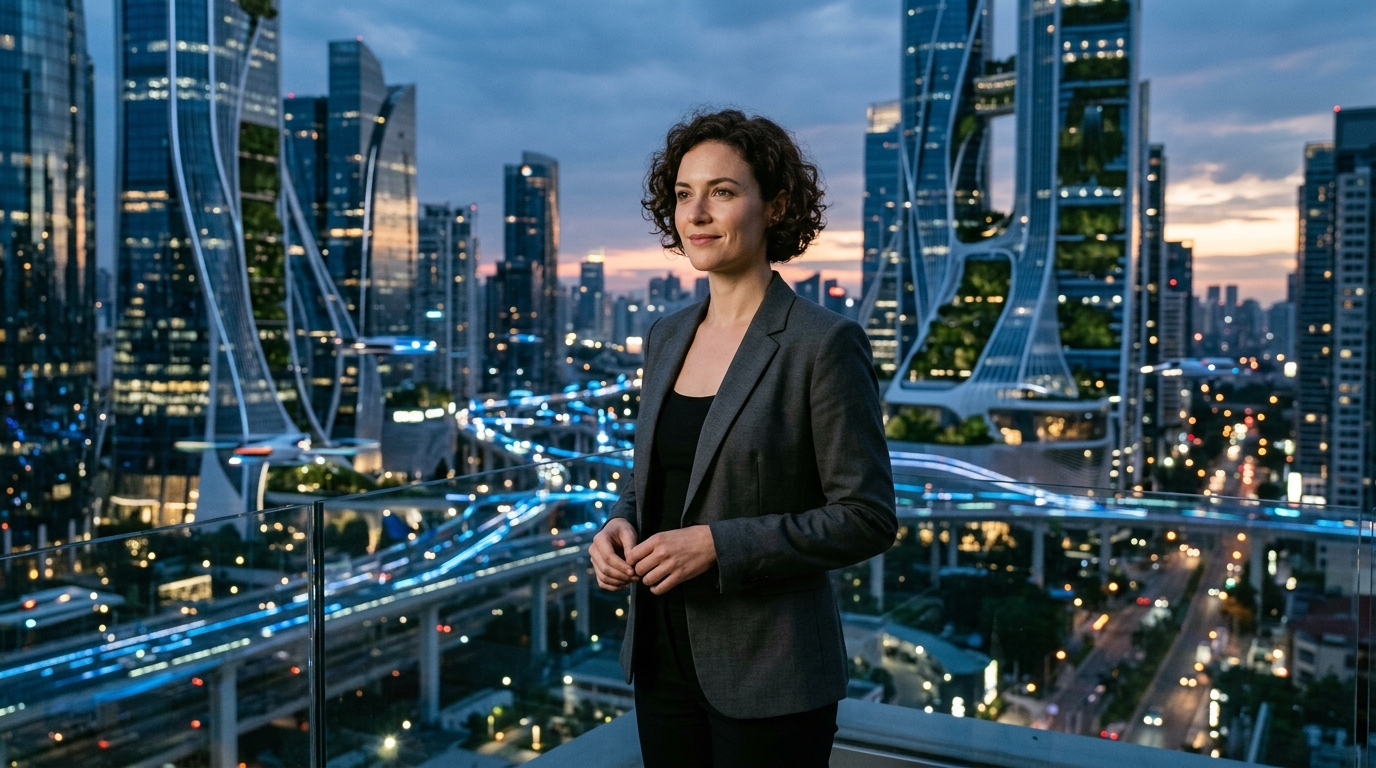
In the glittering world of Hollywood, where fame has traditionally been built on years of effort, talent, and luck, a new figure is emerging to overturn everything. Tilly Norwood is not your average actress. She wasn't born in an American town, she didn't attend drama school, and most importantly, she has no biological existence. She is the product of sophisticated generative AI algorithms, a digital entity promising to offer producers what they've always dreamed of: the perfect performance without the human "eccentricities."
The Technological Birth of a Star
Norwood's case is a far cry from the simple CGI models we've seen in the past. Using Neural Radiance Fields (NeRF) and advanced diffusion models, her creators have managed to imbue her appearance with haunting detail. Every skin pore, every eyelid movement, and every subtle twitch of her facial muscles during an emotional scene has been engineered to bridge the "uncanny valley." The result is a presence that is practically indistinguishable from a human on screen.
However, Tilly is more than just an image. She possesses a "synthetic personality" powered by Large Language Models (LLMs), allowing her to give interviews, interact with fans on social media, and develop her own "public persona." This ability to foster parasocial relationships is what makes her commercially attractive to major studios, as her fan base is already global and curated.
The Economics of Digital Acting
Why is Hollywood turning to solutions like Tilly Norwood? The answer lies in the numbers. A production featuring a traditional A-list star entails massive costs: multi-million dollar salaries, insurance, travel expenses, accommodation, and, of course, the risk of delays due to illness or personal issues. Tilly can "shoot" scenes 24/7, in any location in the world (or the universe) via virtual studios, without ever getting tired or demanding a contract renegotiation.
- Production cost reduction of up to 60% due to the lack of physical shoots.
- Absolute control over the actor's image and behavior by the studio.
- Ability to participate in multiple projects globally at the same time.
- Zero risk of "cancel culture" due to personal scandals, as every move is programmed.
This new reality has sent shockwaves through actors' unions like SAG-AFTRA. Following the historic 2023 strikes, the guarantees won primarily concerned the use of existing actors' digital likenesses. Tilly's case, however, creates a legal loophole: how do you protect jobs when the competitor isn't a human, but a piece of software's intellectual property?
Ethics and the "Future of the Soul" in Art
Beyond the economic aspect, a deeply philosophical question arises: can art exist without the human experience? Acting, at its core, is the translation of the human condition—pain, joy, and mortality—onto the screen. When we see Tilly Norwood shed a tear, we are seeing a probability calculation of what a tear should look like, not an internal process.
"Technology can simulate expression, but it cannot simulate intention. The difference between a great actor and an AI is the difference between a living forest and a photograph of one," veteran industry insiders state.
Nevertheless, the public seems divided. Younger generations, raised with avatars and virtual influencers, show greater acceptance. For many, entertainment is the end product, and if Tilly provides an immersive experience, her biological origin becomes secondary. Hollywood is entering an era where the artist's "truth" is replaced by the algorithm's "perfection," and Tilly Norwood is merely the first in a long line of digital idols set to inhabit our dreams.