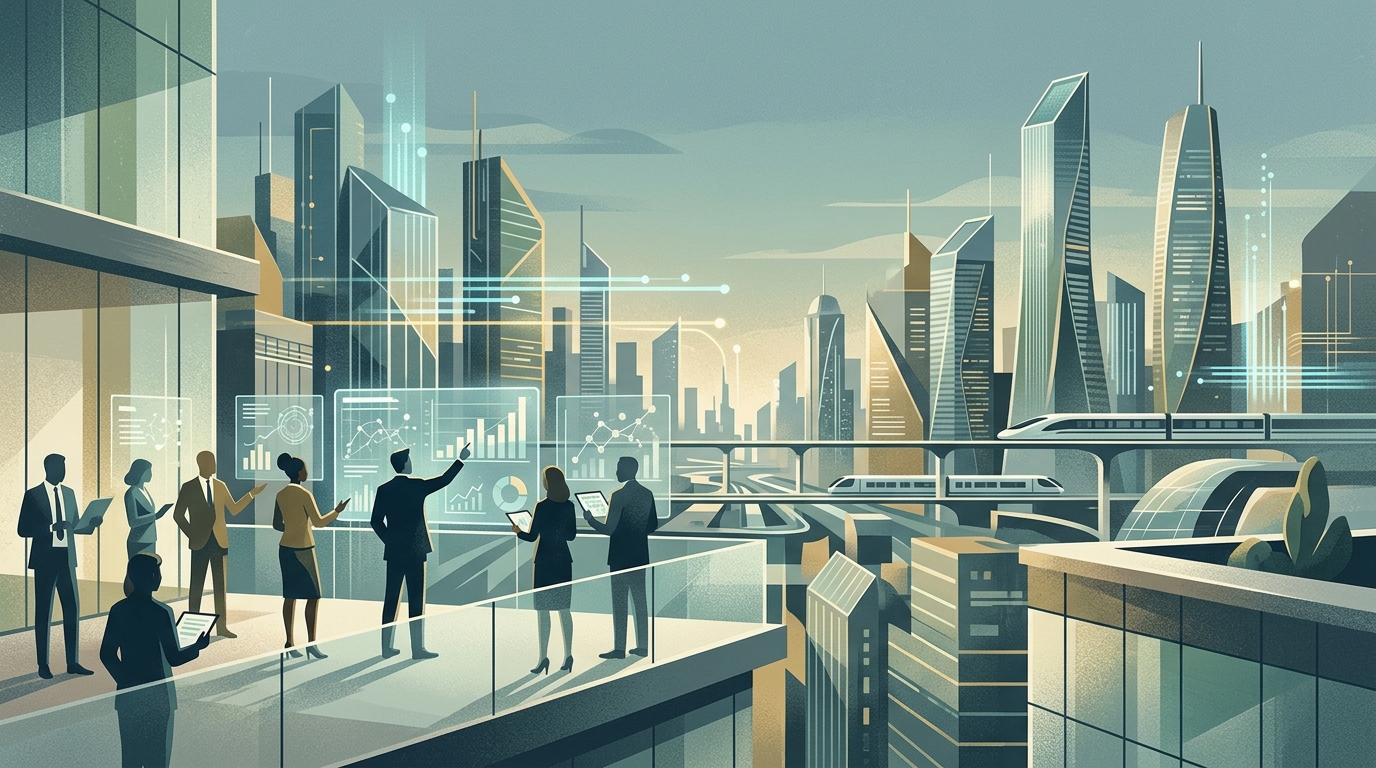
As we navigate the midpoint of 2026, the image of an economist hunched over endless Excel spreadsheets seems like an anachronism. Artificial Intelligence is no longer just a tool in the hands of analysts; it has become the very engine redefining what "economic forecasting" and "policy-making" mean. Recent analysis highlights a fundamental shift: the rules of the game aren't just changing—they are being replaced by a new digital paradigm.
From Static Forecasts to Dynamic Simulation
For decades, econometrics relied on historical data and linear models to predict the future. However, the advent of Large Language Models (LLMs) and Reinforcement Learning has allowed economists to process unstructured data—from social media posts to satellite imagery of cargo ships—in real-time. Today, Agent-Based Models (ABM) enhanced by AI can simulate the reactions of millions of individual consumers to an interest rate hike, offering precision that traditional indicators failed to capture.
This transition means that the economist of the future must be as proficient in programming and data science as they are in economic theory. The ability to "dialogue" with a model, identify its biases, and interpret results within a socio-political context is becoming the new essential skill. AI can calculate the "what," but humans remain the masters of the "why."
The Human Role in an Automated Landscape
Despite the technological superiority of algorithms, economic science remains deeply human-centric. AI lacks "Narrative Economics," a concept introduced by Nobel laureate Robert Shiller. Markets are driven not just by numbers, but by stories, fears, and hopes. The economist of 2026 now acts as an "interpreter" between the cold logic of machines and often irrational human behavior.
- Ethics and Transparency: Using algorithms in public policy raises serious questions. Who is responsible if an AI model suggests measures that disproportionately affect a specific social group?
- Strategic Decision Making: Economists are moving from performing calculations to providing strategic guidance for corporations and governments.
- Interdisciplinarity: Connecting economics with psychology, computer science, and environmental science is becoming the norm.
The Risks of the Algorithmic "Black Box"
One of the biggest challenges facing the industry is the lack of explainability. Many modern AI models operate as "black boxes," producing results without revealing the logical path they followed. For a central bank, making an interest rate decision based on an AI's "hunch" without documentation is politically and economically dangerous. Economists are called to develop "Explainable AI" (XAI) methods that allow for auditability and accountability.
"AI won't replace economists, but economists who use AI will replace those who don't," has become the mantra of our era.
The Education of Tomorrow
Universities worldwide are radically revising their curricula. Statistics is now taught alongside machine learning, and the ethics of technology is a mandatory course. The goal is to create a new generation of scientists who can navigate an environment where information is abundant but critical thinking is rare. The economist of the future is a hybrid professional: part mathematician, part philosopher, and part coder, capable of managing the complexity of a globalized, hyper-connected economy.