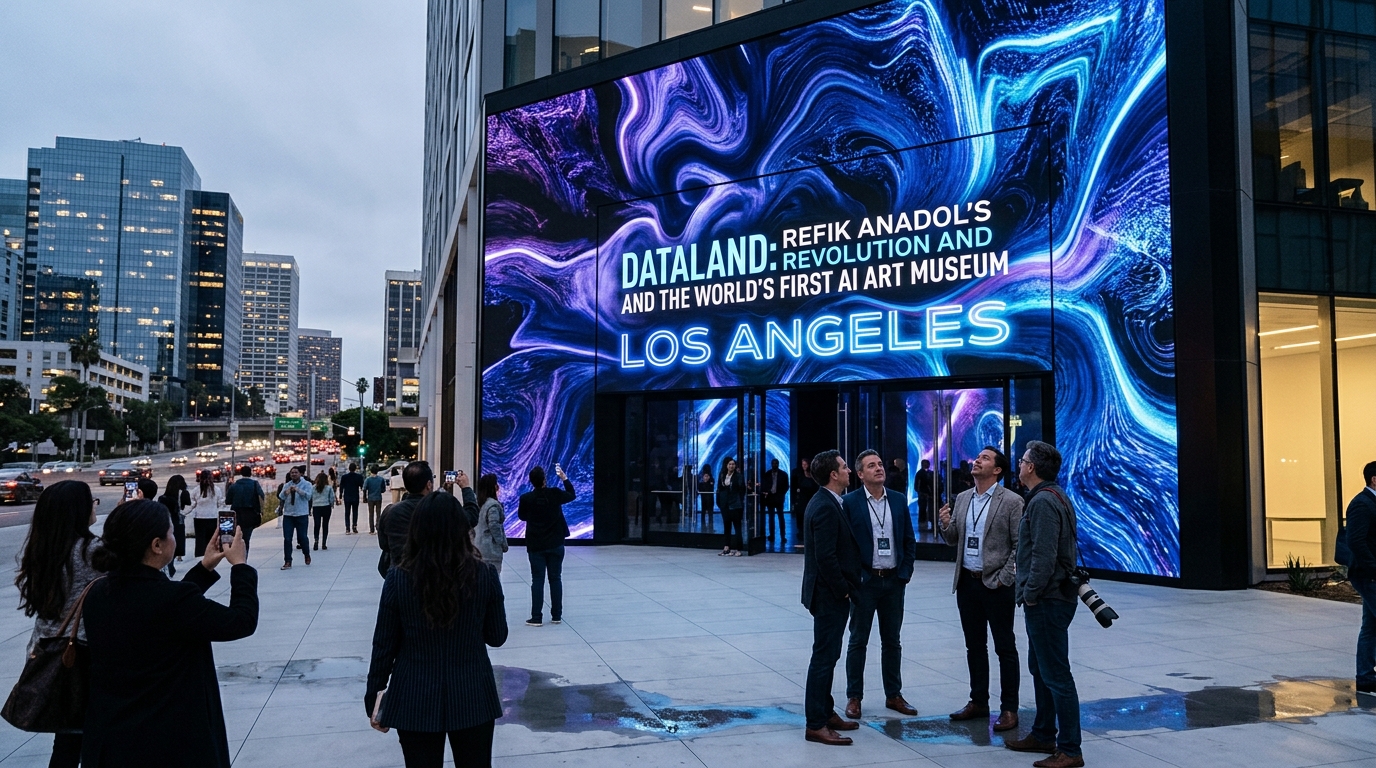
In the heart of Los Angeles, where the architectural genius of Frank Gehry meets the pulse of the modern metropolis, Dataland is not just a new museum; it is the realization of a vision that redefines what "public space" means in the 21st century. Under the guidance of Refik Anadol, the artist who turned algorithms into poetry, Dataland stands as the world’s first permanent institution dedicated exclusively to data art and artificial intelligence.
The founding of Dataland comes at a time when AI is at the center of the global conversation, often sparking fear or skepticism. However, Anadol and his team (Refik Anadol Studio) choose a different path: that of the "collective memory of humanity." Housed in the imposing The Grand LA complex, the museum promises to be a beacon of creativity, where data is treated not as cold numbers, but as the "pigment" of a new artistic language.
The Philosophy Behind Dataland: Data as Paint
For Refik Anadol, artificial intelligence is not an automation tool, but a "collaborator" that allows the artist to visualize the invisible. Dataland is based on the idea that the digital world and the physical world are not distinct, but interconnected. The art hosted there results from processing massive datasets—from NASA archives to sounds of the Amazon rainforest—which algorithms "dream" and transform into fluid, three-dimensional sculptural forms.
This approach radically changes the role of the museum. Traditionally, a museum is a space for preserving the past. Dataland, by contrast, is a living organism. The exhibits are not static; they evolve in real-time, fed by data streams that reflect the state of our planet. It is an attempt to understand our place in a world overwhelmed by information, turning data noise into harmony.
The Large Nature Model: The Ethics of AI Art
One of Dataland’s most significant contributions is the presentation of the "Large Nature Model" (LNM). This is the world's first open-source AI model trained exclusively on nature data. In an era where AI models face criticism for copyright infringement and ethical provenance, Anadol makes a bold move: the LNM was created through collaboration with research institutions, environmental organizations, and indigenous communities.
The result is an immersive experience that allows visitors to "feel" nature in ways never before possible. Through the use of advanced sensors and scent technologies, Dataland offers more than just visual stimuli. Visitors can smell the scent of a forest created by AI or hear the melody of the oceans, translated by algorithms. This multisensory approach aims to raise awareness about the climate crisis, showing how high technology can reconnect us with the natural environment rather than isolating us from it.
Architecture and the Significance of Location
The choice of Los Angeles, and specifically The Grand LA, is no coincidence. LA is the city where the entertainment industry meets the technology of Silicon Beach. Dataland, neighboring the Walt Disney Concert Hall and The Broad, places AI art on the same institutional map as classical music and contemporary art. Frank Gehry’s architecture, with its curves and deconstruction, provides the ideal shell for a museum dealing with the fluidity of data.
The museum features cutting-edge technological infrastructure, including the latest Nvidia processors, allowing for graphics rendering at a resolution that pushes the boundaries of human perception. However, the technology remains in the background. The foreground belongs to the experience. The goal is for the visitor to forget they are looking at a screen or a projector and feel as if they are inside a living dream.
Conclusion: A New Era for Culture
Dataland is not just a tourist destination; it is a laboratory for the future. As artificial intelligence becomes increasingly integrated into our daily lives, we need spaces that help us process it emotionally and intellectually. Refik Anadol succeeds in proving that AI can be a vessel for humanism, a bridge between machine logic and the sensitivity of the human soul.
By opening its doors, Dataland poses the question: What will our legacy be in the digital age? If the answer lies in the images and emotions generated by this museum, then the future of art looks brighter and more inclusive than ever. It is an invitation to see the world not as it is, but as it could be through the eyes of an intelligence that is learning to love nature and humanity.