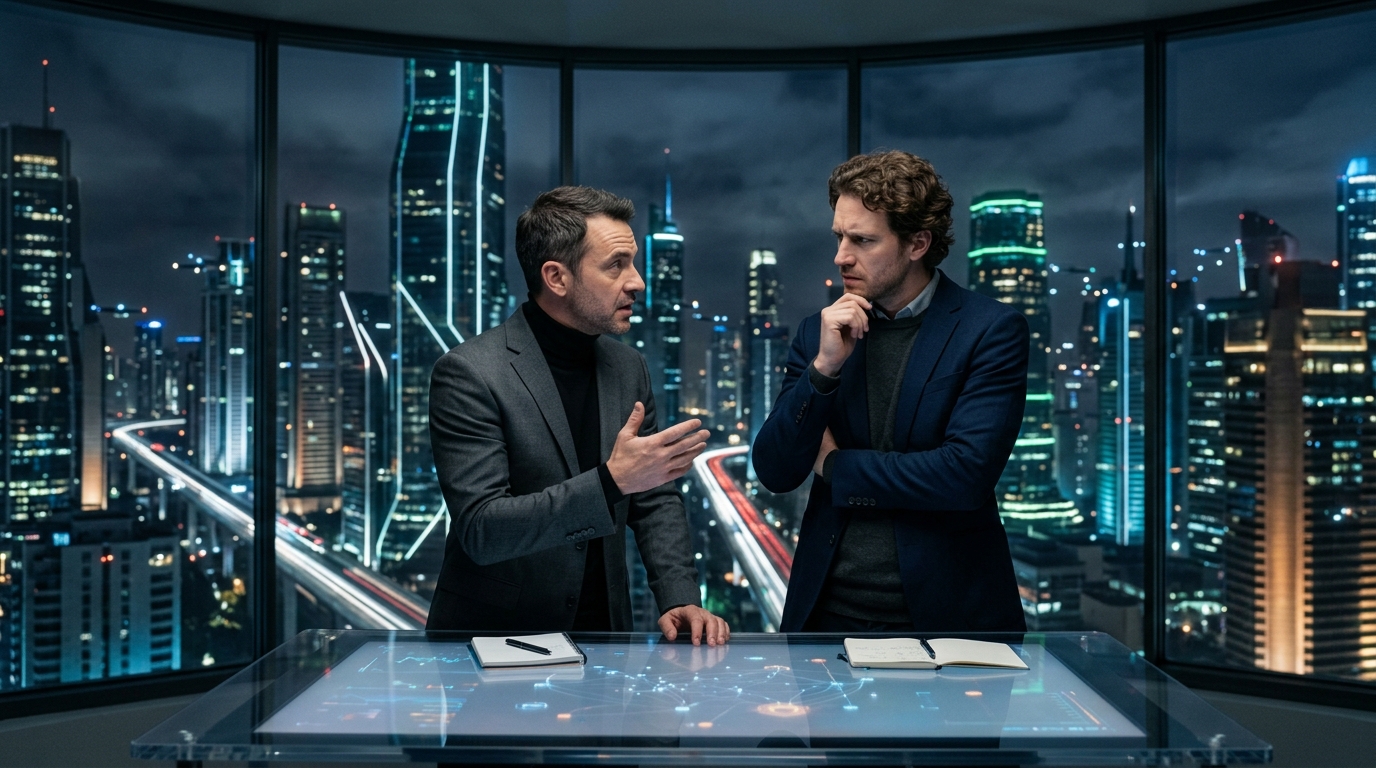
The history of modern artificial intelligence is being written not just in code and silicon, but through deep human schisms. In the heart of Silicon Valley, a titanic struggle is unfolding: on one side stands OpenAI, the undisputed leader that brought ChatGPT to the world, and on the other, Anthropic, the "ethical" challenger founded by defectors from the former. This is not a mere commercial rivalry; it is a battle for the very soul of humanity at the dawn of Artificial General Intelligence (AGI).
The Schism: The Birth of Anthropic
It all began in 2021, when a group of top OpenAI executives and researchers, led by siblings Dario and Daniela Amodei, decided to resign. The cause? A fundamental disagreement over the company's direction. OpenAI, under Sam Altman’s leadership, had begun to pivot away from its non-profit roots, embracing a tight partnership with Microsoft and prioritizing product release speed over rigorous safety protocols.
The Amodeis feared that the race for dominance would lead to the neglect of risks inherent in advanced AI. Thus, they founded Anthropic as a Public Benefit Corporation, aiming to develop systems that are "safe, explainable, and aligned" with human values. Anthropic introduced the concept of "Constitutional AI," where the model is trained to follow a written set of rules—a constitution—rather than relying solely on Reinforcement Learning from Human Feedback (RLHF), which can be subjective or flawed.
A Clash of Models: Claude vs. GPT
Today, the battle is fought on the field of Large Language Models (LLMs). Anthropic’s Claude and OpenAI’s GPT compete neck-and-neck. While OpenAI focuses on multimodality and integration into every possible application via the Microsoft ecosystem, Anthropic bets on reliability and massive "context windows," allowing Claude to analyze entire books or technical manuals in seconds.
However, the irony is that Anthropic, despite its emphasis on ethics, has been forced to follow a similar funding path. To compete with OpenAI, it has accepted billions of dollars from Amazon and Google. This has created a new geopolitical tech landscape: Microsoft vs. Amazon and Google, with OpenAI and Anthropic acting as their respective "front-line soldiers." The independence the Amodeis sought now seems constrained by investor demands for returns and market share.
Safety or Regulatory Capture?
One of the most thorny aspects of this rivalry is their role in legislation. Both companies maintain a heavy presence in Washington D.C. and Brussels. While they claim to want regulations to prevent existential risks, critics accuse them of "regulatory capture." They argue that by calling for strict rules, these giants are essentially raising barriers to entry for smaller companies and the open-source community, securing their own oligopoly.
"This is no longer about computer science; it's about the science of power," notes a market analyst. "Whoever controls the model deemed the 'safe standard' will control the global digital infrastructure of the future."
The Road Ahead: Toward AGI
As we head toward 2027, the tension is expected to peak. OpenAI is experimenting with Q* and other reasoning methods that promise leaps toward AGI, while Anthropic continues to deepen its work on "interpretability," trying to understand what exactly happens inside the "black box" of neural networks. The outcome of this battle will determine whether the AI of the future will be an obedient assistant, an uncontrollable agent, or a closed tool in the hands of a powerful few.