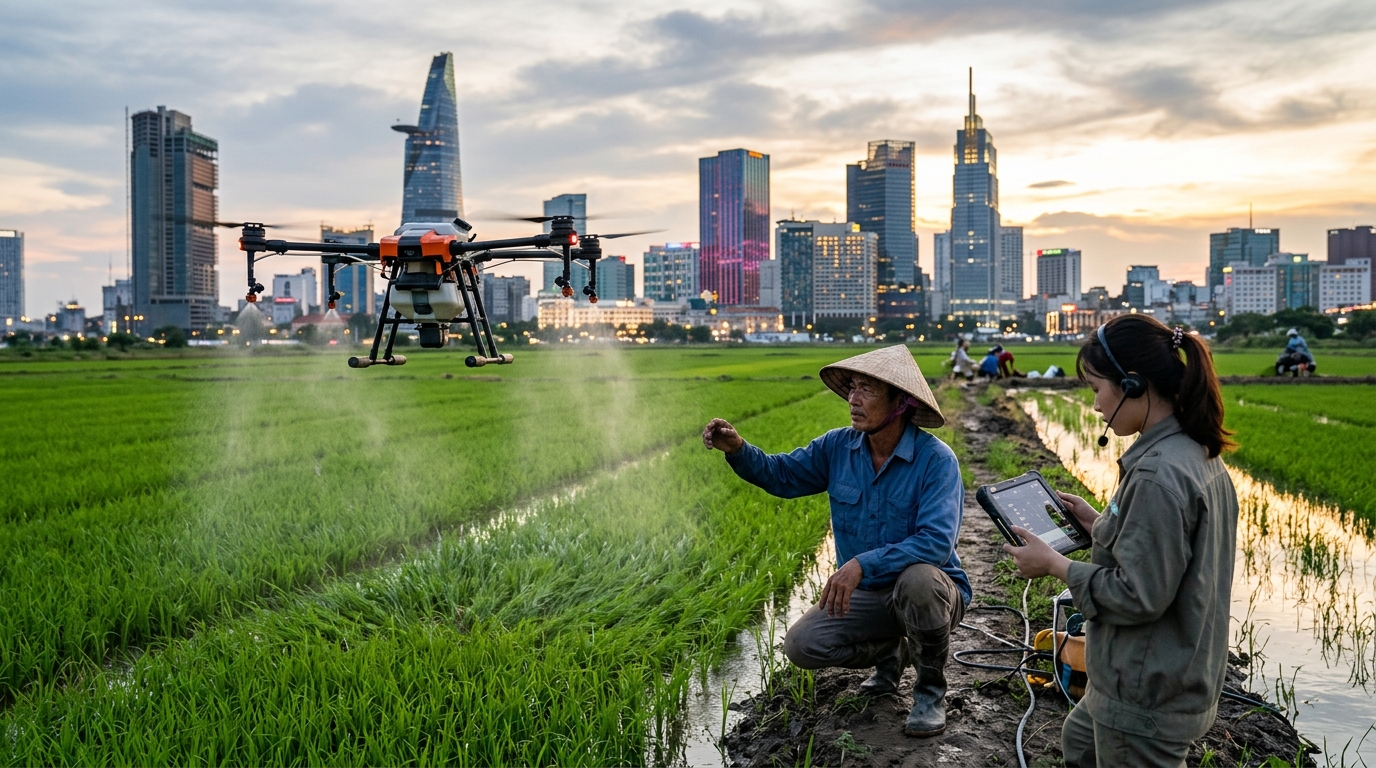
In the heart of Southeast Asia, where centuries-old traditions meet 21st-century challenges, a quiet revolution is taking place. Vietnam, a nation traditionally reliant on agricultural production, is now turning to Artificial Intelligence (AI) to bolster its food security and enhance its competitiveness in the global market. The image of the farmer relying solely on experience and intuition is giving way to a new model where data and algorithms guide every move in the field.
The Necessity of the Technological Transition
For Vietnam, adopting AI is not a luxury but a strategic survival choice. The Mekong Delta, the country's "rice bowl," faces unprecedented threats from climate change, with saltwater intrusion and unpredictable flooding destroying crops. AI offers predictive tools that allow farmers to adapt in real-time. Through IoT (Internet of Things) sensors placed in the soil, producers receive alerts on their mobile phones regarding moisture levels, soil acidity, and the presence of pests.
The use of drones for spraying and monitoring crops has dramatically reduced chemical use and labor costs. As local officials report, the precision offered by these systems ensures that each plant receives exactly the amount of water and fertilizer it needs, minimizing waste and protecting the groundwater.
From Theory to Practice: Smart Farms and Big Data
The application of AI in Vietnam's agricultural production is not limited to data collection. The next stage is analyzing this data for decision-making. Large language models and specialized machine learning algorithms analyze decades of satellite imagery to predict crop yields and suggest optimal sowing and harvesting periods.
- Automated Irrigation: Systems that activate only when moisture falls below a certain threshold, saving up to 40% of water.
- Disease Identification: Mobile apps that use the camera to identify phytopathogenic organisms through computer vision.
- Price Prediction: Algorithms that analyze global demand, allowing farmers to decide which products will be more profitable next season.
This digital transition is actively encouraged by the Vietnamese government through the "Make in Vietnam" strategy, which promotes the development of domestic technological solutions tailored to local needs. The collaboration between tech giants and agricultural cooperatives is creating an ecosystem where innovation does not remain in labs but reaches the last acre of land.
Challenges and the Future of Agricultural Labor
Despite the progress, the path to full digital transformation is not without obstacles. The high cost of initial investments remains prohibitive for many smallholders. Additionally, there is the issue of the digital divide: older farmers often struggle to familiarize themselves with new technologies, requiring continuous training and support.
"AI will not replace the farmer, but the farmer who uses AI will replace the one who doesn't," market analysts note.
In the future, agricultural production is expected to become even more automated. Integrating AI with robotics will allow for the harvesting of delicate products, such as fruits, without human intervention. At the same time, traceability through blockchain, combined with AI, will guarantee consumers the quality and origin of their food, strengthening trust in supply chains.
In conclusion, the case of Vietnam serves as a roadmap for many developing economies. Artificial intelligence is not just a tool for increasing profit, but a necessary mechanism for ensuring food in a warming planet and a rapidly growing population. The challenge now lies in the democratization of this technology, so that the fruits of the digital revolution are shared fairly among all those who toil the earth.