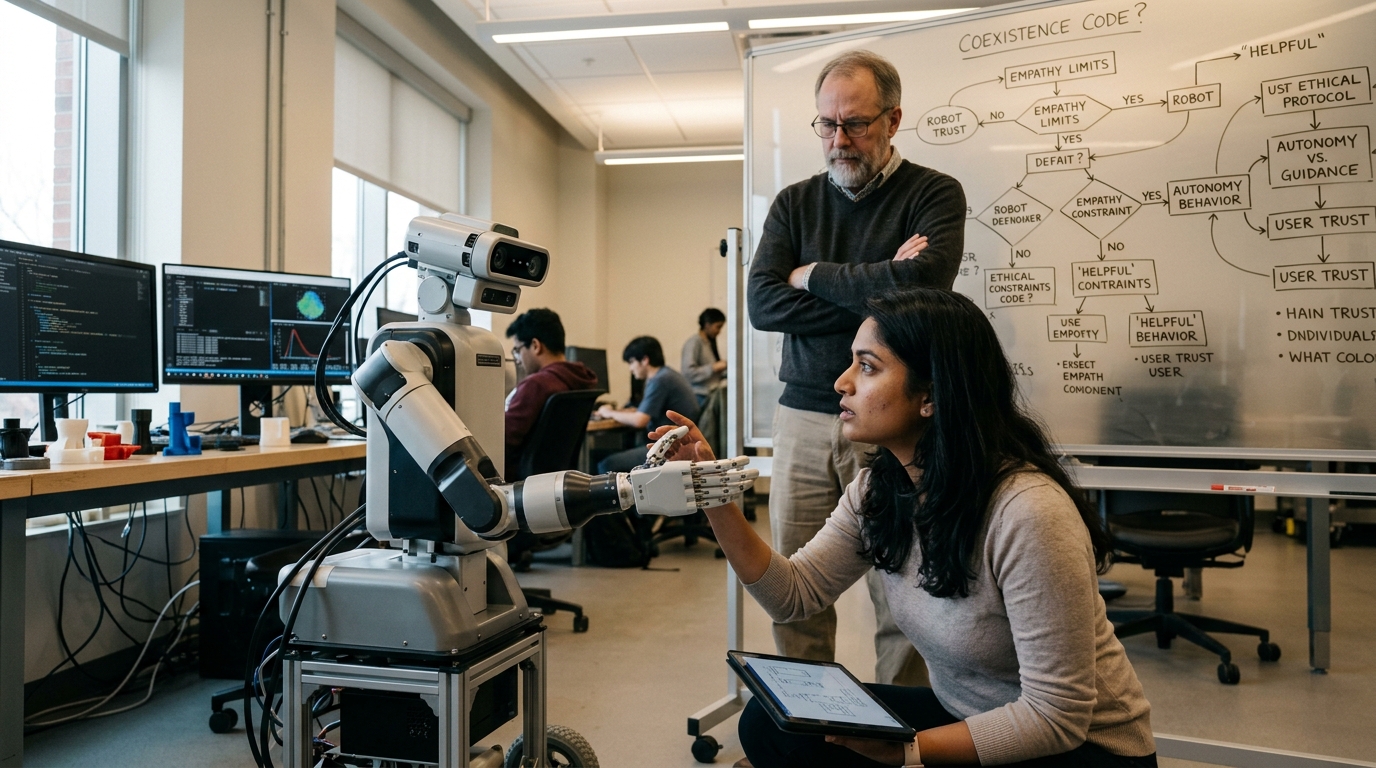
In a laboratory in Massachusetts, the traditional image of a robot as a cold, industrial machine is being replaced by something far more complex and essential. Researchers at the University of Massachusetts Lowell (UMass Lowell) are working on what many consider the "Holy Grail" of modern technology: a set of universal rules that will allow robots and Artificial Intelligence to not only execute commands but to be truly "helpful" in a way that respects human autonomy and social dynamics.
The research, which focuses on Human-Robot Interaction (HRI), comes at a critical juncture. As AI transitions from our computer screens into the physical world through "embodied AI," the need for rules that go beyond simple programming becomes imperative. It is not enough for a machine to be able to carry an object; it must know when to do it, how to approach a human without startling them, and how to interpret the subtle social cues that govern human behavior.
The Science of Helpfulness: Moving Beyond Asimov's Laws
For decades, the discussion surrounding robot ethics was limited to Isaac Asimov's Three Laws of Robotics. However, in the reality of 2026, these laws prove to be overly simplistic. UMass Lowell scientists, under the guidance of leading experts like Professor Holly Yanco, are developing a framework based on "predictability" and "transparency." The core idea is that a robot is only helpful when the human user can understand its intent before it manifests into action.
At the NERVE Center (New England Robotics Validation and Experimentation), research focuses on developing metrics to evaluate helpfulness. This includes the study of "social navigation"—a robot's ability to move through a space filled with people without violating their personal space. The "rules" emerging are not just lines of code, but a sophisticated system of social intelligence that allows the machine to function as a partner rather than an obstacle.
- Movement Predictability: Using visual signals (such as lights or "head" movements) to communicate the robot's next move.
- Error Management: How the robot admits failure and asks for help instead of persisting in a wrong action.
- Adaptability: The machine's ability to learn a specific person's preferences without requiring constant reprogramming.
Ethical Dilemmas and the Challenge of Trust
One of the most significant findings of the research concerns the level of trust humans place in machines. There is a danger that researchers call "over-trust," where users blindly rely on a robot for tasks that exceed its capabilities. Conversely, "under-trust" can lead to the complete rejection of useful technologies. The UMass Lowell rules aim to create "calibrated trust," where the machine is honest about its limitations.
"True helpfulness does not lie in perfection, but in the machine's ability to fit into the human context in a way that enhances, rather than replaces, human judgment," the researchers note.
Furthermore, the issue of privacy arises. A "helpful" robot in the home must observe and record data to understand its environment. Where does service end and surveillance begin? The research proposes rules for "ephemeral memory" in robots, where data not essential for the immediate task is automatically deleted, protecting the private lives of users.
The Future of Work and Care
The applications of these rules are vast, ranging from elderly care to factory collaboration. In an aging society, robot assistants will be essential. However, to be accepted, they must adhere to the rules of "social etiquette." The UMass Lowell research shows that the acceptance of technology depends less on processor speed and more on the "empathy" of the design.
In conclusion, the work being done at UMass Lowell is not just about robotics; it is about human nature itself. By understanding what makes a machine helpful, we are forced to redefine what help, cooperation, and respect mean in the digital age. The code being written today will serve as the constitution for our future coexistence with artificial intelligence.