

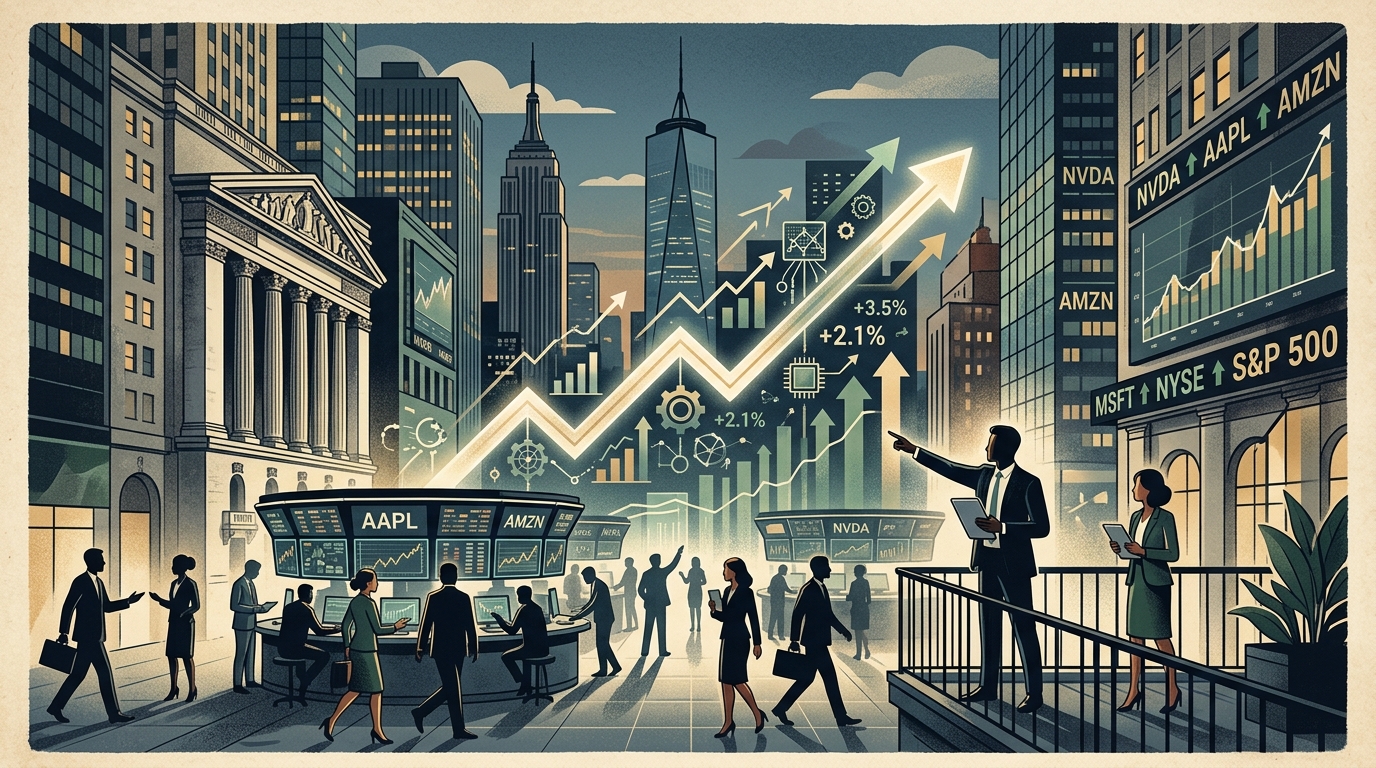
The New York Stock Exchange concluded another week of performance that confirms the dominance of the technology sector as the primary engine of the global economy. With the three major indices — the S&P 500, the Nasdaq, and the Dow Jones — all closing with gains, investor sentiment seems to be balancing between excitement over new technologies and a careful analysis of macroeconomic data. This week was not just a period of growth, but a demonstration of power by the companies defining the digital age, as their results and outlooks continue to exceed analyst expectations.
Artificial Intelligence as the Foundation of Growth
2026 has proven to be the year where Artificial Intelligence (AI) moved from a phase of theoretical promise to full operational integration. Semiconductor companies and cloud computing providers saw their stocks soar as the demand for computing power remains insatiable. Wall Street no longer treats AI as a 'bubble' but as a fundamental restructuring of productivity. Investors are rewarding companies that present clear paths to profitability through automation and data analysis, driving the Nasdaq to new heights.
Notably, the rally was not limited to the well-known giants. There was a diffusion of interest toward smaller tech companies offering specialized solutions in cybersecurity and biotechnology. This broadening of the market suggests that capital is seeking new opportunities beyond the 'Magnificent Seven,' recognizing that the innovation ecosystem is deeper than ever. The ability of these companies to maintain high profit margins in an environment of changing interest rates is key to the continued confidence of institutional investors.
The Fed and the Macroeconomic Landscape
Despite the tech euphoria, the shadow of the US Federal Reserve (Fed) remains over Wall Street. Recent inflation data shows a trend toward stabilization, allowing the market to hope for a more lenient monetary policy. Investors are closely monitoring every statement from Fed officials, looking for clues about future interest rate moves. The 'soft landing' of the economy, which many feared would fail, seems to be materializing, providing the necessary safe environment for risk-taking.
However, market analysis also reveals certain challenges. US consumption is showing signs of fatigue in some sectors, as borrowing costs remain comparatively high. This creates a dichotomy in the market: on one hand, the tech sector thriving due to innovation and strong balance sheets, and on the other, traditional retail and manufacturing sectors struggling with increased operating costs. Wall Street, for now, chooses to focus on the former, believing that technological progress will act as a long-term disinflationary force.
Geopolitics and the Supply Chain
We cannot ignore the role of geopolitical developments in shaping stock prices this week. Tensions in international trade, particularly regarding access to critical raw materials for chip production, have forced companies to redesign their supply chains. Wall Street reacted positively to announcements of new investments in domestic production infrastructure, seeing them as a shield against future crises. Strategic autonomy in high technology has now become an investment criterion.
In conclusion, the positive week on Wall Street reflects a market that has learned to live with uncertainty, betting on human ingenuity and technological evolution. While risks remain — from geopolitical turbulence to potential inflation surprises — the momentum of technology seems sufficient to sustain the trend. Investors, however, are called to remain vigilant, as the success of 2026 is built on delicate balances that require constant monitoring and strategic flexibility.





