

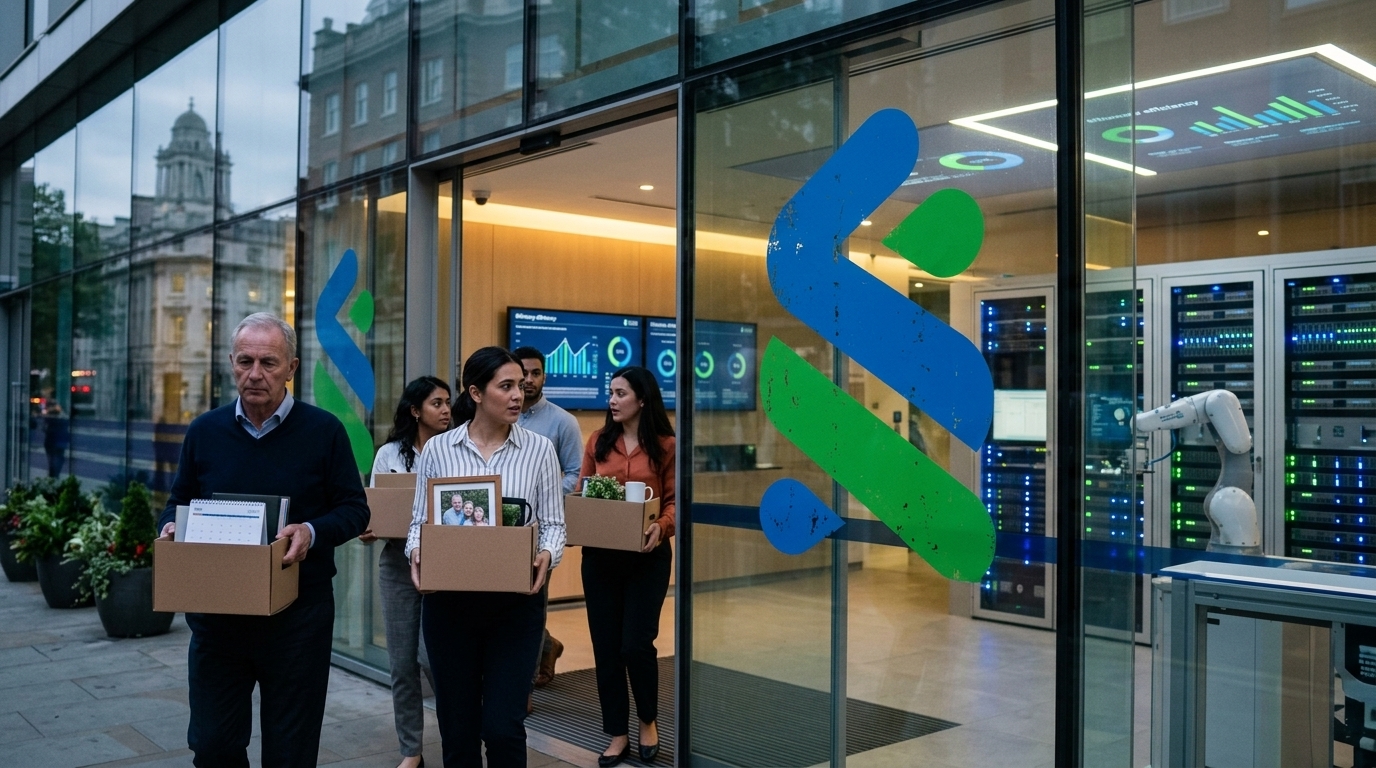
Standard Chartered's announcement of a drastic reduction in its workforce in favor of Artificial Intelligence (AI) is not merely corporate news; it is a profound alarm bell for the global labor market. The British banking giant, with its deep-rooted presence in the emerging markets of Asia and Africa, is accelerating its strategic roadmap toward 2030, aiming to replace thousands of support roles with algorithmic systems and generative AI tools.
The 'Efficiency' Strategy and the End of the Back-Office
At the heart of this transformation lies the imperative to improve the cost-to-income ratio—a metric scrutinized by investors from Wall Street to the City of London. Standard Chartered's management argues that AI integration will facilitate faster data processing, more accurate regulatory compliance, and a significant reduction in operational errors. However, the price of this progress is the elimination of jobs that have traditionally formed the backbone of the banking sector.
The roles most affected are those in data management, customer support services, and administrative functions. The bank is funneling billions of dollars into cloud infrastructure and AI models capable of performing tasks in seconds that previously required hundreds of human hours. This move is far from isolated, following in the footsteps of titans like Citigroup and Goldman Sachs, signaling a structural shift in the financial industry.
The Reskilling Dilemma and Social Reality
While Standard Chartered promises 'reskilling' programs for a portion of its staff, analysts remain skeptical. Transitioning from an administrative role to a position overseeing AI systems requires a skill set that is not easily acquired by the entirety of the existing workforce. Furthermore, the velocity of technological evolution is outpacing the rate at which educational systems and corporate structures can adapt.
- Reduction of operational expenses by at least 15% by 2028.
- Full automation of loan approval processes and fraud detection.
- Shrinking of physical branch networks in favor of digital service hubs.
- Increased dividends for shareholders as a direct result of cost savings.
The societal challenge is immense. When thousands of mid-skilled workers are displaced, a vacuum is created that could exacerbate social inequalities. Standard Chartered maintains that this pivot is essential for survival in an environment where fintech disruptors threaten traditional banking models. Yet, the ethical dimension of 'sacrificing' workers remains a contentious issue.
AI as a Catalyst for a New Economic Order
As we navigate 2026, the AI promise of 'liberating humans from repetitive tasks' is beginning to look more like a threat than an opportunity for many. The Standard Chartered case is the experiment the entire business world is watching. If the bank succeeds in boosting profitability without triggering operational collapse or massive public backlash, its model will be replicated at lightning speed by every major corporation on the planet.
"We are not just automating processes; we are redesigning the very concept of banking for the 21st century," bank executives state.
However, history teaches us that technological revolutions always have winners and losers. In the current phase, the winners appear to be the shareholders and the owners of the algorithms, while the losers are the thousands of employees who see their careers rendered obsolete by a few lines of code. The need for a new social contract—perhaps involving Universal Basic Income or the taxation of robots—is becoming more urgent than ever.





