

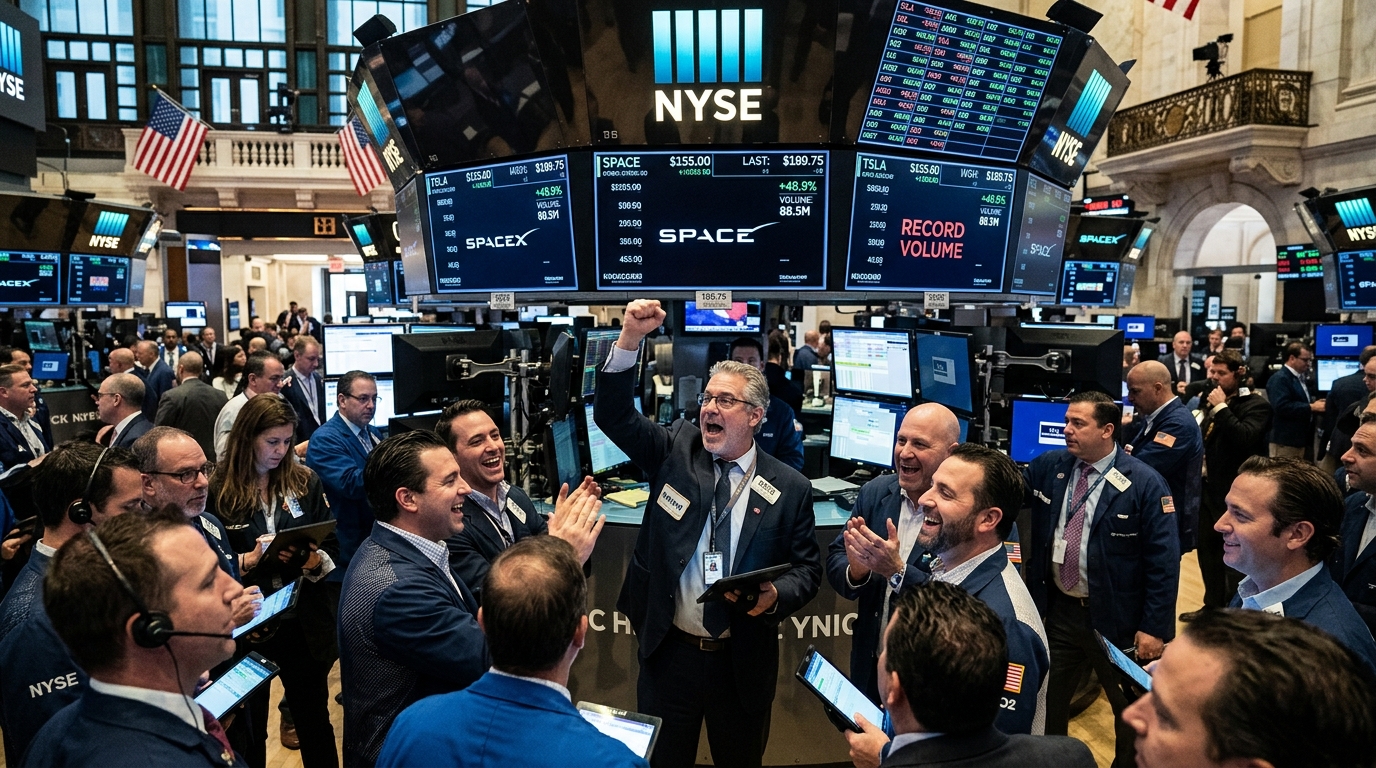
June 12, 2026, will be etched in the annals of financial history as the day the boundaries between the terrestrial economy and the final frontier finally dissolved. The long-anticipated initial public offering (IPO) of SpaceX was not merely a stock market event; it was a display of dominance that redefined market capitalization in the age of artificial intelligence and interplanetary exploration. With a valuation touching a staggering $1.7 trillion, Elon Musk’s company didn’t just enter Wall Street—it conquered it, positioning itself alongside titans like Apple and Microsoft.
From Texas Test Sites to the New York Stock Exchange
The road to this moment was paved with challenges, spectacular explosions, and technological triumphs. For years, SpaceX operated as a closely-held private entity, allowing Musk to make high-stakes decisions without the scrutiny of quarterly earnings reports. However, the maturation of the Starlink network and the proven reliability of the Starship system made a public debut inevitable. The capital requirements for funding the colonization of Mars necessitated access to the deep liquidity of public markets.
Analysts point out that SpaceX is no longer valued as a simple aerospace company. It is a hybrid behemoth: a telecommunications provider via Starlink, a space logistics firm, and a critical national security contractor for the United States. This multifaceted nature is what drove the share price to levels many deemed unthinkable just a few years ago. Demand from institutional investors was so high that the offering was oversubscribed within hours of the books opening.
The Starlink Engine and the Starship Promise
The true "crown jewel" of SpaceX, according to economists, is Starlink. With millions of subscribers in every corner of the globe and profit margins reminiscent of software companies, the satellite network provides the steady cash flow the company needs. In presentations to investors, SpaceX executives emphasized that Starlink is expected to become the backbone of the global internet, especially as data demand from AI applications grows exponentially.
"You aren't buying a stock; you are buying a ticket to the future of the human species," remarked one of the lead underwriters of the issuance.
On the other hand, Starship represents the long-term bet. Its ability to ferry hundreds of tons of cargo into orbit at a fraction of the cost of traditional rockets unlocks entirely new markets: from microgravity industrial manufacturing to asteroid mining. Investors are betting that SpaceX will hold a monopoly on transportation to the Moon and Mars for the next decade, making it the primary infrastructure provider for the emerging space economy.
Geopolitics and Regulatory Hurdles
The IPO also brings the company's geopolitical significance into sharp focus. SpaceX is now inextricably linked to American national power. However, being a public company also means greater scrutiny. Regulators in the US and Europe are already expressing concerns about the concentration of such immense power in the hands of one company and one individual. Issues such as space traffic management and orbital debris will now be matters for boards of directors and shareholders, not just scientists.
Furthermore, there is the question of the "Musk risk." The founder's personality, which has been the driving force behind the company's success, is also a source of volatility. Shareholders will now demand greater transparency and perhaps more institutional governance, which often clashes with Musk’s freewheeling style. Despite these risks, the market sent a clear message: space is the next great investment frontier, and SpaceX is its undisputed leader.
Conclusion: A Financial Big Bang
The SpaceX IPO is not the end of a journey, but the beginning of a new era. As the company begins trading on international markets, the capital raised will accelerate programs that were recently the stuff of science fiction. For the average investor, access to SpaceX offers a rare opportunity to participate in a once-in-a-century technological revolution. Wall Street proved today that it is willing to fund the dream of the stars, provided it is backed by robust financials and an unstoppable drive for innovation.





