

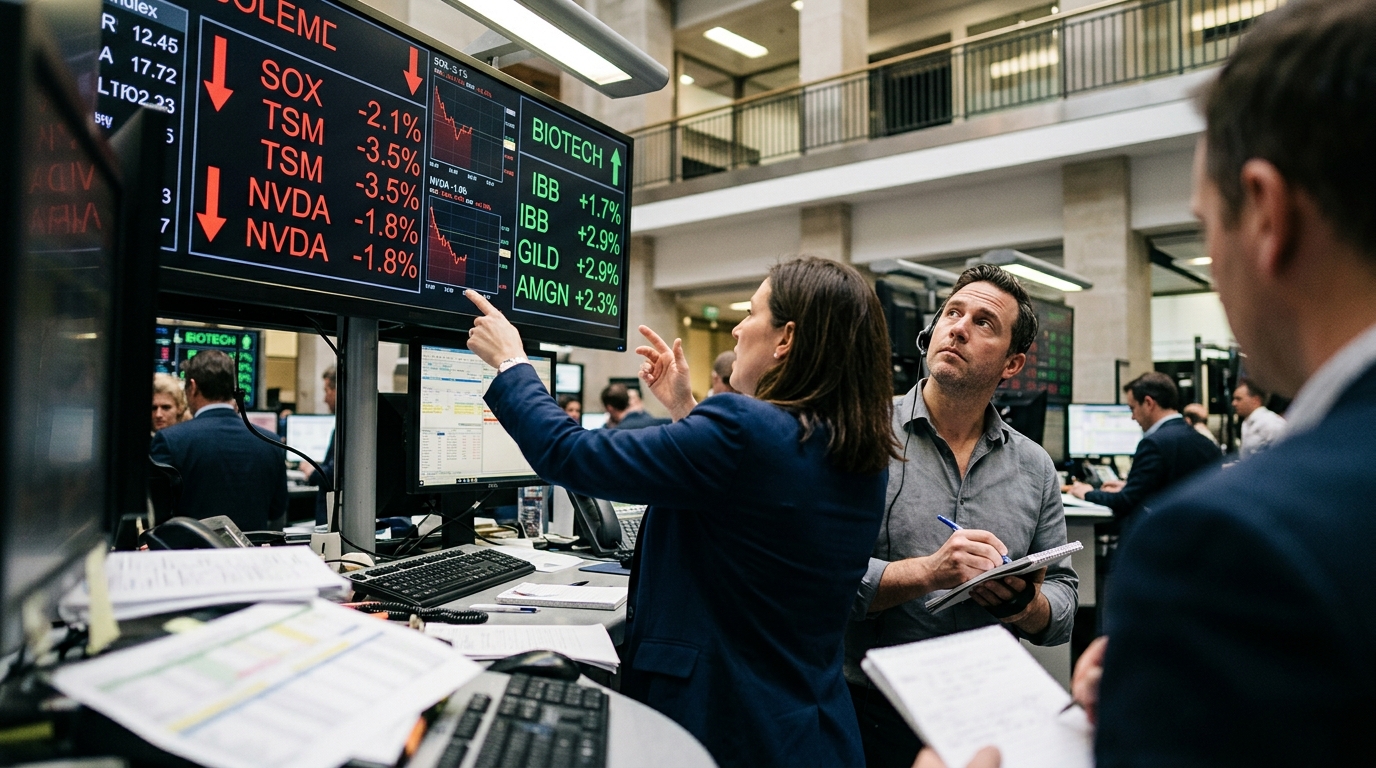
The trading session on Friday, June 26, 2026, will likely be remembered as the moment Wall Street began to seriously question the absolute dominance of the semiconductor sector. While the S&P 500 ended with marginal losses, the internal market dynamics revealed a profound shift in investor psychology. The sharp decline in tech stocks, specifically the chipmakers that fueled the AI rally over the past two years, was partially offset by an impressive surge in the biotechnology sector, with Moderna leading the charge.
The Dethroning of the Silicon Kings
For months, investors indiscriminately bought anything related to artificial intelligence infrastructure. However, valuations have reached levels that many analysts now consider unsustainable. Nvidia, AMD, and Broadcom saw their share prices face intense pressure as sales data indicated a gradual normalization of demand. This is not a collapse, but rather a necessary correction. The market is realizing that the transition to the AI era is a marathon, not a sprint, and expectations for explosive profitability every quarter are beginning to return to earth.
Furthermore, geopolitical tensions surrounding the semiconductor supply chain continue to cast a shadow. New restrictions on exporting advanced chips to Asia, combined with the European Union's efforts to impose stricter regulatory frameworks on data center energy consumption, created a climate of uncertainty that prompted institutional portfolios to lock in profits.
Moderna: The New Biotech Bet
In contrast to the tech fatigue, Moderna emerged as the big winner of the day. The rise in its stock price was no accident. The company announced positive results from Phase III clinical trials for its new personalized cancer vaccine, which uses mRNA technology in combination with AI algorithms to detect mutations. This represents the perfect convergence of biology and informatics, demonstrating that the true value of AI may ultimately lie in its application within life sciences rather than in the manufacturing of hardware itself.
"The market is beginning to reward companies that present tangible results in the application of technology, rather than just those providing the tools," noted a senior analyst at Goldman Sachs.
The shift toward defensive stocks and the healthcare sector also suggests a broader concern regarding global economic growth in the second half of 2026. With interest rates remaining at relatively high levels to curb persistent service-sector inflation, investors are seeking safety in companies with strong cash flows and products that are essential regardless of the economic cycle.
Macroeconomic Outlook and the Fed's Role
The Federal Reserve remains the ultimate arbiter of market direction. Despite the dip in chips, the overall US economy shows resilience, which complicates the decision to cut interest rates. The S&P 500's retreat can be viewed as a "healthy" decompression, preventing the formation of a bubble similar to the dot-com era. However, for the average investor, this volatility requires composure and strategic diversification.
- The semiconductor sector remains the core of the future economy, but valuations must align with actual earnings.
- Biotechnology is entering a "golden age" thanks to the integration of AI into R&D processes.
- Benchmark indices will continue to face pressure as the market searches for the next big narrative following the initial explosion of generative AI.
In conclusion, Wall Street's decline on Friday is not the end of the bull market, but a redistribution of power. Capital is moving from the "how" of technology (chips) to the "what" (healthcare, energy, infrastructure). For the global economy, this shift offers opportunities, as sectors that were previously overshadowed by Big Tech now find themselves in the spotlight of institutional interest.





