

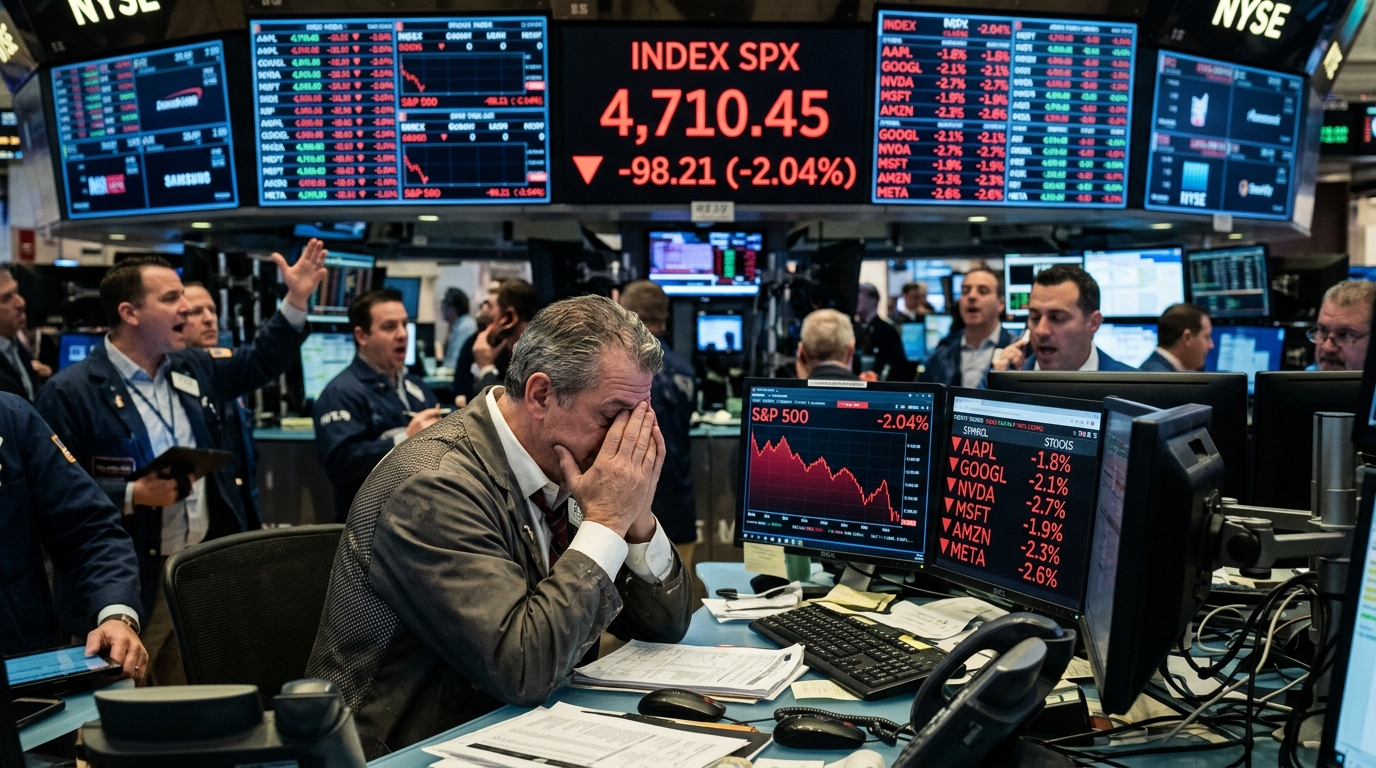
June 9, 2026, will likely be remembered as the day Wall Street's faith in the limitless ascent of Artificial Intelligence was put to a rigorous test. The S&P 500 recorded a 2% drop, a move triggered by a massive wave of sell-offs in the stocks of companies leading the AI revolution. After months of relentless growth, the market appears to be entering a phase of introspection, where promises of the future are no longer enough to justify astronomical valuations.
Market Fatigue and the Profitability Question
For more than two years, the narrative surrounding Artificial Intelligence has acted as the fuel for a historic rally in equities. However, recent financial results and forecasts for the second half of 2026 point to a troubling trend: the capital expenditures (CapEx) of Big Tech companies are increasing at rates that returns on investment (ROI) are struggling to match. Investors are beginning to wonder exactly when the productivity promised by AI will translate into net profits for the majority of enterprises.
The decline was not limited to semiconductor manufacturers like Nvidia, which saw its market capitalization retreat significantly, but also spread to cloud service providers and software firms. The market seems to be punishing the 'wait-and-see' approach, now demanding tangible proof that AI is not just a tool for efficiency improvements, but a new revenue-generating engine.
Concentration Risk and Macroeconomic Pressures
One of the key issues highlighted by today's drop is the excessive concentration of the S&P 500 in just a few tech stocks. When the 'Magnificent Seven' sneeze, the entire market catches pneumonia. This dependency has made the index extremely vulnerable to shifts in sentiment within the tech sector. Meanwhile, inflation data remaining above the 2% target complicates the situation, as it reduces the likelihood of further aggressive interest rate cuts by the Fed through the summer.
- Semiconductor stocks led the decline with losses exceeding 4% in some cases.
- Concerns about an AI bubble are intensifying as P/E (Price-to-Earnings) ratios remain at historically high levels.
- The Volatility Index (VIX) spiked, suggesting nervousness for the upcoming sessions.
"We are not seeing the end of Artificial Intelligence, but the end of the period of innocence, where every AI announcement meant an automatic stock price increase,"says a Goldman Sachs analyst. The market now demands maturity and fiscal discipline.
Towards a Healthy Correction or a Prolonged Slump?
Many analysts consider a 2% drop to be a 'healthy correction' that will allow the market to decompress. The excesses of the past needed to be rationalized. However, there is also the opposing view which argues that the market has priced in a 'perfect landing' scenario and absolute AI dominance, which may not materialize as quickly as expected.
Investor strategy appears to be shifting, with a rotation toward more defensive sectors or companies with strong cash flows that do not depend directly on the next large language model (LLM). The remaining question is whether tech giants will manage to present new evidence that will rekindle interest or if we will enter a 'winter' for tech stocks, similar to the 2000-2001 period.





