

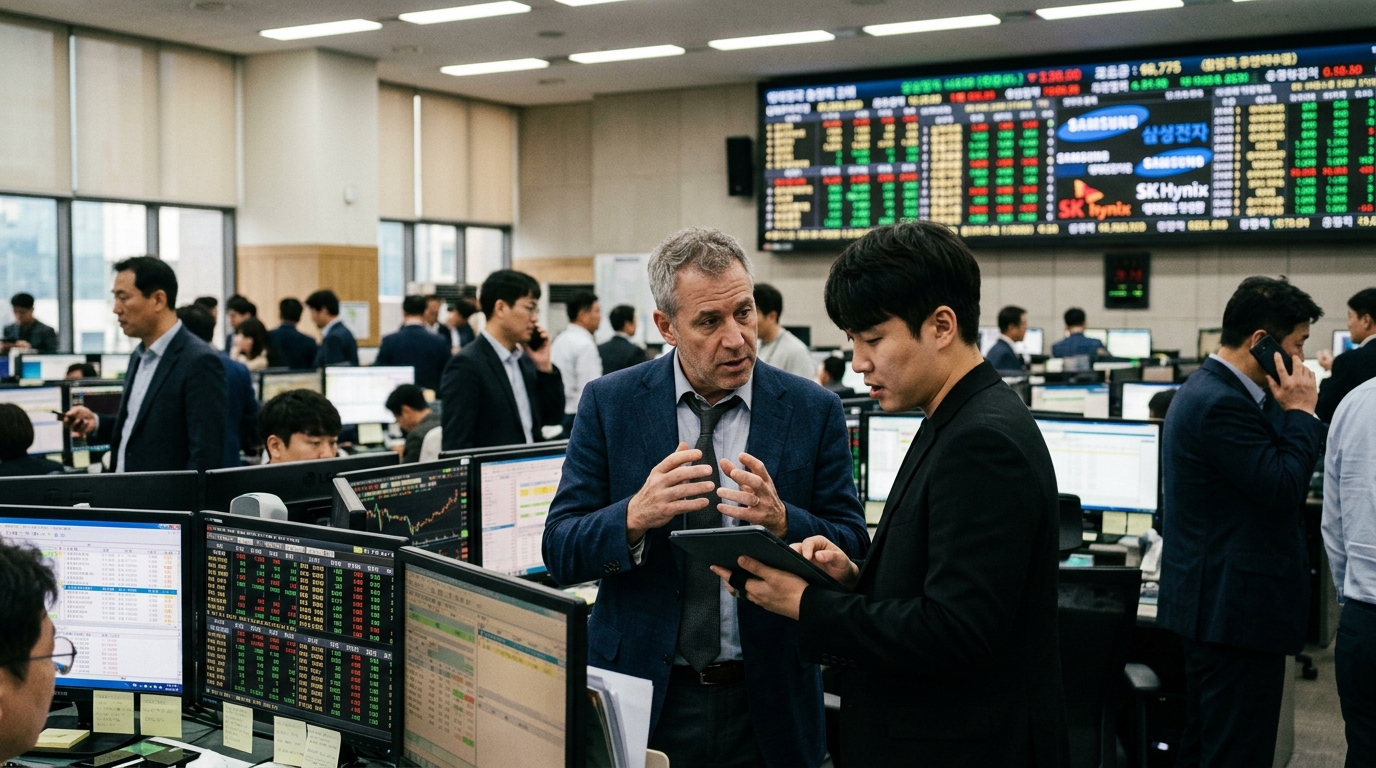
In the heart of the global Artificial Intelligence (AI) revolution, two names dominate the supply chain but paradoxically remain on the fringes of the stock market euphoria enjoyed by their American counterparts. Samsung Electronics and SK Hynix, the twin pillars of the South Korean economy, stand at a critical juncture. As we move through May 2026, the demand for High Bandwidth Memory (HBM) has surged to levels unforeseen just three years ago, yet the so-called "Korea Discount" remains stubbornly persistent.
The Value Paradox in the AI Age
An analysis of financial data reveals a striking dissonance. While companies like Nvidia and Microsoft see their price-to-earnings (P/E) ratios reach stratospheric levels, Samsung and SK Hynix are trading at valuations more reminiscent of traditional manufacturing than tech leadership. SK Hynix, which currently holds the lead in HBM3E and HBM4 technology, serves as the primary supplier for Nvidia’s accelerators. Without Hynix’s memory chips, the training of Large Language Models (LLMs) would grind to a halt.
However, investors remain cautious. This hesitation stems from a deeply rooted belief that the memory market remains a cyclical commodity business, where prices fluctuate wildly based on supply and demand. But in 2026, this narrative is shifting. AI memory is no longer a mere commodity; it is a specialized, high-value component requiring close design collaboration with processor manufacturers. Samsung, with its massive vertical integration, is racing to close the gap with SK Hynix, investing billions in new production lines to fuel the next generation of data centers.
The Structural "Korea Discount"
Why does the market refuse to recognize the full value of these companies? There are three primary reasons behind the "Korea Discount." First, corporate governance. The Chaebol model (family-controlled conglomerates) in South Korea is often criticized for a lack of transparency and policies that favor controlling shareholders over minority investors. Despite the Seoul government's "Value-up" program, changes are occurring at a glacial pace.
Second, geopolitical risk. Proximity to North Korea and reliance on the Chinese market for legacy chip sales create a permanent "risk premium" on their shares. Third, low dividend yields compared to US tech firms lead international fund managers to prefer the relative safety and shareholder-friendliness of Wall Street.
- SK Hynix controls over 50% of the HBM market, making it indispensable to Nvidia's ecosystem.
- Samsung is expected to regain market share with the launch of HBM4 memory in late 2026.
- Valuations for Korean firms are approximately 40% lower than US peers on a P/E basis.
- The South Korean government is pushing tax incentives to encourage aggressive share buybacks.
The Strategic Importance of Memory in 2026
As AI applications migrate from the cloud to personal devices (Edge AI), the need for energy-efficient memory is becoming the new battlefield. Samsung has a unique advantage here: it manufactures everything from the chips to the smartphones themselves. This integration allows it to optimize performance in ways its competitors cannot. SK Hynix, on the other hand, has become the darling of hyperscalers, offering solutions that push the boundaries of physics.
"You aren't just buying a semiconductor company; you are buying the foundation upon which 21st-century digital intelligence is built," notes a Bloomberg Intelligence analyst.
In conclusion, while the market may continue to treat Samsung and SK Hynix as "bargain" plays due to geopolitics and governance, their technological reality is far more potent. They are the silent sovereigns of an era dependent on data flow. For the patient investor, the gap between market valuation and technological prowess represents perhaps the last great opportunity in the tech sector for this decade.





