

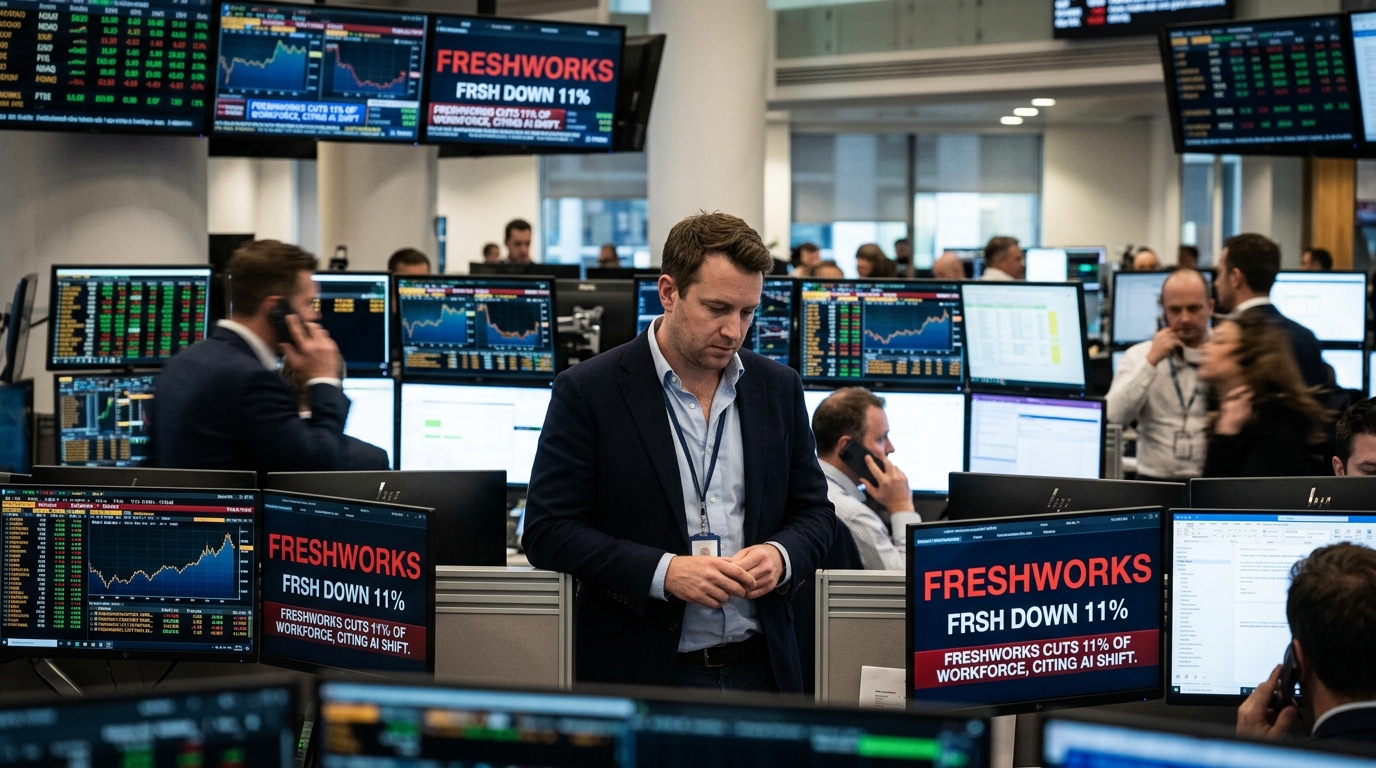
Freshworks’ announcement to cut 11% of its workforce is more than just a corporate headline; it is a stark harbinger of the future for the Software-as-a-Service (SaaS) industry. As Artificial Intelligence (AI) transitions from an experimental novelty to a central operational pillar, technology companies are being forced to fundamentally re-evaluate their structures. This move by Freshworks, affecting approximately 660 employees, confirms that the era of "growth at all costs" has officially yielded to the era of "profitability through automation."
The Strategic Pivot to an AI-First Model
Freshworks CEO Dennis Woodside was unequivocal in his communication to shareholders and staff: the company must become leaner. The reorganization focuses on consolidating customer service, IT service management (ITSM), and sales/marketing divisions into a unified platform powered by advanced AI models. The logic is as efficient as it is ruthless: where dozens of employees were once needed to manage support tickets or analyze sales data, an algorithm can now perform 80% of that work in a fraction of a second.
This transition isn’t solely about cost-cutting. It is about survival in a market where customers now demand embedded intelligence in the tools they use. Competing against giants like Salesforce and Zendesk, Freshworks realizes that excess headcount in traditional roles acts as a drag on the innovation speed required in this new epoch. The company is betting its future on the idea that a smaller, AI-augmented team can outperform a larger, traditional one.
Economic Pressures and the Purging of SaaS Bloat
For years, the software industry was characterized by "SaaS bloat"—an excessive expansion of personnel and services fueled by low interest rates and easy access to venture capital. Today, with a volatile economic environment and Wall Street investors demanding higher margins, Freshworks is following the path blazed by other tech titans. The cuts aim to improve operating cash flows and free up capital for heavy investment in AI infrastructure.
- Consolidating products to reduce internal fragmentation and overhead.
- Refocusing on large enterprise clients who prioritize automation solutions.
- Reducing sales and marketing expenses through AI-driven lead generation and qualification.
Market analysts suggest that Freshworks is trying to prove it can remain competitive without maintaining the footprint of a traditional service provider. The company’s stock reacted positively to the news, highlighting the market's preference for leaner, technologically advanced corporate structures over labor-heavy ones.
The Human Cost and the Skills Gap
Beneath the numbers and strategic analyses are hundreds of professionals whose roles are being rendered obsolete. The Freshworks phenomenon highlights a structural shift in the labor market: demand for traditional support and sales roles is waning, while the need for AI engineers, data analysts, and experts in "algorithmic training" is skyrocketing.
"The challenge for the modern tech worker is no longer just knowing a tool, but the ability to collaborate with AI to produce exponential value,"a leading industry executive noted.
While Freshworks has promised severance packages and outplacement support, the reality is that the SaaS job market is becoming saturated with talent looking for roles that are gradually being automated. This creates a societal pressure for rapid upskilling—a pace that educational systems and even the corporations themselves often struggle to match. The middle-class tech worker is finding themselves at the epicenter of a technological displacement that shows no signs of slowing down.
Conclusion: The Future of Software
Freshworks’ move acts as the "canary in the coal mine." 2026 will likely be remembered as the year the software industry ceased to be labor-intensive and definitively became capital- and algorithm-intensive. The company’s success in this new environment will be judged by whether its "AI-first" platform can truly deliver the value it promises to customers, offsetting the loss of human capital. For the rest of the industry, the message is clear: adapt your workforce and your business model, or face the same inevitable reckoning.





