

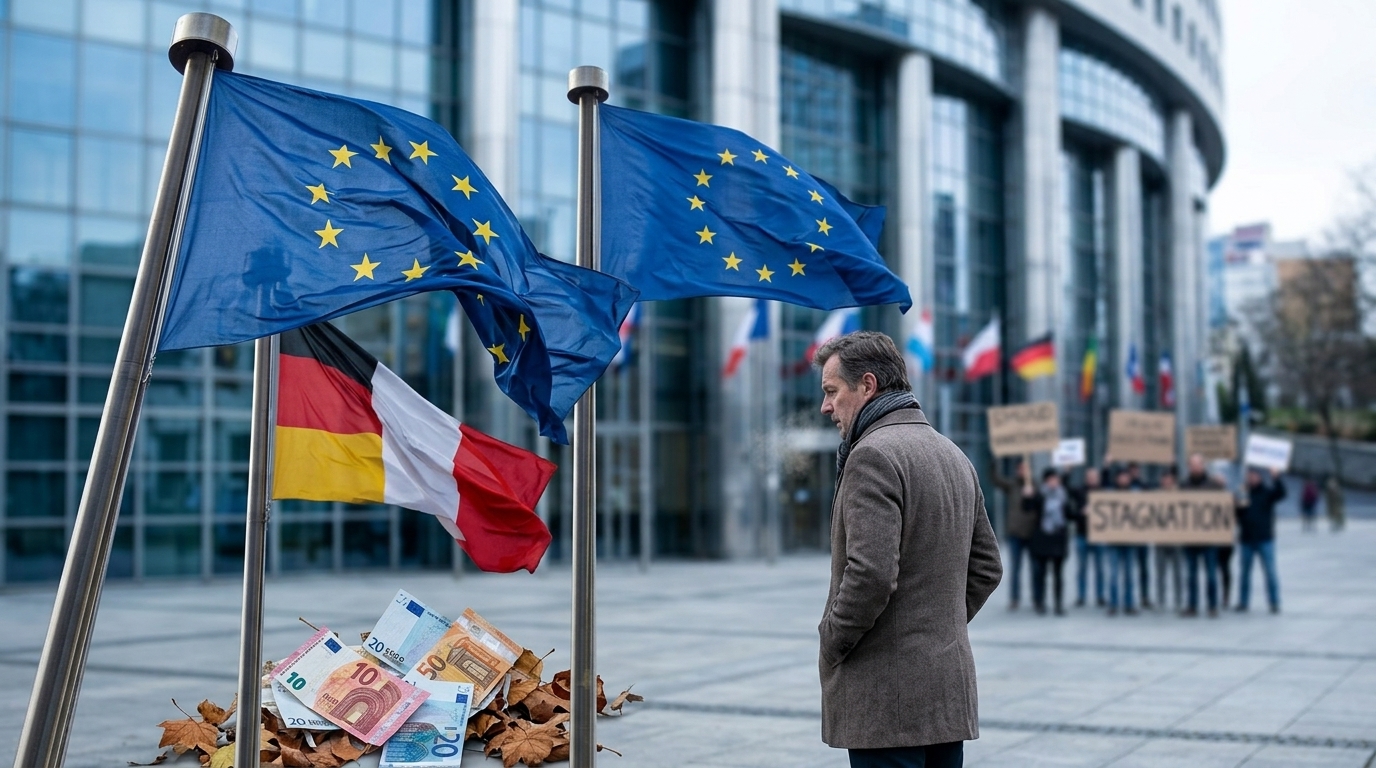
The Eurozone economy stands at a precarious crossroads, as the latest data for May 2026 reveals a disturbing retreat in activity, dragging the bloc to its lowest levels since 2023. The long-anticipated recovery appears to be indefinitely postponed as a combination of persistent inflation, high interest rates, and geopolitical tensions creates a volatile cocktail that stifles growth. Purchasing Managers' Index (PMI) indicators suggest that the downturn is no longer confined to the manufacturing sector but is dangerously spilling over into services, which had previously served as the European economy's final bastion.
The Service Sector Slump: The Final Stronghold Recedes
For much of 2025, the services sector—ranging from tourism to financial consulting—managed to keep the Eurozone away from a technical recession. However, the May 2026 data shows that consumer resilience has reached its breaking point. With real incomes squeezed by housing costs and food prices, households are slashing non-essential spending. The drop in demand for services is particularly alarming, as this sector represents the lion's share of the region's GDP.
Businesses in the hospitality and tourism sectors are reporting significant declines in bookings, while corporate services are seeing contracts frozen. Uncertainty about the future is driving both private individuals and institutional investors toward a wait-and-see approach, exacerbating the vicious cycle of economic stagnation. Market sentiment has taken a severe hit, with consumer confidence sliding to levels reminiscent of the darkest days of the energy crisis.
Geopolitical Instability and the Cost of Living
One cannot analyze the current economic state without considering the broader geopolitical context. Ongoing conflicts on Europe's periphery and disruptions in supply chains have kept energy prices at levels that make industrial production unfeasible in many parts of the bloc. Germany, traditionally Europe's "engine," continues to suffer the most, as its model based on exports and cheap energy has sustained structural cracks.
Furthermore, the rise in the cost of living is no longer a transitory phenomenon. Despite central bank efforts, core inflation remains stubbornly above the 2% target, forcing the European Central Bank (ECB) to maintain interest rates at restrictive levels. This increases borrowing costs for businesses and mortgage rates for households, draining vital liquidity from the real economy. "Inflation fatigue" is now evident across all social strata, sparking social unrest and political instability in several member states.
The ECB’s Challenge: Rates on a Tightrope
Frankfurt faces a classic dilemma: continue the fight against inflation by keeping rates high or pivot to aggressive cuts to stimulate a dying growth rate? The May 2026 figures make this decision even harder. A premature loosening of monetary policy could reignite inflationary pressures, especially if energy prices spike again. Conversely, delaying support measures risks turning a mild contraction into a deep and prolonged recession.
"The Eurozone is not just facing a cyclical downturn, but a structural challenge of adapting to a world of higher costs and diminished globalization," market analysts note.
The lack of fiscal space in many countries, due to high debt levels, means that governments have limited tools for intervention. The Stability and Growth Pact, back in full force, limits the potential for expansionary policy, leaving the burden of rescue almost entirely on the ECB. Discussions regarding the need for new common European financing tools are heating up again, but political divisions between the North and South remain as wide as ever.
Conclusion: An Uncertain Future
As the first half of 2026 draws to a close, the Eurozone finds itself in a state of fragile equilibrium. The slump in economic activity to its lowest level in three years is a wake-up call that cannot be ignored. Without a coordinated effort to boost competitiveness, reduce energy dependency, and restore consumer confidence, the bloc risks sliding into a period of stagflation that could last for years. The road ahead requires bold decisions and, above all, a unified European strategy that transcends national borders.





