

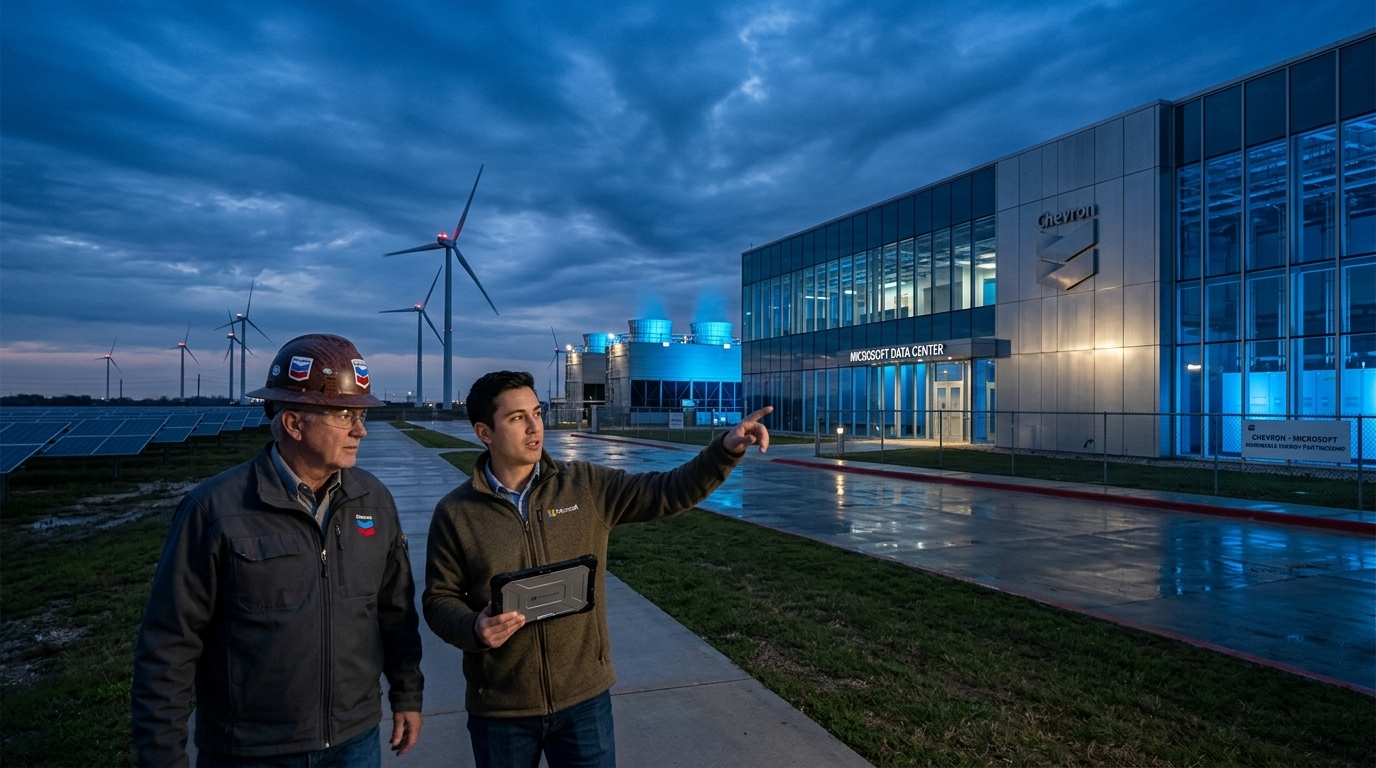
The announcement of the partnership between Chevron and Microsoft to develop a co-located natural gas power generation facility in Texas is not merely a business deal; it is a formal admission that the Artificial Intelligence (AI) revolution requires an energy infrastructure that renewable energy sources (RES) are currently unable to provide on their own. The agreement entails the construction of a power plant that will directly feed Microsoft's data center, ensuring stability and uninterrupted operation, isolated from the fluctuations of the public grid.
The Harsh Reality of 'Firm' Power
For years, tech giants like Microsoft, Google, and Amazon promoted a vision of total decoupling from fossil fuels. However, the advent of Large Language Models (LLMs) has shifted the paradigm. Training and operating these models require massive amounts of energy, 24/7. While wind and solar power are excellent for reducing carbon footprints, they lack the 'firm power' necessary to prevent AI systems from failing. Chevron, leveraging its dominance in the Permian Basin of Texas, offers Microsoft exactly that: reliability.
The choice of natural gas as a 'bridge fuel' is a strategic decision. Although it emits carbon dioxide, it is significantly cleaner than coal and provides the necessary flexibility to meet peak demand. Microsoft, for its part, finds itself in a difficult position: it must balance its promise to become 'carbon negative' by 2030 with its need to dominate the AI race, which consumes energy at rates reminiscent of heavy industry.
Texas as the Epicenter of the New Industrial Revolution
It is no coincidence that this deal is taking place in Texas. The state possesses its own independent grid (ERCOT), which has been repeatedly tested by extreme weather events. The 'co-located' approach allows Microsoft to bypass grid connection delays, which in some parts of the US can reach up to ten years. Chevron, on the other hand, finds a guaranteed customer for the natural gas it extracts, creating a closed loop of production and consumption.
- Direct access to energy sources without the need for large grid transformers.
- Reduction in energy transmission costs and line losses.
- Enhanced energy security for critical AI infrastructure.
This move is expected to spark backlash from environmental groups who view the return to natural gas as a step backward. However, analysts point out that Microsoft will likely invest in Carbon Capture and Storage (CCS) technologies at the same facility in partnership with Chevron, which is a leader in this field. This could turn the project into a blueprint for how the old energy industry can support the new digital economy.
Geopolitical and Economic Implications
On a global scale, the Chevron-Microsoft deal sends a clear message: AI dominance is inextricably linked to energy sovereignty. Nations or companies that control both the algorithms and the fuel that powers them will hold the upper hand in the 21st century. Chevron is transforming from a traditional oil company into an infrastructure provider for technology, while Microsoft ensures that the 'heart' of its operations never stops beating, regardless of pressures on the national grid.
"It is no longer about whether energy is green or black, but whether it is available the moment the AI needs it," says an energy market analyst.
In conclusion, this partnership highlights the need for realistic energy planning. The utopia of an immediate transition to 100% renewables is clashing with the reality of data center requirements. The alliance between Big Oil and Big Tech may be the only path to sustain AI growth without triggering energy crises in local communities.





