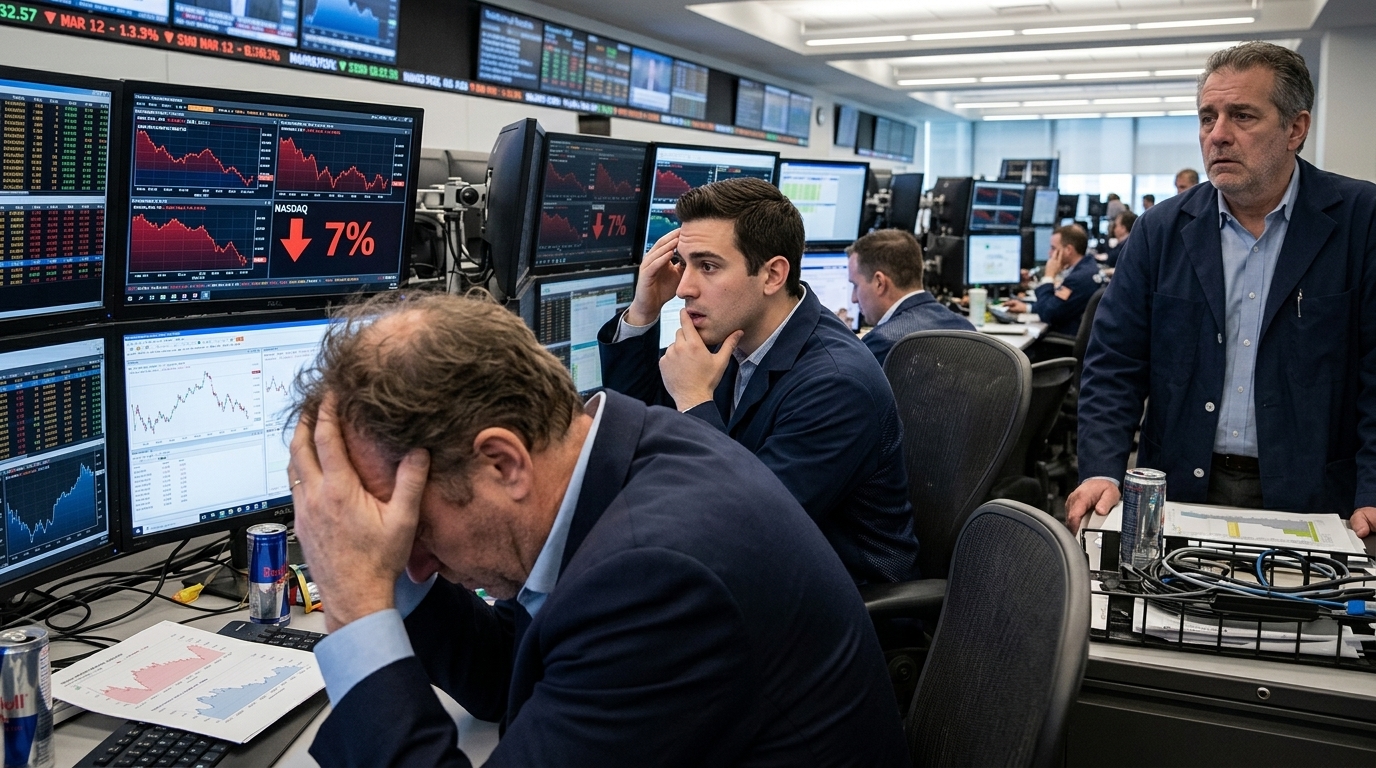
The history of financial markets is punctuated by moments where euphoria blinds investors, leading to a collective denial of fundamental realities. Last week, however, Bank of America (BofA) acted as the modern-day Cassandra that was actually heard—and proven right. In a note to investors that will be remembered for its uncanny timing, the bank recommended 'taking profits,' pointing out that seven critical warning lights were flashing red. What followed was a 7% slide in the Nasdaq, shattering the narrative of the unstoppable AI ascent.
The Seven Warning Signals
What did Bank of America see that others chose to ignore? Their analysts didn't rely on gut feeling; they utilized a rigorous quantitative model. Among the seven 'lights' that signaled danger, the most prominent were extreme capital concentration in a handful of tech stocks, irrational valuations relative to free cash flow, and a growing disconnect between stock prices and actual corporate earnings. Furthermore, investor sentiment had reached levels of 'intoxication' that historically precede major corrections.
- Extreme Positioning: Institutional investors were 'all-in' on tech, leaving little room for new buyers to push prices higher.
- Chip Valuations: The semiconductor sector was trading at multiples reminiscent of the 2000 dot-com bubble.
- Macroeconomic Friction: Persistent inflation and the Fed's hawkish stance began to squeeze the cost of capital for growth-oriented firms.
The resulting drop was not a mere fluctuation. It was a violent recalibration of expectations. Semiconductor companies, the backbone of the AI rally, saw their market values evaporate within a few trading sessions, marking the worst performance since the 2020 pandemic era.
The Chip Rout and the Bubble Specter
The eye of the storm was, predictably, the semiconductor sector. NVIDIA, AMD, and other industry titans found themselves in the crosshairs of aggressive selling. The question haunting Wall Street was simple: Have AI investments begun to yield fruit for the companies buying this hardware, or are we in a cycle of massive oversupply? BofA argued that while demand remains structurally sound, the expectations for the speed of enterprise AI adoption were wildly optimistic.
“This isn't the end of AI, but it is the end of the era of the 'free lunch' rally,” the report noted.
The 7% Nasdaq correction served as a much-needed pressure release valve. For many seasoned analysts, this move was necessary to restore some semblance of sanity to the market. However, for retail investors who entered at the peak, the lesson was painful. The index's heavy reliance on the 'Magnificent Seven' proved to be its Achilles' heel; when these giants stumbled, there was nowhere for the broader index to hide.
The Road Ahead: Life After the Correction
What follows such a significant shock? Bank of America suggests a more discerning approach. The era where 'all boats rise with the AI tide' is effectively over. From now on, investors will demand tangible results, clear profitability, and specific roadmaps for AI implementation. The market is entering a phase of maturity where the distinction between true innovators and those merely riding the hype will become stark.
In conclusion, BofA’s warning was not an attempt to predict a total collapse, but a reminder that the laws of economics still apply, even in the age of generative algorithms. The 7% drop may just be the beginning of a prolonged period of volatility as the global market attempts to find the true price tag for the technological revolution we are currently living through.