

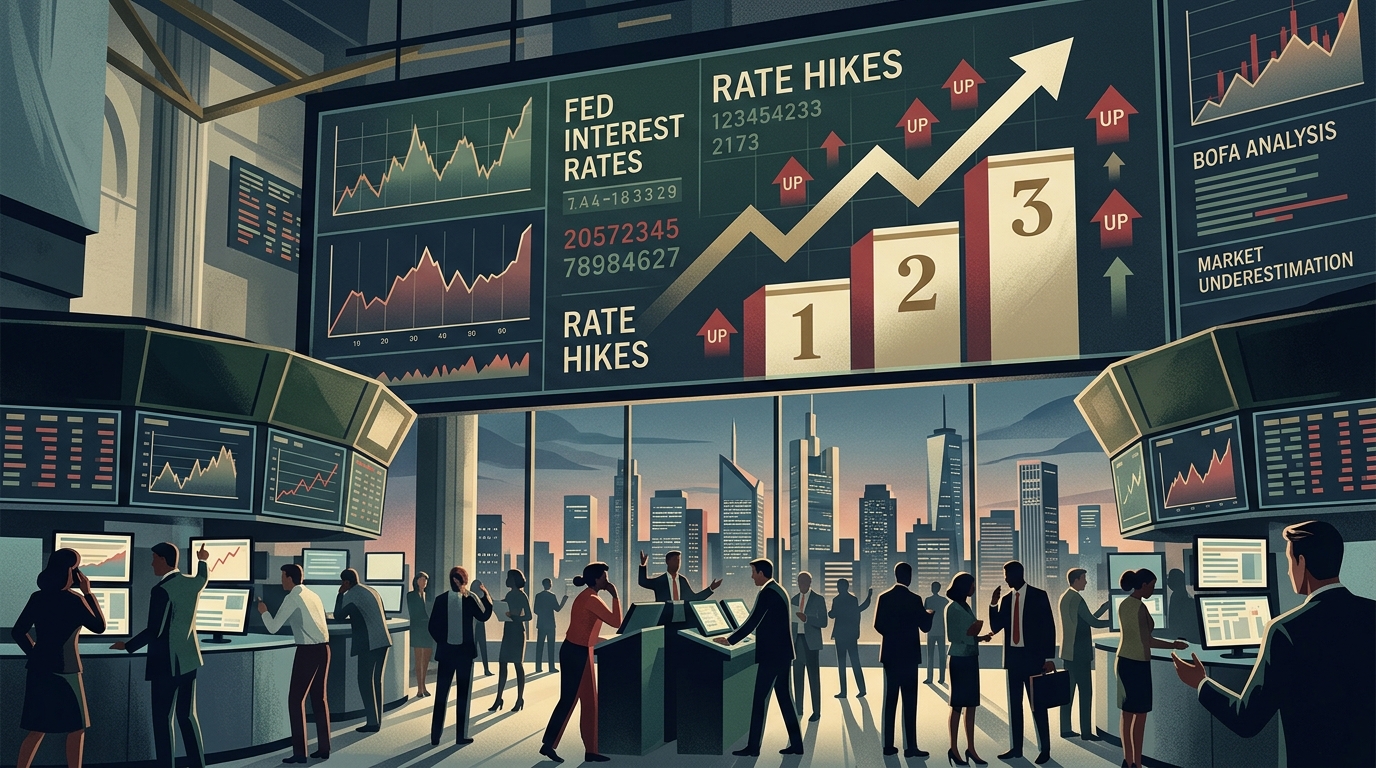
At a time when most Wall Street analysts and investors were betting on a gradual easing of monetary policy or, at worst, a prolonged pause, Bank of America (BofA) has disrupted the prevailing consensus. In a provocative new analysis, the banking giant argues that the Federal Reserve (Fed) may be forced to implement up to three additional interest rate hikes by late 2026—a development that markets have yet to even begin pricing in.
Resilience Defying Gravity
BofA’s core argument rests on the unexpected resilience of the U.S. economy. Despite consecutive tightening cycles initiated in previous years, consumer spending remains robust, and the labor market continues to exhibit dynamics that defy traditional economic theories. The bank's analysts point out that while inflation has retreated from its historic peaks, it is showing a dangerous "stickiness" in sectors such as services and housing.
According to the report, the "no landing" scenario is gaining traction over the much-anticipated "soft landing." In this context, the economy continues to grow above its potential rate, preventing inflation from returning to the Fed's 2% target. If the Fed determines that current conditions are insufficient to tame prices, its only recourse will be to further increase the cost of borrowing.
The Gap Between Expectations and Reality
BofA’s concern focuses primarily on the fact that bond and equity markets remain overly optimistic. Asset prices currently reflect a belief that rates have reached their terminal peak. However, history has shown that when the Fed surprises the market with hawkish moves, the resulting correction is typically violent and abrupt.
- The labor market remains overheated, with unemployment at historically low levels.
- Wage increases are fueling a feedback loop of demand and price hikes.
- U.S. fiscal policy remains expansionary, counteracting part of the monetary tightening.
BofA’s lead strategist notes that "the risk is no longer just how long rates will stay high, but how much higher they must go." This fundamentally changes the outlook for corporations relying on cheap financing and for consumers already squeezed by the cost of living.
Global Market Implications
Such a move by the Fed would not only impact the United States. A further strengthening of the U.S. dollar would exert pressure on emerging market currencies and force the European Central Bank (ECB) to reconsider its own strategy. Europe, already struggling with lower growth rates, would find itself in a precarious position if forced to follow the Fed’s hikes to protect the Euro's parity and curb imported inflation.
"The market is living in an illusion of safety. The reality of the data suggests the inflation battle is far from won, and the price for this complacency could be three additional rate hikes that freeze investment activity," the report states.
In conclusion, Bank of America’s warning serves as a crucial wake-up call. While the base case remains stability, investors must prepare for the possibility of a Fed that prioritizes price stability over economic growth, even if it means a painful period of higher rates throughout 2026 and into 2027. The narrative of 'higher for longer' may soon be replaced by 'higher for even longer,' catching an entire generation of traders off guard.





