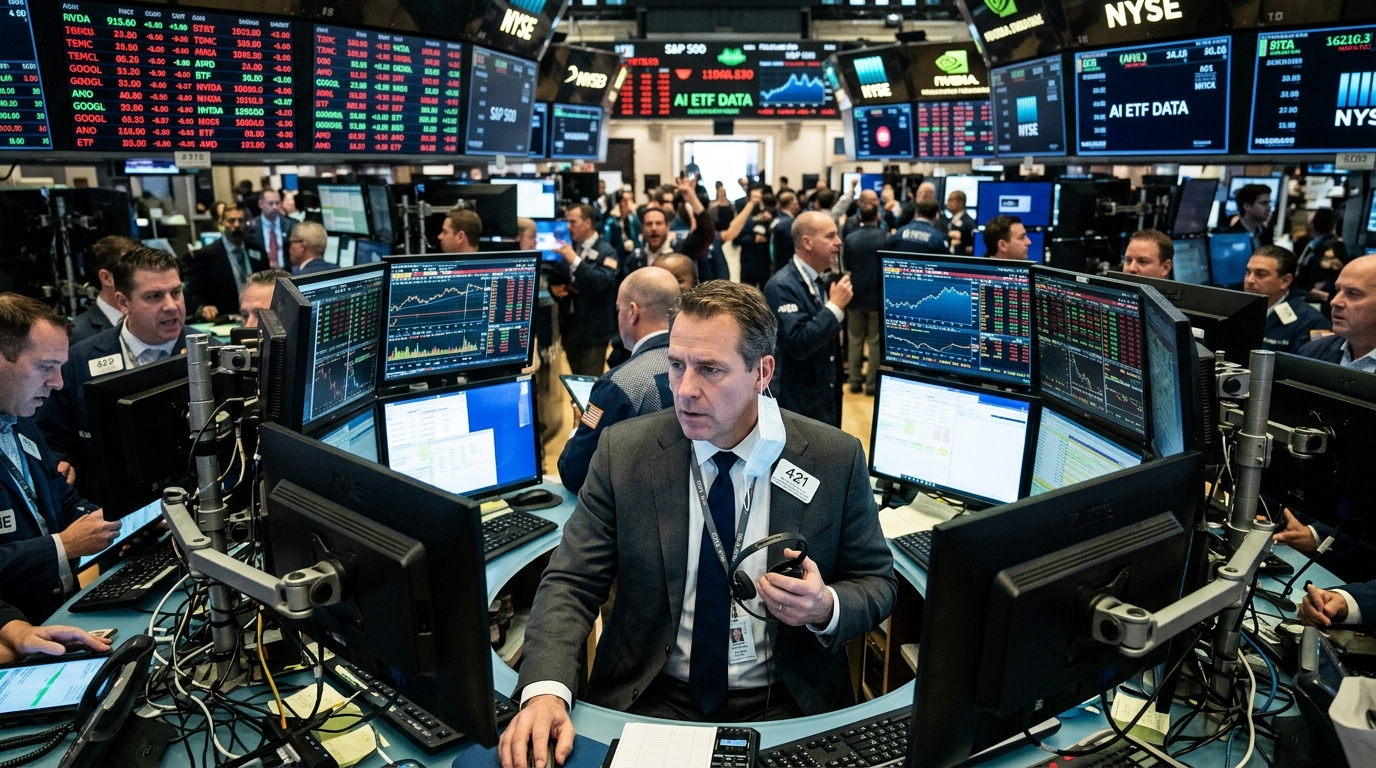
Nvidia's dominance on the stock market over the past two years has been nearly absolute. However, for many analysts and institutional investors, the question is no longer how high the semiconductor giant can climb, but who will be the next player to record similar explosive growth. This search has led to a significant shift toward actively managed Exchange-Traded Funds (ETFs), which promise to outperform passive indices by identifying companies currently flying under the mass market's radar.
The Transition from Infrastructure to Applications
According to a recent analysis by Morningstar, the AI market is entering a new phase of maturity. While the first phase was exclusively about hardware and building fundamental infrastructure—where Nvidia dominated—the second and third phases focus on companies providing necessary power, cooling systems, and ultimately, the software that will leverage this processing power. Active ETFs have the advantage of flexibility: their managers can change portfolio composition in real-time, avoiding excessive concentration in stocks deemed overvalued.
- Energy Infrastructure: Companies managing the electrical grid and power supply to data centers.
- Cooling Systems: The immense heat generated by AI processors makes thermal management companies critical players.
- Specialized Software: Businesses integrating AI into vertical markets such as healthcare and legal services.
Why Are Active ETFs Gaining Ground?
Traditional ETFs, such as those tracking the Nasdaq 100 index, are obliged to follow a predetermined weighting. This means if Nvidia makes up 10% of the index, the ETF must maintain that percentage. Conversely, an active manager can decide that Nvidia has reached its peak and move capital into a smaller semiconductor firm like Broadcom or Marvell Technology, or even into players not directly related to chips, such as Vertiv. This "stock picking" ability is what attracts investors who fear a potential bubble in mega-cap tech stocks.
"Artificial intelligence is no longer a monolithic market. It is an ecosystem, and in every ecosystem, opportunities shift from raw material producers to service providers," Morningstar analysts note.
Risks and Challenges
Despite the allure of high returns, active management comes with higher expense ratios compared to passive funds. Furthermore, there is always the risk of human error. A manager might bet on a company they believe is the "next Nvidia," only to see its technology surpassed by a competitor within months. The speed at which AI evolves makes forecasting extremely difficult, even for the most seasoned Wall Street analysts.
Conclusion: The Search for Value
The shift toward active AI ETFs reflects a deeper change in investor psychology. Following a period of euphoria, the market is now looking for real fundamentals and sustainable business models. The "next Nvidia" might not even be a chip company, but a firm that manages to turn AI into a profitable consumer application or critical industrial infrastructure. For investors, the challenge remains: to distinguish the noise from real innovation in a rapidly changing environment.