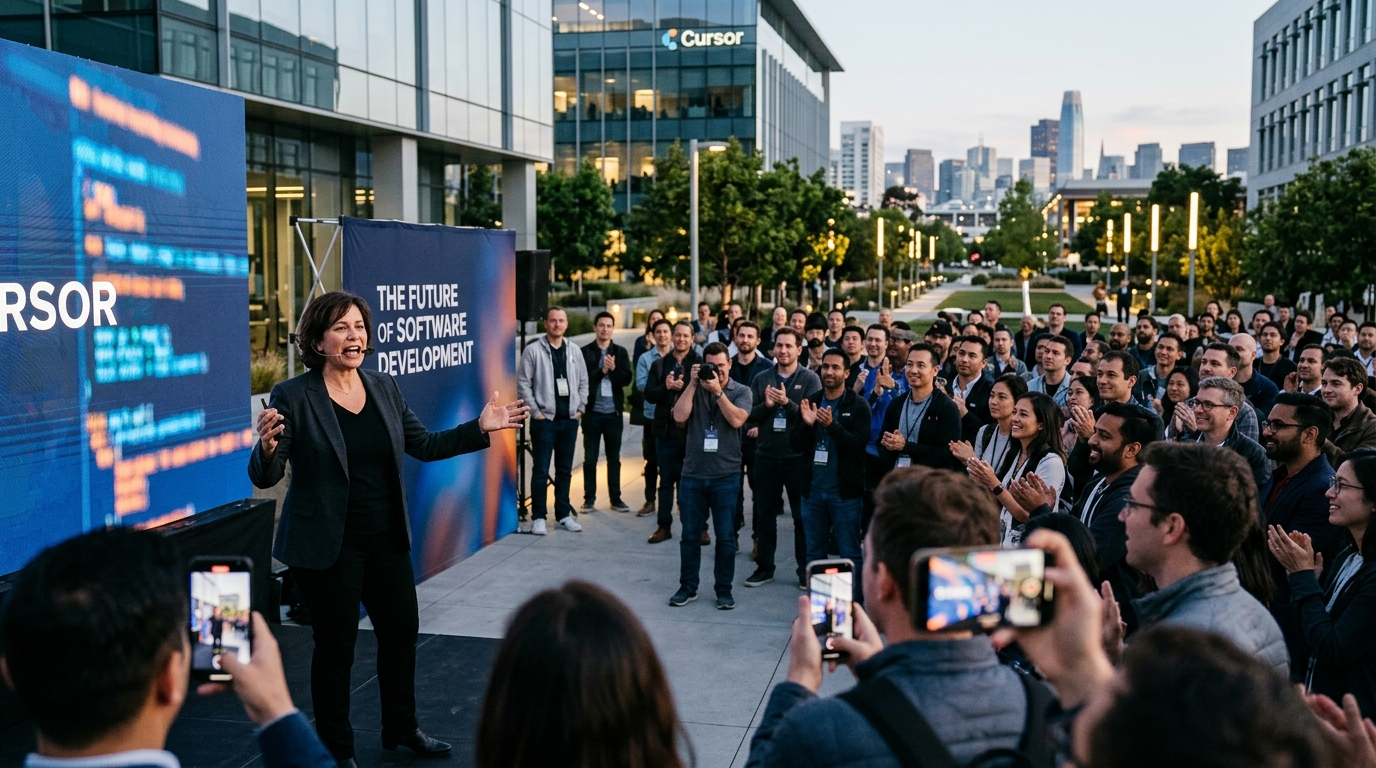
In the breakneck world of artificial intelligence, few trajectories are as staggering as that of Cursor. News that the startup, which develops an AI-native code editor, is in talks to raise $2 billion at a valuation reaching or exceeding $50 billion has sent shockwaves through Silicon Valley. This represents an explosive ascent, considering that just months ago, its valuation was a mere fraction of this figure. Cursor is not merely a tool; it is the symbol of a new era where software engineering ceases to be a manual labor of syntax and evolves into a high-level oversight process.
The Anatomy of a Meteoric Rise
Cursor, developed by the company Anysphere, began as a fork of Microsoft’s ubiquitous Visual Studio Code (VS Code). However, its defining characteristic is the deep, organic integration of Large Language Models (LLMs) directly into the core of the development environment. While other tools function as mere plugins, Cursor "thinks" alongside the developer, understanding the entire structure of a project—the codebase—rather than just the active file.
A $50 billion valuation places Cursor in the same league as titans like SpaceX or OpenAI in terms of market expectations. Investors, including heavyweights like Andreessen Horowitz and Thrive Capital, appear to be betting that Cursor will become the operating system for the next generation of engineers. The speed of adoption among software engineers is unprecedented; many claim that returning to traditional code editors feels like reverting to a typewriter after using a modern computer.
Competing with Microsoft and the Incumbents
The rise of Cursor presents a fascinating irony. Microsoft, which owns GitHub and Copilot, has long dominated the AI coding space. The fact that a small startup has managed to seize the spotlight using Microsoft’s own infrastructure (VS Code) and models from OpenAI (where Microsoft is the primary investor) highlights the agility of new entrants. Cursor offers features like "Composer," which allows users to describe complex changes across multiple files simultaneously—a capability that GitHub Copilot was slower to implement with similar fluidity.
The question now is whether this valuation is justified by revenue or if it is another symptom of "AI mania." Reports suggest that Cursor’s Annual Recurring Revenue (ARR) is growing at rates rarely seen in the history of SaaS (Software as a Service). This suggests that enterprises are willing to pay a premium for tools that multiply developer productivity—one of the largest costs for any modern business. If a developer can do in one hour what previously took five, the ROI for a $20-per-month subscription is undeniable.
The Future of Work: From Coder to Orchestrator
Beyond the spreadsheets, Cursor’s success underscores a fundamental shift in the software engineering profession. If AI can write 90% of the code, what is the human’s role? The answer lies in architecture, logic, and problem-solving. The developer of the future will not spend their days debugging syntax but orchestrating systems. Cursor accelerates this transition, democratizing the ability to build complex software even for those with less technical depth.
- The strategic importance of "Context Awareness": The tool's ability to ingest and understand the entire project repository.
- Dependency on third-party models: How Cursor manages the massive API costs from OpenAI and Anthropic.
- Microsoft’s potential counter-move: Will we see an aggressive acquisition attempt or a move to restrict the open-source foundations of VS Code?
In conclusion, Cursor is not just a successful startup; it is the harbinger of a new software economy. If this funding round closes at the rumored terms, it will formalize the belief that AI is no longer a peripheral assistant but the backbone of global code production. The challenge for Cursor will be to maintain its innovative edge as it scales, avoiding the structural bloat that often accompanies decacorn status. For now, it remains the gold standard for what AI-native productivity looks like.