For decades, Artificial Intelligence has been confined to digital cages. From the first chess algorithms to today’s Large Language Models (LLMs) like ChatGPT, machine intelligence has been limited to processing symbols, text, and images. However, reality—the world of friction, gravity, and unpredictable physical interactions—remained an insurmountable obstacle. This is changing now with the rise of Physical Intelligence (Pi), a startup that has managed to capture the attention and capital of Silicon Valley giants like Amazon and Nvidia.
Breaking Moravec’s Paradox
In computer science, 'Moravec’s Paradox' describes an ironic truth: it is relatively easy to teach a computer to solve complex mathematical problems or play chess at a championship level, but it is extremely difficult to teach it the motor skills of a one-year-old child. For a robot to pick up an egg without breaking it requires an understanding of the world that cannot be encoded in words alone.
San Francisco-based Physical Intelligence aims to solve exactly this problem. Instead of programming robots for specific tasks (such as moving a box in a warehouse), the company is developing a 'universal physical intelligence model.' This is software that functions as a general brain, allowing any machine to learn how to interact with its environment through observation and experience, much like humans do.
The Alliance of Titans: Why Nvidia and Amazon are Rushing In
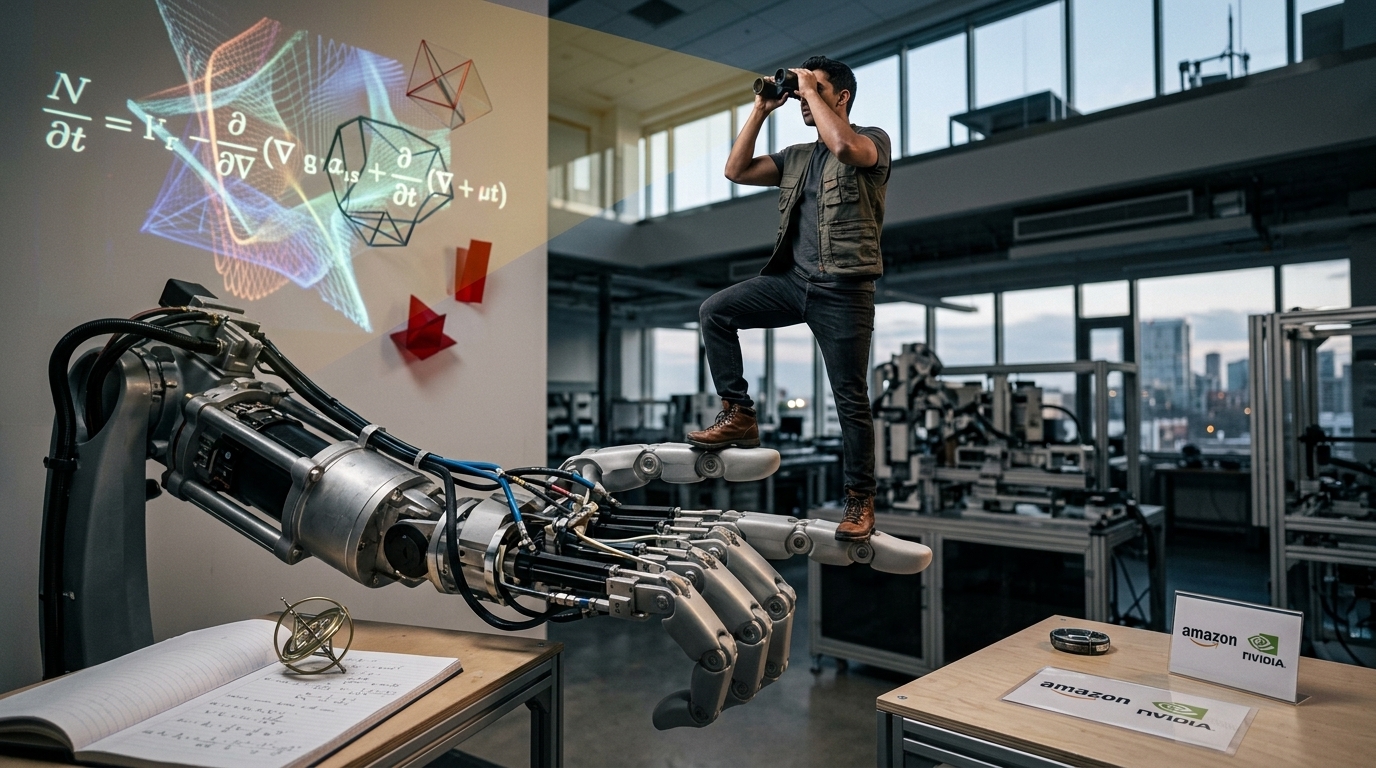
The recent $400 million funding round, which valued the company at $2 billion, is not just another investment. It is a strategic positioning. For Nvidia, Physical Intelligence represents the next massive market for its processors. If every robot in the world needs a powerful AI brain to move, the demand for chips will skyrocket far beyond data centers.
For Amazon and Jeff Bezos, the stakes are even more immediate. Amazon’s warehouses are already filled with robots, but these are largely 'deaf' and 'blind,' following strictly predefined paths. A robot that understands physics could handle irregular objects, pack items with care, and operate in environments not designed exclusively for machines. Automating the supply chain at this level would mean a colossal reduction in costs and an increase in speed.
From LLMs to LPMs: Large Physical Models
Pi’s technological approach is based on what we call Large Physical Models (LPMs). While ChatGPT was trained on trillions of words from the internet, Pi’s models are trained on movement data and sensory information. The challenge here is the data scarcity. The internet is full of text, but there are no ready-made libraries of 'haptic data' or 'balance data.'
The company uses a method that combines video training with reinforcement learning. Robots try, fail, and correct their movements in simulations and the real world. The result is a system that can transfer knowledge from one task (e.g., folding a garment) to another (e.g., clearing a table) by understanding the common physical principles governing both actions.
Social and Economic Implications
The success of Physical Intelligence could signal the beginning of a new industrial revolution. If AI gains a 'body,' the impact on the labor market will be deeper than that of chatbots. While LLMs threaten white-collar jobs, Embodied AI targets manual labor. However, proponents of the technology argue that this will solve labor shortages in sectors like agriculture, elderly care, and construction.
The remaining question is the timeline. Biology took millions of years to perfect human movement. Silicon Valley is betting that, with the help of Nvidia and Amazon, Artificial Intelligence will achieve it in less than a decade. Physical Intelligence is not just building robots; it is building the interface between digital code and material reality.