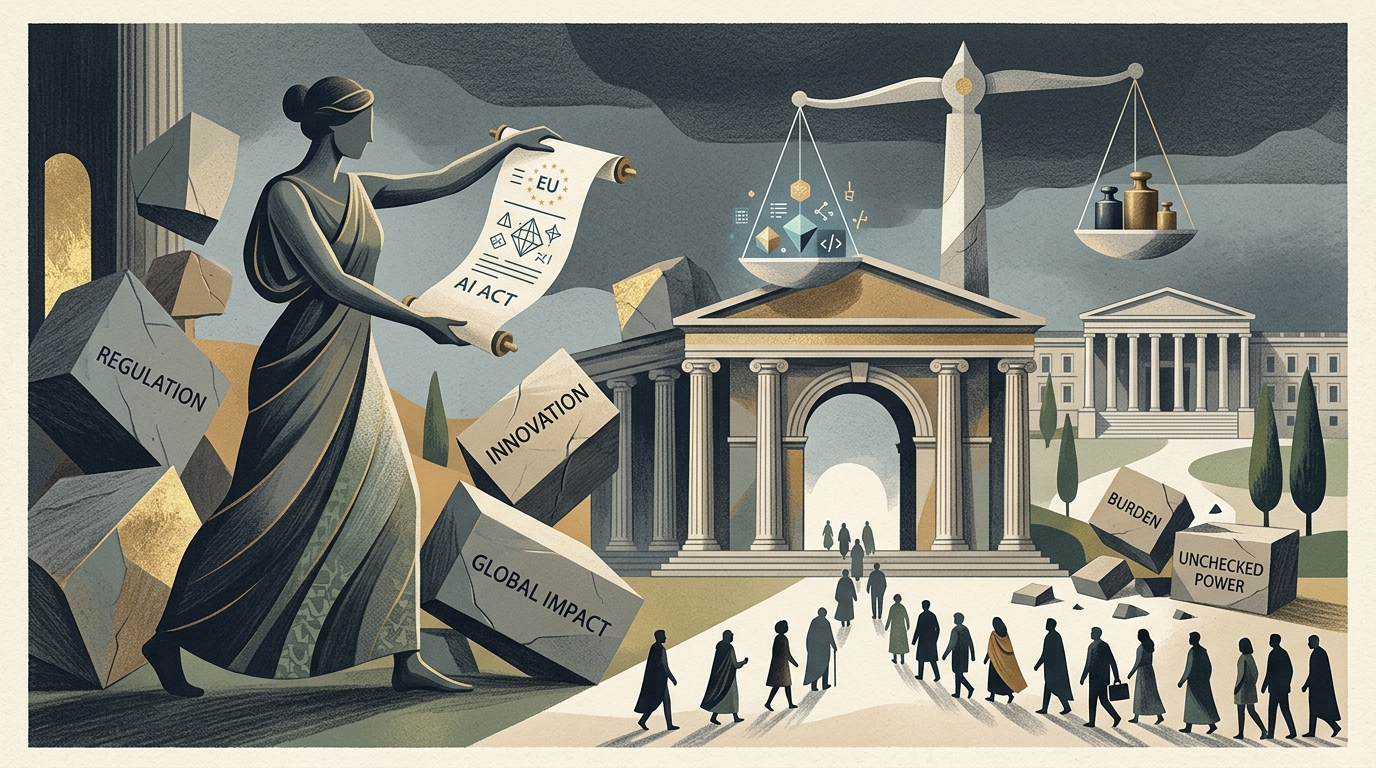

In the sixth century BCE, I walked the streets of Athens and witnessed a city fractured by debt and the concentration of power in the hands of a few. My response was the Seisachtheia—the shaking off of burdens. Today, in June 2026, we face a similar concentration of power, not in land or silver, but in the algorithmic structures that govern our lives. The recent discourse surrounding 'AI as a Public Utility' is not merely a technical debate; it is the most significant constitutional question of our era.
The Institutional Imperative: From Commodity to Infrastructure
For the past decade, we have treated Artificial Intelligence as a luxury product or a specialized service. However, as of 2026, AI has permeated the foundational layers of our civilization. From the management of material requirements planning (MRP) in our warehouses to the diagnostic tools used in cardiac arrest care, AI is no longer an 'option.' It is the infrastructure upon which the modern polis is built. When a technology becomes as essential as water, electricity, or the roads we travel, its governance must shift from the whims of the market to the stewardship of the public.
Treating AI as a public utility implies three fundamental shifts in governance. First, universal access: the benefits of high-level compute and foundational models cannot be reserved for those with the deepest pockets. Second, transparency of the 'black box': if an algorithm determines a citizen's creditworthiness or medical priority, that algorithm must be subject to public audit. Third, stability: we cannot allow the critical systems of our states to be vulnerable to the sudden bankruptcy or pivot of a single private entity.
Sovereignty and the Global Commons
The geopolitical landscape of 2026—marked by semiconductor gambits in Malaysia and shifting alliances in Southeast Asia—demonstrates that AI is the new currency of sovereignty. For the European Union, and specifically for Greece, the 'Public Utility' model offers a path toward strategic autonomy. We must move beyond the role of mere consumers of foreign-built models. By establishing a 'Digital Common Good,' we create a framework where sovereign states invest in shared compute resources and open-source models that reflect our specific cultural and legal values.
"True freedom is not the absence of law, but the presence of laws that serve the common interest over the private gain."
In my analysis, the current model of 'Digital Feudalism'—where citizens and states are tenants on platforms owned by a handful of global corporations—is unsustainable. It erodes the agency of the individual and the authority of the state. By redefining AI as a public utility, we are not stifling innovation; rather, we are providing the stable ground upon which true, democratic innovation can flourish. We are ensuring that the 'Digital Eyes' on our roads and the 'Thinking Warehouses' of our industry serve the many, not just the few.
A Framework for the Digital Common Good
To achieve this, I propose a three-tiered governance framework. At the local level, states must provide 'Public Compute' as a basic right for startups and researchers. At the continental level, the EU must expand the AI Act to include 'Utility Obligations' for foundational model providers, ensuring they cannot unilaterally withdraw services or manipulate pricing for political leverage. Finally, at the global level, we must advocate for a 'Digital Red Cross'—a body that ensures AI-driven medical and environmental breakthroughs are shared as part of the human heritage.
The task before us is to ensure that the AI revolution does not render us passive observers of our own governance. We must be the architects of our digital fate. Just as the ancient Athenians learned that the health of the city depended on the participation of all, we must learn that the health of the digital age depends on the public nature of its most powerful tools.